
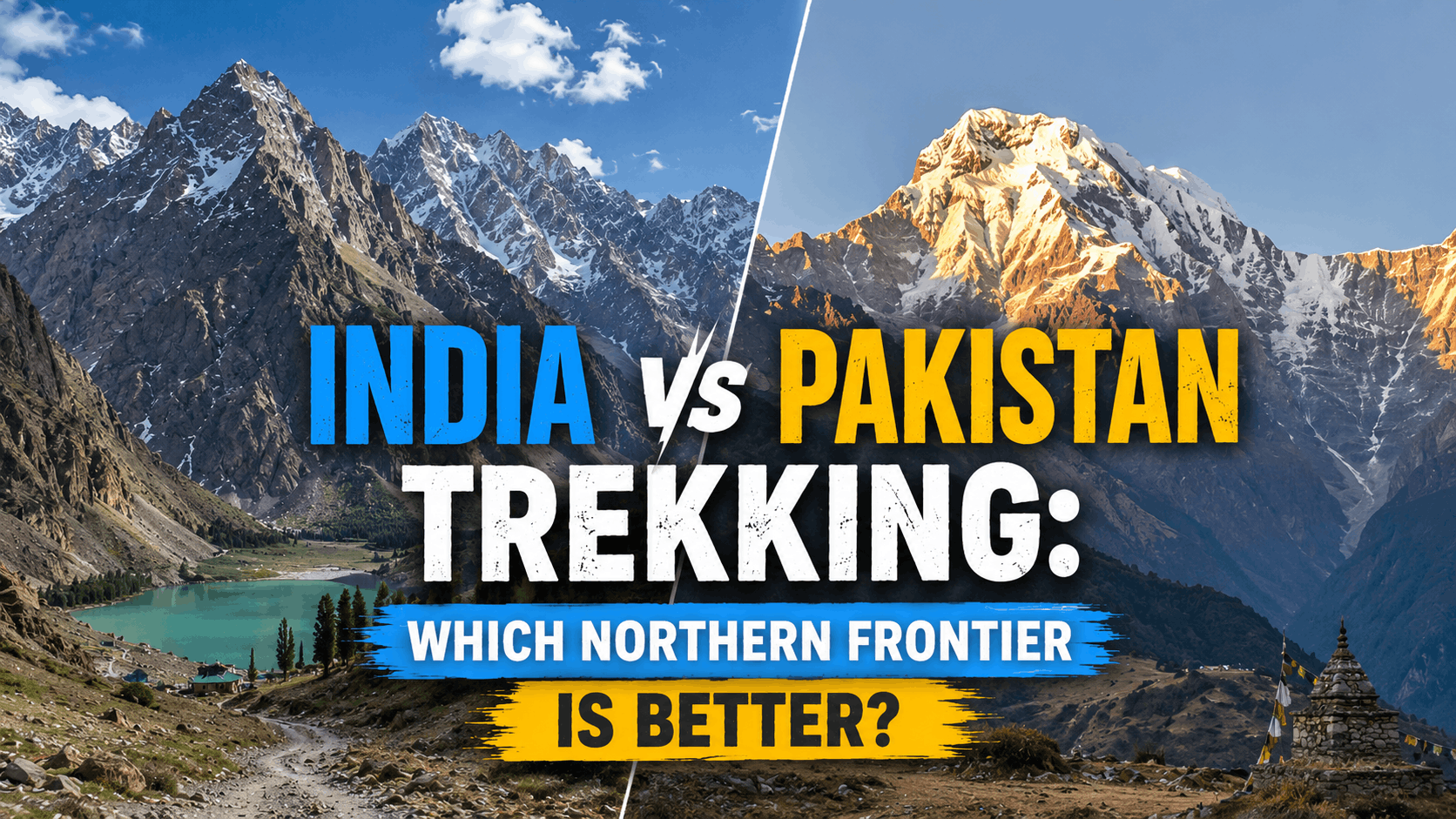
Two countries. One mountain spine. A decision that will define your next expedition.
The Himalayas and Karakoram do not respect the border that splits them. On one side, India’s northern regions Ladakh, Spiti, Uttarakhand, Sikkim offer ancient Buddhist monasteries perched above turquoise rivers, high-altitude deserts with a texture unlike anywhere else in Asia, and a trekking infrastructure built across decades of international tourism. On the other side, Pakistan’s north Gilgit-Baltistan, Hunza, Chitral, Azad Kashmir throws up a concentration of 8,000-metre peaks that has no parallel anywhere on Earth, a hospitality culture that genuinely surprises most first-time visitors, and wilderness that feels, in places, genuinely undiscovered.
Neither side wins cleanly. Both sides win in ways the other cannot match.
This guide is written for adventure trekkers who want to navigate the complexities of India vs Pakistan trekking to understand exactly what they are choosing between when they pick one frontier over the other.

Understanding What You Are Comparing
One framing point matters before anything else: these are not equivalent destinations in terms of tourism development. India’s northern regions have been receiving international visitors at scale for over forty years. Pakistan’s north has been largely off the mainstream radar for decades partly geopolitics, partly limited infrastructure and is only now entering a serious growth phase in adventure tourism.
What this means practically: India’s north is easier, better-documented, and more forgiving for independent travellers. Pakistan’s north is rawer, less crowded, often more dramatic, and increasingly accessible for those willing to do a bit more planning.
Both are extraordinary. The question is what kind of extraordinary you are looking for.
Part One: Region by Region – India vs Pakistan Trekking Compared

Ladakh (India) vs Gilgit-Baltistan (Pakistan)
These two regions are the headline act on each side the destinations most trekkers mean when they say “I want to go to the Indian north” or “I want to go to the Pakistani north.”
Ladakh sits at an average elevation of around 3,500 metres in the Jammu & Kashmir union territory of India. It is a high-altitude cold desert: ochre and grey mountains, Buddhist gompas clinging to cliff faces, turquoise lakes so still they read as mirrors, and the Indus River threading through valleys that Buddhist monks have farmed for over a thousand years. Leh, the regional capital, is a functioning city with good hotels, reliable internet, and a well-worn tourist infrastructure.
Ladakh rewards slow travel more than any itinerary can prepare you for. Trekkers come for routes like Markha Valley, the Chadar frozen river trek in winter, and the increasingly popular Zanskar Valley crossings but the region has a gravitational quality that pulls people back repeatedly. Many trekkers who arrive planning two weeks end up negotiating an extension.
Gilgit-Baltistan operates at a different scale entirely. This is the region that contains K2, Nanga Parbat, Rakaposhi, Broad Peak, and both Gasherbrum peaks five of the world’s fourteen 8,000-metre mountains within a single administrative territory. The Karakoram Highway, often called the Eighth Wonder of the World, connects Islamabad to the Chinese border through a corridor of mountains so tall and so close to the road that the drive itself is a destination.
Hunza Valley, the jewel of Gilgit Baltistan for most visitors, offers one of the most photographed mountain backdrops on Earth: the triple pyramid of Rakaposhi, Ultar Sar, and Bojahagur Duanasir visible from the valley floor, apricot orchards terracing down to the river, and Baltit Fort watching over it all from its rocky perch. Skardu, further east, is the gateway to K2 and the Baltoro Glacier a different, starker kind of beauty that speaks directly to serious trekkers.
The key difference: Ladakh feels curated. Gilgit-Baltistan feels discovered. Both adjectives are compliments.
Spiti Valley (India) vs Hunza Valley (Pakistan)
Spiti is Himachal Pradesh’s highest, coldest, and most remote district a side-valley branching off from the Kullu Valley that sits in genuine rain shadow and receives less than 200mm of rainfall annually. The monasteries here Ki, Tabo, Dhankar are among the oldest Buddhist institutions in the world. Ki Monastery, perched impossibly on a rock pyramid above the Spiti River at 4,166 metres, has been occupied for over a thousand years.
Spiti rewards trekkers who want altitude, solitude, and cultural depth in roughly equal measure. The Spiti-to-Ladakh route via Kunzum La and Baralacha La is one of the great high-altitude road journeys in Asia, and the Pin Valley trekking routes into the surrounding wilderness are excellent and still relatively lightly trafficked.
Hunza Valley is Pakistan’s most visited mountain destination and, once seen, easy to understand why. The valley sits at around 2,500 metres, which makes it accessible earlier in the season than most other high-altitude destinations in Pakistan’s north. The apricot blossom season in April draws photographers from across Asia. The views of Rakaposhi (7,788 m) from the valley floor are one of those sights like the first glimpse of Everest from Namche where the brain takes a moment to process that the mountain is real.
Karimabad, Hunza’s main settlement, has good accommodation, a growing restaurant scene, and the best base for day hikes and multi-day treks in the Karakoram foothills. The Eagle’s Nest viewpoint above town at sunrise, with Rakaposhi, Ultar Sar, and Passu Cones visible simultaneously, competes with any mountain viewpoint in India’s north. For those seeking more committed trekking, the Rakaposhi Base Camp trek (4–5 days return from Minapin) delivers close-range views of the mountain’s south face in a route that remains far quieter than equivalent trails in India.
The key difference: Spiti offers deeper cultural immersion. Hunza offers more dramatic mountain scenery at lower altitude, making it accessible to a wider range of trekkers.

Uttarakhand (India) vs Azad Kashmir & the Fairy Meadows Region (Pakistan)
Uttarakhand the “Land of Gods” is India’s trekking heartland. The Garhwal and Kumaon Himalayas here contain routes like Valley of Flowers (a UNESCO World Heritage Site), Roopkund, Kedarkantha, Har Ki Dun, and the high-altitude Char Dham pilgrimage circuit. This is where most first-time India trekkers begin, and for good reason: the trail infrastructure is excellent, altitude gain is manageable, and the combination of alpine meadows, glacial lakes, and Hindu temple culture is unique anywhere in the world.
The region is accessible from Delhi by overnight bus or train to Haridwar or Dehradun, making it one of the most logistically straightforward high-altitude trekking destinations in Asia for international visitors.
Azad Kashmir, by contrast, is Pakistan’s least-known trekking region and increasingly its most surprising. While Gilgit-Baltistan gets the expedition crowds, Azad Kashmir quietly holds some of the most beautiful high-altitude lakes on the subcontinent. Ratti Gali Lake, a glacial jewel sitting at 3,700 metres in the Neelum Valley, is reachable in a single day from Dowarian a short enough approach that it draws Pakistani families on weekend trips, yet remote enough that international trekkers remain rare. The lake sits in a broad cirque surrounded by snow-dusted ridges, its turquoise water fed by snowmelt throughout summer.
Further into the Neelum Valley, Chitta Katha Lake at 4,200 metres is harder to reach and harder to forget. The trail climbs through dense pine forest before breaking into open alpine meadows, and the lake itself flanked by twin peaks offers one of the most photogenic wild campsites in Pakistan. Neither lake requires technical skill or specialist equipment. Both reward trekkers willing to step off the well-worn Karakoram circuit.
On the other side of Pakistan’s north, Fairy Meadows needs no introduction among those who have been, and deserves far more attention among those who haven’t. The meadow, a grassy shelf at 3,300 metres on the northwestern flank of Nanga Parbat (8,126 m), offers perhaps the single best viewpoint of any 8,000-metre peak from a campsite reachable without technical skills. The jeep track up from the Karakoram Highway and the subsequent three-hour walk in are demanding but entirely doable. At night, with Nanga Parbat’s Raikiot Face rising above the treeline in starlight, the campsite earns its name without argument.
(Note: the Raikiot Face is the northwestern aspect visible from Fairy Meadows; the Rupal Face the world’s highest mountain face sits on the Astore side, to the south.)
The Nanga Parbat Base Camp trek from Fairy Meadows is a 3–4 day return journey that delivers genuine high-altitude wilderness experience for trekkers who cannot commit to the longer Baltoro expeditions.
The key difference: Uttarakhand has breadth and variety across many routes. Azad Kashmir’s high-altitude lakes offer intimate alpine beauty in a setting most international trekkers haven’t found yet, while Fairy Meadows delivers one of the world’s great single viewpoints in a short, accessible package.
Sikkim & Northeast India vs Chitral & the Hindu Kush (Pakistan)
Sikkim is India’s least-visited but arguably most visually overwhelming Himalayan state. The Kangchenjunga circuit, Goecha La trek, and Dzongri trail place trekkers in the shadow of the world’s third-highest mountain, through rhododendron forests and high-altitude meadows that feel untouched compared to Nepal’s busier corridors. The permit requirements for certain restricted areas have kept Sikkim lightly visited an advantage for trekkers who specifically seek that.
Chitral and the Hindu Kush in Pakistan’s Khyber Pakhtunkhwa province is a region most international trekkers have never considered, and which tends to become an obsession once encountered. The Kalash Valleys, home to the Kalash people a pre-Islamic minority community with festivals, wooden temples, and a culture that has no parallel in either Pakistan or Afghanistan sit in the mountains above Chitral town. The Shandur Pass, at 3,734 metres, hosts what is commonly called the world’s highest polo tournament each July.
For trekkers, the routes around Tirich Mir (7,708 m) and the broader Hindu Kush offer genuine wilderness trekking with very few other travellers.
The key difference: Sikkim is more accessible and better documented. Chitral is genuinely off the map and rewards trekkers who approach it with curiosity rather than a fixed itinerary.
Part Two: Category Breakdown

Trekking: Where Does the Best Trail Actually Go?
India’s edge: Volume, variety, and infrastructure. From beginner-friendly routes in Uttarakhand to serious high-altitude crossings in Ladakh and Zanskar, India’s northern trekking network covers more terrain for more ability levels. Tea houses, guesthouses, and established campsites mean independent trekking is genuinely viable across most routes.
Pakistan’s edge: Scale and concentration of elite terrain. The Baltoro Glacier corridor contains more 8,000-metre peaks per trekking kilometre than any route in India or anywhere else. The K2 Base Camp trek and the approach to Concordia (the dramatic glacial confluence where the Baltoro and Godwin-Austen glaciers meet, surrounded by four of the world’s five highest peaks) represent a category of mountain experience India simply cannot replicate.
Beyond the Baltoro, Snow Lake reached via the Biafo-Hispar traverse, one of the longest glacier treks outside the polar regions is a multi-week journey through 120 kilometres of ice that sits in a completely different tier of wilderness adventure. Rush Lake, at 4,694 metres the highest documented alpine lake in Pakistan, is reachable on a steep 3–4 day trek above Hopar in Hunza and rewards the climb with a mirror-still sheet of water encircled by hanging glaciers. These routes, combined with the Nanga Parbat approaches and the Rakaposhi Base Camp, give Pakistan’s north a trekking menu that goes far deeper than K2 alone.
Verdict for adventure trekkers: If you want variety and flexibility, India. If you want the most dramatic mountain trekking available anywhere in Asia, Pakistan’s Karakoram is in a class of its own. Ultimately, your choice for India vs Pakistan trekking depends on whether you prioritize easy access or raw, elite mountain exposure.
Accessibility: Getting In, Getting Around, Getting High
India wins this category without much debate. Leh has direct flights from Delhi. Manali and Shimla are reachable overnight from the capital. Visa on arrival is available for most nationalities. Once in region, jeeps, shared taxis, and bus networks connect most trailheads. The infrastructure for independent travel is mature and well-understood.
Pakistan has improved substantially in recent years. Islamabad to Skardu flights run daily in season. The Karakoram Highway is one of the more dramatic road journeys in Asia. But the permit system for restricted areas (particularly near the China border), the requirement for No Objection Certificates (NOCs) for foreign nationals in certain zones, and the logistical complexity of organising porters and guides independently means most international trekkers in Pakistan use a local company which is genuinely advisable, not a limitation.
Visa acquisition for Pakistan requires more advance planning for most Western passport holders, though the e-visa system has simplified this considerably since 2019.
Verdict: India is more straightforward for independent trekkers. Pakistan rewards those who plan ahead and are comfortable working with a local trekking company.
Cost: What Does It Actually Take?
India is generally more expensive for comparable trekking than Pakistan, though still reasonable by international standards.
| Expense Category | India (North) | Pakistan (North) |
|---|---|---|
| Budget guesthouse per night | USD 15 – 35 | USD 10 – 25 |
| Mid-range hotel per night | USD 50 – 100 | USD 30 – 70 |
| Local meal | USD 3 – 8 | USD 2 – 5 |
| Budget trek (10 – 14 days, guided) | USD 800 – 1,500 | USD 600 – 1,200 |
| Premium expedition (K2/Baltoro style) | USD 2,000 – 4,000 | USD 2,500 – 7,000+ |
| Internal flights (Leh / Skardu) | USD 80 – 200 | USD 60 – 150 |
Pakistan offers slightly better value at the budget and mid-range level for accommodation and food. The premium expedition cost in Pakistan runs higher than comparable India treks due to the logistics of the Baltoro corridor porter costs, permit fees, and the sheer duration of the journey.
Verdict: Pakistan edges India at the budget level. For expedition-grade trekking, costs are broadly comparable, with Pakistan running somewhat higher for its most remote routes.

Culture: What Does the Journey Feel Like Beyond the Mountains?
India offers extraordinary cultural density. Buddhist monasteries in Ladakh and Spiti that have functioned continuously for over a millennium. Hindu pilgrimage culture in Uttarakhand that has shaped the landscape literally, in the form of ancient temples and ghats. Sikkim’s Tibetan-influenced communities. The cultural layer in India’s north adds a dimension to every trek that goes beyond scenery.
Pakistan’s north carries a different cultural character, one that surprises most first-time visitors. The hospitality culture in Gilgit-Baltistan and Hunza is genuinely remarkable being invited for tea, offered a meal, or housed by a stranger is not an occasional occurrence but a near-daily one. Balti culture around the Baltoro reflects generations of mountain knowledge carried in living memory. The Kalash people of Chitral offer a cultural encounter found nowhere else in the region. Islamic culture in Pakistan’s north blends with pre-Islamic mountain traditions in ways that, to outside observers, feel fascinating rather than restrictive.
Verdict: Incomparable rather than competing. India offers cultural layering across millennia of documented history. Pakistan offers warmth, surprise, and encounters that most travellers describe as the unexpected highlight of their trip.
Safety: The Honest Picture
Both regions carry real risks for high-altitude trekkers altitude sickness, weather changes, river crossings, and remote evacuation logistics apply on both sides of the border.
India has the more stable geopolitical profile for most international visitors and a more developed emergency response infrastructure in trekking regions.
Pakistan has made significant security improvements across its northern regions over the past decade. Gilgit-Baltistan, Hunza, and Azad Kashmir are considered safe for international trekkers by most Western governments’ current travel advisories, with specific areas near certain provincial borders requiring closer monitoring. The areas covered in this guide Skardu, Hunza, Fairy Meadows, Chitral, the Neelum Valley receive growing numbers of international visitors without incident.
Practical advice: Check your government’s current travel advisory before booking either destination, carry comprehensive high-altitude travel insurance for both, and use established local guides and trekking companies in Pakistan for any glacier or restricted-zone trekking.
Food: Fuelling the Expedition
India’s north reflects the extraordinary breadth of Indian cuisine adapted to mountain conditions. Ladakhi thukpa (noodle soup) and tsampa (roasted barley) are deeply satisfying after a long trekking day. Uttarakhand’s aloo ke gutke, chainsoo, and bal mithai represent a mountain food culture entirely distinct from the plains. Tea houses in Ladakh serve everything from Tibetan butter tea to surprisingly good pizza.
Pakistan’s north runs on a simpler but deeply satisfying culinary tradition. Chapshuro a Balti meat-filled flatbread is one of the finest trail foods anywhere in the mountains. Hunza’s dried apricots and mulberries are legendary, and with good reason. Camp cooking on expedition treks egg parathas in the morning, daal and rice at night, chai throughout is consistently better than the conditions in which it is produced have any right to allow.
Verdict: India wins on variety. Pakistan wins on warmth meals here come with conversation and genuine welcome that no menu can capture.
The Scorecard
| Category | India’s North | Pakistan’s North |
|---|---|---|
| Most dramatic single trek | Markha Valley / Chadar | K2 Base Camp / Baltoro / Snow Lake |
| Best for beginners | ✓ Strong | Moderate |
| Peak concentration | Good | Unmatched (5 of 14 eight-thousanders) |
| High-altitude lakes | Roopkund, Dal, Chandratal | Ratti Gali, Chitta Katha, Rush Lake |
| Independent travel | Easy | Requires planning |
| Cultural depth | Extraordinary | Different but equally compelling |
| Value for money | Good | Slightly better at budget level |
| Crowds | Moderate to busy | Light to moderate |
| Accessibility | High | Moderate (growing) |
| Food variety | High | Moderate |
| Hospitality | Warm | Exceptional |
Who Should Go Where
Choose India’s north if:
- This is your first high-altitude trekking trip and you want a safety net of infrastructure
- You want cultural immersion alongside mountain scenery monasteries, temples, festivals
- Independent trekking without a guide or fixed company is important to you
- You have limited time and want maximum flexibility
- You want multiple trek options across varied terrain in a single trip
Choose Pakistan’s north if:
- You are an experienced trekker looking for the most concentrated mountain experience available
- Standing beneath K2 at Concordia, or watching Nanga Parbat rise above Fairy Meadows, is on your list specifically
- You are comfortable with expedition-style logistics and working with a local company
- You want somewhere that feels genuinely undiscovered compared to the Himalayan mainstream
- The idea of being invited for tea by strangers in a mountain village appeals rather than unnerves you
The honest answer for serious trekkers: Go to both. They are not competing for the same thing. India’s north will change how you think about culture and landscape together. Pakistan’s north will change how you think about mountains.

Practical Planning Snapshot
India North
- Visa: e-Visa available for most nationalities; relatively straightforward
- Best entry point: Delhi, then fly to Leh or take the Manali Leh road
- Trekking season: June – September for high routes; October – November for lower altitude; January – February for Chadar
- Guides required: Not mandatory for most routes but recommended above 4,500 m
- Currency: Indian Rupee (INR); ATMs available in Leh and Manali
Pakistan North
- Visa: e-Visa available for most Western nationalities; apply 2 – 4 weeks before travel
- Best entry point: Islamabad, then fly to Skardu or Gilgit
- Trekking season: Late June – early September for Baltoro; April – October for Hunza; June – September for Azad Kashmir lakes
- Guides required: Mandatory for restricted zone treks; strongly recommended for all glacier trekking
- Currency: Pakistani Rupee (PKR); ATMs in Skardu and Gilgit; carry cash for Askole and beyond
Frequently Asked Questions About Trekking in India and Pakistan
Is Pakistan safe for international trekkers?
Yes, Pakistan’s primary trekking regionspecifically Gilgit-Baltistan, the Hunza Valley, and the Chitral district are considered safe for international trekkers. Over the past decade, the security situation in northern Pakistan has improved dramatically. The local communities in these mountain territories are exceptionally welcoming, and street crime against foreigners is practically non-existent.
However, mountain safety requires a realistic approach. The risks in Pakistan are primarily environmental rather than political. You will be dealing with extreme altitudes, volatile glacial weather, landslide-prone roads, and remote wilderness where emergency medical evacuation requires a military helicopter. Furthermore, because several elite trekking routes run close to sensitive international borders, the government mandates that foreign nationals travel with licensed guides and secure a No Objection Certificate (NOC). Always check your home country’s latest travel advisories before booking, obtain comprehensive high-altitude travel insurance, and partner with an established, DTS-registered local operator to navigate checkpoints seamlessly.
Which country has better mountain scenery, India or Pakistan?
“Better” depends entirely on whether you prefer immense vertical scale or diverse alpine landscapes. Neither country wins cleanly because they showcase entirely different geological profiles.
Pakistan’s north is defined by raw, unforgiving, and concentrated verticality. It is the only place on Earth where four 8,000-meter peaks (K2, Broad Peak, Gasherbrum I, and Gasherbrum II) stand within a short radius of each other around the Concordia glacial confluence. The Karakoram range features jagged, steep granite spires like the Trango Towers and massive, exposed glaciers that make you feel like you’ve stepped into an ice age. It is dramatic, colossal, and stark.
India’s northern frontiers offer incredible landscape variety and cultural integration. While it has towering giants like Kangchenjunga and Nanda Devi, India’s scenery blends high-altitude, monochrome cold deserts in Ladakh and Spiti with the lush, wildflower-carpeted alpine meadows (bugyals) of Uttarakhand and the dense rhododendron forests of Sikkim. If you want brutal, unmatched mountain walls, Pakistan takes the prize. If you want a visually diverse transition from green valleys to snow-capped peaks alongside ancient living culture, India is superior.
Is Hunza Valley better than Ladakh?
Hunza Valley and Ladakh are the two crown jewels of South Asian mountain tourism, but they offer completely different travel experiences. Hunza is better if your priority is accessible, jaw-dropping vertical relief and lush valley floors. Sitting at an altitude of around 2,500 meters, Hunza allows you to look straight up at the 7,788-meter pyramid of Rakaposhi and the sheer Passu Cones while standing amidst apricot orchards. The lower base elevation means you don’t need days of idle acclimatization just to enjoy the views, and the local Ismaili hospitality culture is legendary for its progressive, welcoming warmth.
Ladakh is better if you want a massive, high-altitude trans-Himalayan desert experience steeped in Tibetan Buddhist culture. Leh, the capital, sits at a breathless 3,500 meters, requiring mandatory rest days to avoid altitude sickness. Ladakh’s beauty lies in its vast, stark landscapes, mirror-like high lakes like Pangong Tso, and ancient, cliff-clinging Buddhist monasteries (gompas) that have functioned for a thousand years.
Choose Hunza for dramatic Karakoram landscapes, glacier-fed valleys, and iconic mountain views; choose Ladakh for endless cold deserts, high mountain passes, and centuries-old Buddhist monasteries.
Can foreigners trek independently in Pakistan?
Legally, foreigners cannot trek independently across the best routes in Pakistan. The country divides its mountains into “Open” and “Restricted” zones. In Open zones such as certain short day-hikes around Hunza, the Kalash Valleys in Chitral, or parts of Swat you can technically walk without an official guide. However, the iconic trekking routes that draw international adventurers, including K2 Base Camp, the Baltoro Glacier loop, Snow Lake, and anything requiring the crossing of a major pass like the Gondogoro La, lie strictly within restricted or border areas.
To enter a restricted zone, Pakistani law requires international travelers to book through a licensed, government-registered tourism agency. The agency must hire a certified local guide, arrange mandatory accident insurance for the porters, and submit your passport details to the Ministry of Tourism to secure an official No Objection Certificate (NOC). Attempting to bypass these checkpoints without an authorized guide and matching government paperwork will result in being turned back by military or police personnel. For peace of mind and legal compliance, plan to budget for a guided expedition.
Which country is cheaper for trekking: India or Pakistan?
India is significantly cheaper for independent and mid-range trekkers, while Pakistan offers excellent value at the basic budget hospitality level but becomes more expensive for elite, deep-wilderness expeditions.
In India, the abundance of roads, competitive local agency networks, and an established teahouse and homestay system mean you can complete classic routes like the Markha Valley in Ladakh or the Kedarkantha trek in Uttarakhand for $40 to $80 per day. You don’t need an elaborate logistics team because food and shelter are often readily available on the trail.
In Pakistan, while a basic hotel room or meal in Hunza or Skardu is incredibly inexpensive ($15–$30 a night), actual wilderness trekking requires self-contained expeditions. Because routes like the Baltoro Glacier offer zero permanent lodges or villages, your tour operator must hire an extensive support crew: mountain guides, cooks, and a team of porters to carry multiple weeks’ worth of tents, kerosene fuel, and food supplies. When you factor in mandatory government permit fees, domestic flights to Skardu, and agency overhead, a standard K2 Base Camp trek will run between $2,500 and $5,000+, making Pakistan a larger financial investment.
What is the best first trek for beginners in India or Pakistan?
For beginners, India is the gentler and more practical starting point, particularly through the well-established trail systems of Uttarakhand or Himachal Pradesh. The Kedarkantha Trek or Har Ki Dun in Uttarakhand are phenomenal first-time options. They feature clear, well-trodden paths, manageable daily elevation gains (mostly staying under 3,800 meters), beautiful pine forest scenery, and simple campsite or guest house options that don’t require technical adaptation.
If you are set on Pakistan as your first destination, the absolute best beginner option is the trek to Fairy Meadows in Gilgit-Baltistan. After a thrilling jeep ride from the Karakoram Highway to Jail, the actual trek is a gentle, three-hour walk along a wide, well-shaded pine forest path. It climbs to a comfortable 3,300 meters, where you can sleep in wooden cabins and look directly up at the massive Raikhot Face of Nanga Parbat (8,126 meters). It delivers a world-class, 8,000-meter mountain viewpoint with minimal physical strain. Beginners in Pakistan should strictly avoid long glacial traverses like the Baltoro, which require intense physical endurance and camping on ice.
How hard is the K2 Base Camp trek compared to Everest Base Camp?
The K2 Base Camp trek in Pakistan is profoundly more difficult, isolated, and physically taxing than the Everest Base Camp (EBC) trek in Nepal or any standard route in India. While the maximum sleeping elevations are comparable K2 Base Camp rests around 4,650 meters and EBC at 5,364 meters the infrastructure is poles apart.
Everest Base Camp is a “teahouse trek.” You walk on manicured, stepped trails, eat from restaurant menus, and sleep in heated rooms with Wi-Fi access every night.
K2 is a raw, committing multi-week expedition. Out of a 14-day trek, you will spend roughly 8 to 10 days walking directly on the uneven, shifting moraine, loose scree, and bare ice of the Baltoro Glacier. There are no lodges, villages, or shops. You sleep in tents on the ice, use primitive dry-pit toilets, and rely entirely on what your porter team carries in. Furthermore, many K2 itineraries exit via the Gondogoro La pass (5,560 meters), which demands fundamental mountaineering skills, crampons, and ascending fixed ropes in freezing, pre-dawn conditions. K2 is an adventure for seasoned trekkers; EBC is achievable for fit beginners.
What permits do I need for trekking in Ladakh and Spiti?
Trekking in India’s northern frontiers requires a clear understanding of domestic border bureaucracy, as Ladakh, Spiti, and Sikkim share frontiers with Pakistan, China, and Tibet. For standard trails in Uttarakhand or Himachal Pradesh, you only need basic state forest department permits, which are inexpensive and easily acquired at the trailhead or through a local guide.
However, for Ladakh and Spiti, international travelers (and often domestic Indian tourists) require an Inner Line Permit (ILP) or a Protected Area Permit (PAP) to enter restricted border valleys. In Ladakh, you need an ILP to visit areas like the Nubra Valley, Pangong Tso, and the Tso Moriri trekking circuits. This can be processed easily online via the official Ladakh LAHDC portal or through an agency in Leh within 24 hours.
For Spiti Valley, foreign nationals must obtain a PAP to travel the circuit between Reckong Peo and Kaza due to its proximity to the Tibetan border. These permits require a minimum of two or more foreigners traveling together, passport copies, and a visa verification check at the District Magistrate’s office in Shimla, Kulla, or Reckong Peo. Always carry multiple physical photocopies of these permits, as you will encounter numerous military checkpoints on the road.
Can I do a teahouse (lodge-to-lodge) trek in Pakistan?
No, continuous, multi-day “teahouse trekking” networks do not exist in Pakistan in the way they do across Nepal or parts of India like Ladakh’s Markha Valley. Pakistan’s trekking infrastructure is fundamentally built around self-supported wilderness camping.
If you choose a classic route in the Karakoram or Hindu Kush such as the Baltoro Glacier, Snow Lake, or the routes around Tirich Mir you must sleep in tents and travel with a full kitchen crew. There are no mountain lodges, tea stalls, or village homestays along these glaciated paths.
The only exceptions are short, single-overnight hikes or valley base-camp excursions. For example, you can trek up to Fairy Meadows and stay in localized wooden cabins with basic dining halls. Similarly, in the Neelum Valley of Azad Kashmir or parts of the upper Hunza Valley (like Passu and Gulmit), you can execute day hikes or two-day loops while using small village guest houses as your base. However, if your dream is to walk for a week from village to village, sleeping in a bed and ordering hot meals from a menu each night, you should look to India’s Ladakh or Uttarakhand regions rather than the Pakistani Karakoram.
How does the summer monsoon affect trekking in India vs Pakistan?
The summer monsoon which runs roughly from mid-June to early September creates a stark divide in trekking conditions across the subcontinent, rendering some regions treacherous while turning others into perfect trekking windows.
In Pakistan’s northern frontiers (Gilgit-Baltistan), the summer is the prime trekking season. The massive walls of the outer Himalayas act as a geographical shield, blocking the heavy monsoon clouds rolling up from the Indian Ocean. As a result, the Karakoram range remains in a “rain shadow,” experiencing hot, dry, and stable weather, which opens up high-altitude glacier passes like the Gondogoro La or Biafo-Hispar traverse.
In India, the monsoon splits the country. Lush green regions like Uttarakhand, Sikkim, and the lower valleys of Himachal Pradesh receive torrential downpours, leading to high risks of flash floods, cloudbursts, and destructive landslides that shut down mountain highways. However, India’s trans-Himalayan districts, Ladakh and Spiti Valley, also sit in a total rain shadow. While Delhi or Mumbai flood, Ladakh experiences crisp blue skies, making July and August the absolute peak window to trek the Markha Valley or cross the Zanskar passes.
What are the medical evacuation and helicopter rescue logistics in the Karakoram?
Emergency medical evacuation in Pakistan’s Karakoram is logistically complex and strictly regulated, requiring extensive preparation before you arrive. Because the top trekking routes are deep in glaciated terrain far from roads, emergency rescue relies entirely on military-operated Askari Aviation helicopters. The Pakistani military controls all high-altitude aviation resources.
To secure a helicopter rescue in Pakistan, you must have an active rescue insurance policy that explicitly covers high-altitude evacuation up to 6,000 meters. Crucially, Askari Aviation will not scramble a flight unless a guaranteed cash deposit or a confirmed insurance bond (usually $5,000 to $10,000) is cleared in advance. This is why booking through a reputable local agency is vital; your agency acts as the ground handler, maintaining the required emergency deposit with Askari Aviation to ensure a helicopter takes off immediately if an emergency arises on the Baltoro.
In India’s northern regions like Ladakh, the Indian Air Force or private charter operators execute rescues. While still complex and reliant on clear weather, the proximity of military bases near Leh and the presence of basic cell service or satellite communication check-points along trails like the Markha Valley make initiating a rescue slightly faster than in the deep wilderness of the Karakoram.
Which region offers better high-altitude alpine lakes: Azad Kashmir or Uttarakhand?
This comparison targets two entirely different styles of mountain beauty: Uttarakhand offers spiritually significant, high-altitude glacial tarns surrounded by classic Himalayan peaks, while Azad Kashmir offers vibrant, turquoise alpine lakes framed by dramatic meadows.
Uttarakhand is perfect for trekkers seeking rugged, dramatic water bodies steeped in history and spirituality. Routes lead to places like Roopkund Lake (the infamous skeleton lake at 5,020 meters), Kedartal, or Hemkund Sahib. These lakes are often located at extreme elevations, sit close to major peaks like Bhagirathi or Shivling, and require demanding climbs over moraine and rock. They carry a stark, mystical, and high-mountain atmosphere.
Azad Kashmir’s Neelum Valley is unmatched if you want raw, intensely colorful alpine lakes set against green slopes. Ratti Gali Lake (3,700 meters) and Chitta Katha Lake (4,200 meters) are stunning, turquoise glacial jewels fed directly by cascading snowmelt. The surrounding terrain breaks into fields of wildflowers and dramatic alpine amphitheaters. They are highly photogenic and offer pristine wilderness camping options that are still remarkably untouristed by international travelers compared to the busy trails of northern India.
Conclusion: Final Verdict
The Karakoram and the Himalayas share a geological origin the same tectonic collision that pushed the Indian subcontinent into Asia over fifty million years ago created both ranges. The border between India and Pakistan did not change that. The mountains on both sides belong to the same story.
What separates them now is human: different cultures, different infrastructure, different relationships with the outside world, and different trekking experiences that reflect all of those things.
For adventure trekkers, the most accurate answer to “India vs Pakistan north?” is not a winner. It is a sequence. Start where you are most comfortable. Build toward what challenges you. Eventually, if the mountains have done their work, you will find yourself planning the other side.
The Baltoro and the Markha Valley are both waiting. Neither is going anywhere.


This Post Has 3 Comments