
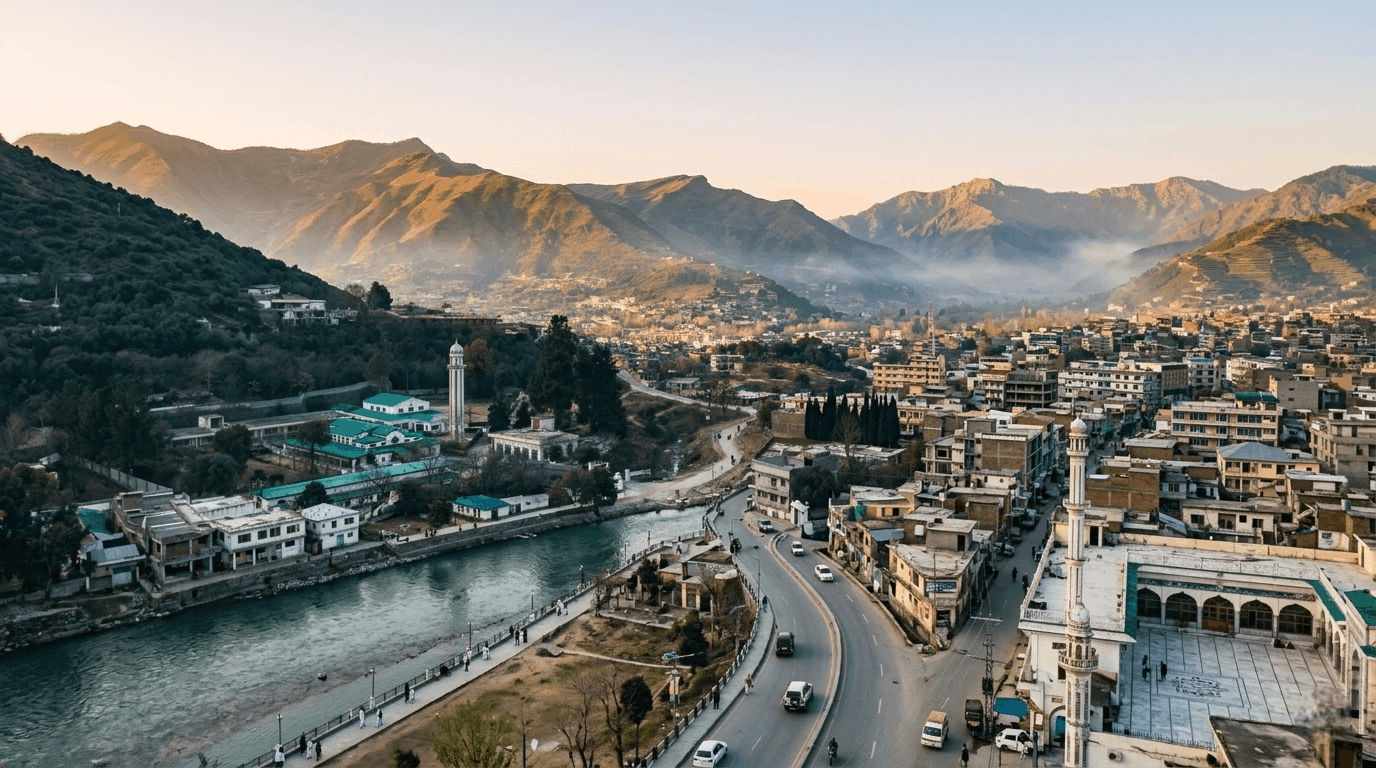
Mingora (Pashto: مینګورہ) is the third-largest city in Khyber Pakhtunkhwa and the 26th largest in Pakistan, with a population of approximately 331,091 residents. Located in the Swat District along the banks of the Swat River, it stands as the commercial and cultural epicenter of the entire Malakand Division. Its strategic position makes it the primary entry point for tourists exploring Swat Valley, offering the perfect balance between urban infrastructure and access to natural attractions.
Where is Mingora? Geographic Location & Significance
Mingora sits in the south-central portion of Swat Valley, positioned strategically along the Swat River at an elevation of approximately 900 meters above sea level. The city lies in Khyber Pakhtunkhwa province in northern Pakistan, approximately 230 kilometers (143 miles) northwest of Islamabad and roughly 100 kilometers from Peshawar.
The city’s geographic location represents the convergence point between the lower Swat regions and the deeper valleys that stretch northward. This positioning has historically made Mingora the natural meeting point for traders, pilgrims, and travelers moving between the plains and mountain regions.
Strategic Position in Swat District
Mingora functions as what geographers call the “gateway settlement” of Swat Valley. Unlike remote mountain destinations, Mingora’s location offers:
- Direct access to modern transportation infrastructure
- Connection to national highways (Swat Motorway/N-06)
- Proximity to Saidu Sharif Airport
- Established commercial services and facilities
This accessibility distinguishes Mingora from higher-altitude destinations like Kalam, Malam Jabba, or Kumrat Valley, which require additional travel time and more specialized planning.
Is Mingora a City? Metropolitan Status & Importance
Yes, Mingora is definitively a city and more specifically, a metropolitan center. According to Pakistan’s 2017 census, Mingora holds the following classifications:
- 3rd largest city in Khyber Pakhtunkhwa province
- 26th largest city in Pakistan overall
- Largest urban center in the Malakand Division
- Commercial epicenter of northern Khyber Pakhtunkhwa
The city’s metropolitan status reflects decades of urban development, commercial expansion, and infrastructure investment that transformed it from a regional market town into a fully-fledged city with municipal services, banking institutions, educational facilities, and modern amenities.
Mingora and Saidu Sharif: Twin Cities
Mingora exists in a unique urban configuration alongside Saidu Sharif, located just 2.5 kilometers (1.5 miles) south. These twin cities represent a fascinating case study in urban growth where two originally distinct settlements expanded until they began overlapping. Today, they function as one contiguous metropolitan area while maintaining separate administrative identities.
Saidu Sharif hosts several significant institutions including the Swat High Court bench and Saidu Sharif Airport, while Mingora serves as the primary commercial and market hub. Together, they comprise Swat’s largest urban agglomeration.

Getting to Mingora: Distance & Travel Routes
From Islamabad to Mingora
Distance: 230 kilometers (143 miles)
Travel Time: 3 to 3.5 hours (depending on traffic and road conditions)
Recommended Route: AH1/M-1 → M-16 → Bahrain/N-06
Google Map: Islamabad to Mingora
The journey follows one of Pakistan’s most well-developed highway corridors. The first two hours traverse the M-1 motorway, passing through relatively flat terrain before entering the foothills of Khyber Pakhtunkhwa. The final section follows the scenic N-06 (also called Swat Road) as you enter the valley itself.
Facilities on Route: Service stations along the M-1 and M-16 provide restaurants, prayer rooms, washrooms, and rest areas making the journey comfortable for families.
From Peshawar to Mingora
Distance: Approximately 100-110 kilometers (62-68 miles)
Travel Time: 2 to 2.5 hours
Route: N-06 directly through Swat Valley
Google Map: Peshawar to Mingora
This route is significantly shorter and takes you directly through scenic Swat Valley landscape from the regional capital city.
From Lahore to Mingora
Distance: Approximately 420 kilometers (260 miles)
Travel Time: 6 to 7 hours
Google Map: Lahore to Mingora
The Lahore route primarily uses the M-2 motorway connecting to the M-1, offering an all-highway experience suitable for long-distance travelers.
From Karachi to Mingora
Distance: Approximately 1,100+ kilometers (680+ miles)
Travel Time: 14+ hours or 1-2 day journey
Google Map: Karachi to Mingora
Most travelers from Karachi combine flights with ground transportation, taking domestic flights to Islamabad or Peshawar before driving to Mingora.
Transportation Options
Private Vehicle: Most flexible option; allows stops at scenic points and independent exploration
Bus Services: Faisal Movers and other intercity bus companies operate regular services; budget-friendly but longer travel times
Taxi/Ride-Sharing: Available from major cities; negotiate fares in advance
Rental Cars: Several agencies in Islamabad and Peshawar offer car rental with drivers
Pro Travel Tip for Adventurers: If you are using these transportation hubs to map a larger northern Pakistan tour package, many travelers head straight towards Gilgit-Baltistan after completing their Swat itinerary. Before finalizing your transport rentals, make sure to read our detailed Fairy Meadows Pakistan Travel Guide to check current 4×4 union jeep costs, mandatory mountain drivers, and essential road safety tips for your next big trekking milestone.

Mingora Weather & Best Time to Visit
Understanding Mingora’s Climate
Mingora experiences a temperate subtropical climate, significantly milder than higher-altitude areas within Swat. The city’s elevation of approximately 900 meters moderates extreme temperatures compared to the plains below.
Monthly Temperature Breakdown
| Month | Average High | Average Low | Conditions |
|---|---|---|---|
| January | 12°C (54°F) | 3°C (37°F) | Cold, frost at night |
| February | 14°C (57°F) | 5°C (41°F) | Cool, occasional rain |
| March | 21°C (70°F) | 9°C (48°F) | Mild, spring growth |
| April | 27°C (81°F) | 14°C (57°F) | Warm, pleasantly green |
| May | 31°C (88°F) | 19°C (66°F) | Warm, brief monsoon showers |
| June | 32°C (90°F) | 23°C (73°F) | Hottest month, occasional rain |
| July | 30°C (86°F) | 22°C (72°F) | Hot, peak monsoon |
| August | 29°C (84°F) | 21°C (70°F) | Hot, monsoon rains |
| September | 26°C (79°F) | 17°C (63°F) | Warm, decreasing rain |
| October | 20°C (68°F) | 11°C (52°F) | Pleasant, clear skies |
| November | 15°C (59°F) | 6°C (43°F) | Cool, occasional rain |
| December | 10°C (50°F) | 2°C (36°F) | Cold, rare snowfall |
Annual Rainfall: 897mm (35.3 inches)
Precipitation concentrates in two periods: winter/early spring (January-April) and monsoon season (July-August). Mingora receives significantly less snowfall than higher elevations; winter snow is rare but occasionally occurs during severe cold snaps.
Best Time to Visit Mingora
Peak Season (April-May & September-October)
Temperatures are comfortable (15-25°C / 59-77°F), vegetation is lush, and weather is generally stable. Roads are clear, and all attractions are fully accessible. This is when most tourists visit.
Secondary Season (March & November)
Pleasant weather with fewer crowds, though some higher-altitude destinations may be difficult to reach in early March.
Summer Monsoon (June-August)
Hot and humid with frequent rain. Higher elevations in Swat experience significant rainfall, occasionally making higher roads temporarily impassable. However, Mingora itself remains accessible, and prices are lower. Only visit if you enjoy rain and prefer to stay in the city or lower valleys.
Winter (December-February)
Cold temperatures and occasional rain. Not ideal for higher elevations, though Mingora itself remains accessible. Winter tourism focuses on enjoying the city, festivals, and occasional snowfall in nearby areas.
Weather Patterns to Know
- June and July are the hottest months (average 30°C / 86°F)
- January and February are coldest (average 5°C / 41°F)
- Night temperatures can drop significantly bring layers even in summer
- Sudden weather changes are common in mountain regions
- Flash flooding can occur during heavy monsoon rains

Top Tourist Attractions in Mingora
While Mingora primarily serves as a base camp, the city itself offers several worthwhile attractions and is the departure point for nearby wonders.
In Mingora
Swat Museum
Located in the heart of Mingora, the Swat Museum houses the most comprehensive collection of Gandhara Buddhist artifacts in the region. The museum displays sculptures, coins, manuscripts, and archaeological findings that illuminate the region’s ancient Buddhist civilization. This is essential for understanding Swat’s historical significance.
Fizagat Park
A peaceful recreational space in the Mingora area offering walking trails, green spaces, and views of the surrounding valley. Popular with families and joggers, Fizagat provides a quiet escape from the commercial bustle of the main bazaar.
Mingora Bazaar
The commercial heart of Swat’s economy. Walking through the main bazaar offers authentic glimpses of local commerce, traditional crafts, gemstones, and handmade textiles. The bazaar never feels touristy it’s where Swat Valley residents actually shop.
Mingora Chena Shopping Market
A more organized shopping district offering modern retail establishments alongside traditional shops. This is the practical place to purchase clothing, electronics, and modern goods.
Taj Chowk
The central roundabout and social gathering point of Mingora. The area around Taj Chowk pulses with activity and represents modern urban Mingora.
Saidu Sharif (2.5 km away)
Though technically separate, Saidu Sharif is visited as part of the Mingora area. It hosts the Swat High Court building and administrative headquarters. The town has several restaurants and accommodations, making it essentially an extension of greater Mingora.
Near Mingora (Day Trips)
Butkara Stupa Complex
Archaeological excavations reveal a large central stupa surrounded by over 200 smaller votive stupas, dating to the 1st-2nd century CE. This is one of Swat’s most important Buddhist heritage sites, demonstrating the region’s significance as a Buddhist center during the Kushan Empire.
Aligrama Archaeological Site
Near Saidu Sharif Airport, this site contains remains of Gandhara grave culture dating to approximately 1000 BC, revealing evidence of trade connections and cultural development thousands of years ago.
River Swat
The Swat River flowing through Mingora Swat offers picnic spots, swimming areas in summer, and scenic riverside walking paths. The river is central to Swat’s identity and provides cooling relief during hot months.

Where to Stay: Hotels & Accommodation
Mingora’s tourism infrastructure has expanded significantly, offering accommodation across all budget ranges. Hotels serve both tourists and business travelers, resulting in consistent quality across categories.
Luxury & Upper-Mid-Range Hotels
These establishments offer modern amenities, air conditioning, hot water systems, decent restaurant facilities, and sometimes parking. Expect to pay 3,000-6,000 PKR (roughly $11-22 USD) per night.
What to expect: Clean rooms, attached bathrooms, TV, phone service, Wi-Fi, and restaurant access. Some offer views of the valley or river.
Mid-Range Hotels
Comfortable, clean accommodations at 1,500-3,000 PKR ($6-11 USD) per night. These represent good value, with adequate facilities for most travelers’ needs.
What to expect: Basic but comfortable rooms, attached bathrooms, limited restaurant service, basic Wi-Fi.
Budget Guesthouses
Family-run establishments at 500-1,500 PKR ($2-6 USD) per night. Often preferred by backpackers and budget travelers. Quality varies significantly inspect the room before committing.
What to expect: Simple but clean rooms, shared or private bathrooms, basic amenities, authentic local hospitality.
Mingora Bypass Hotels
A cluster of hotels along the Mingora bypass road offers convenient location with less central-city noise. This is where many tourists choose to stay for easier access to onward travel.
Booking Tips
- High season (April-May, September-October) requires advance booking
- Off-season (June, August, December-February) offers better negotiated rates
- Ask about “home stay” options with local families for cultural immersion
- Confirm hot water availability during cooler months
- Request room inspection before checking in at budget establishments

Food & Cuisine: What to Eat in Mingora
Mingora’s food culture reflects authentic Pashtun traditions, with dishes that have remained largely unchanged for generations. The emphasis is on fresh ingredients, slow-cooking methods, and bold spice combinations.
| Famous Food in Mingora | Local Serving Style | Estimated Price (PKR) |
| Chapli Kabab | Clay Platter (Parat) with Onions | 150 – 250 per kabab |
| Swat Trout Fish | Crispy Grilled / Fried on Metal Plate | 1500 – 2500 per kg |
| Pure Swat Honey | Organic Mountain Honey (Jars) | 1200+ per kg |
| Local Green Tea / Kahwa | Traditional Clay Cups (Pyalay) | 60 – 100 per cup |
Must-Try Dishes
Chapli Kabab
A ground meat patty seasoned with spices, onions, and herbs, then pan-fried. This Swat specialty differs from other Pakistani kababs in its flattened, burger-like shape and particular spice blend. Eaten with naan bread and fresh onions.
Dum Pukht (Slow-Cooked Rice)
Rice cooked by the dum method sealed in a pot to trap steam resulting in fragrant, perfectly cooked grains with meat or vegetables. This is comfort food in Swat cuisine.
Local Rice Dishes
Basmati rice cooked with local vegetables, herbs, and sometimes meat. Swat’s rice has distinctive flavor due to local water and cooking traditions.
Trout (Qailach)
Swat River trout, served grilled or cooked in traditional style. Fresh mountain trout is a delicacy, especially in riverside restaurants.
Traditional Breads
Tandoori naan, roti, and chapati form the foundation of meals. The tandoor-baked naan has a particular char and texture unique to the region.
Swat Honey
Famous throughout Pakistan, Swat produces distinctive honey with unique properties attributed to high-altitude wildflower sources. Available at local markets.
Tea Culture
Chai (tea) is central to Swat hospitality. Traditional green tea with spices, milk tea, and cardamom tea accompany meals and social moments. Expect to be offered chai frequently it’s how locals connect with guests.
Where to Eat
- Mingora Bazaar restaurants: Authentic local cuisine, simple settings, very affordable
- Bypass hotels: More upscale dining, varied menus, English-speaking staff
- Street food stalls: Fresh kebabs, fried breads, and quick meals; exercise standard food safety judgment
Dietary Considerations
- Vegetarian options are limited but available (daal/lentils, vegetable curries)
- Alcohol is not culturally appropriate and unavailable
- Food is often spicy request less spice if needed
- Tap water should be avoided; drink bottled water

Shopping & Local Markets
Mingora’s markets offer authentic shopping experiences quite different from commercial malls of larger cities.
Mingora Bazaar Swat: Famous Products & Local Prices (2026)
| Famous Product / Souvenir | Quality / Type | Estimated Local Price (PKR) |
| Authentic Swati Shawls | Pure Wool (Hand-woven) | PKR 3,500 – PKR 8,500+ |
| Traditional Pashtun Clothes | Cultural Embroidered Suits | PKR 4,000 – PKR 7,500 |
| Pure Swat Mountain Honey | Sidr (Bery) Honey – Per Kg | PKR 2,500 – PKR 4,000 |
| Handmade Tribal Jewelry | Silver / Semi-Precious Stones | PKR 1,500 – PKR 5,000 |
| Walnut Wood Handicrafts | Small Carved Boxes / Decor Items | PKR 1,200 – PKR 4,500 |
| Swat Local Dry Fruits | Premium Walnuts (Akhrot) – Per Kg | PKR 900 – PKR 1,400 |
Main Bazaar (Mingora Bazar)
The original commercial heart, densely packed with shops selling:
- Textiles & Shawls: Traditional Swat shawls with distinctive weaving patterns
- Gemstones: Local and semi-precious stones from the region
- Handicrafts: Carved wood, pottery, traditional crafts
- Spices & Dry Goods: Loose spices, dried fruits, nuts
- Clothing: Traditional shalwar kameez, local fabrics
Shopping Tips: Prices are negotiable in traditional bazaar shops. The atmosphere is authentically local, not touristy. Arrive early to avoid afternoon crowds.
Mingora Chena Shopping Market
A more modern shopping district with:
- Contemporary retail stores
- Electronics and household goods
- More uniform pricing (less negotiation)
- Cleaner, organized layout
Local Products Worth Buying
- Swat Honey: Renowned for quality and unique flavor
- Carved Wood Items: Skillfully crafted boxes, frames, traditional designs
- Shawls: Locally woven with traditional patterns
- Gems & Stones: Available in specialty shops (verify authenticity)
- Local Pottery: Hand-made ceramics reflecting regional style
Safety & Travel Tips for Mingora
Mingora city swat has undergone significant transformation regarding safety, particularly after the 2009-2010 security challenges. The city is now widely considered safe for tourists, though standard travel precautions apply.
Safety Overview
- Overall Assessment: Safe for tourists; no significant security threats to visitors
- Law Enforcement: Visible police presence; responsive authorities
- Local Attitude: Residents are generally welcoming and protective of tourists
- Areas to Avoid: No specific tourist areas are unsafe, though avoid isolated areas at night
Practical Safety Tips
Documents & Money
- Keep passport copy separate from original
- Use ATMs in hotels or established banks for withdrawals
- Split money into multiple locations
- Small bills are useful for markets where change is an issue
Transportation
- Travel between cities during daylight hours
- Use established taxi services or hotel referrals rather than hailing random cabs
- Negotiate fares before entering unmarked taxis
Cultural Respect
- Dress modestly (shoulders and knees covered)
- Remove shoes when entering homes or religious spaces
- Ask before photographing people
- Respect prayer times; some businesses may close temporarily
Health Precautions
- Carry basic medications (stomach remedies particularly useful)
- Drink only bottled water
- Use sunscreen and bug repellent
- Travel insurance including medical evacuation is wise
Communication
- International roaming works with major carriers
- Local SIM cards offer better rates; available at airports
- Learn basic Urdu or Pashto phrases; locals appreciate the effort
Natural Hazards
Monsoon Flooding: July-August rainy season can create flash floods in valleys. Avoid driving during heavy rainfall.
Mountain Roads: Higher valleys require careful driving. Heavy vehicles navigate better than small cars on steep sections.
Temperature Extremes: Winter nights are cold (bring layers); summer midday heat is intense (stay hydrated).
Mingora as Your Swat Valley Base Camp
Mingora’s true value emerges when understood as the operational base for experiencing all of Swat Valley. Rather than a destination in itself, Mingora provides infrastructure for exploring the surrounding region.
Why Mingora Works as a Base
Proximity to Major Attractions:
- Kalam (northern valley): ~100 km, 3-4 hour drive
- Malam Jabba Ski Resort: ~60 km, 2-3 hour drive
- Bahrain: ~30 km, 1 hour drive
- Naran-Kaghan: ~60 km via alternate routes
Infrastructure Advantages:
- Modern banking and ATM facilities
- Diverse restaurant options and food security
- Quality hotels across all budgets
- Reliable transportation options
- Medical facilities if needed
Logistical Hub:
- Rental vehicle companies
- Tour operator offices
- Travel agency networks
- Shopping and supplies
3-Day Mingora-Based Itinerary
Day 1: Mingora Orientation
- Arrive morning/afternoon
- Visit Swat Museum (historical context)
- Explore Mingora Bazaar (shopping, local food)
- Evening walk along Swat River
- Dinner in Mingora
Day 2: Northern Valleys Day Trip
- Early departure for Kalam (or Malam Jabba depending on season)
- Full day exploring upper valleys, scenic spots
- Return to Mingora evening
Day 3: Archaeological Heritage & Relaxation
- Visit Butkara Stupa and Gandhara sites
- Riverside picnic or Fizagat Park
- Shopping/final markets
- Evening departure
Accommodation Strategy
Most visitors spend 1-2 nights in Mingora city, using it as a transit point and base for day trips, rather than as an extended destination. This pattern suits Mingora’s role perfectly.
FAQ: Everything You Need to Know
What is famous in Mingora Swat?
Mingora is famous for being the commercial and administrative hub of Swat Valley. More specifically, it’s known for:
- Swat Museum: The largest collection of Gandhara Buddhist artifacts
- Strategic Location: Gateway to entire Swat Valley system
- Shopping & Markets: Authentic bazaars with traditional goods
- Hospitality Infrastructure: Hotels and restaurants serving tourists exploring the region
- Historical Significance: Close proximity to major Buddhist archaeological sites
Mingora itself isn’t famous for specific attractions (those are scattered throughout the valley), but rather for being the place where those attractions become accessible.
Is Mingora safe for tourists?
Yes, Mingora is safe for tourists. The city has experienced significant improvement in security over the past decade. Visitors report positive experiences and welcoming interactions with residents. Standard travel safety precautions apply (avoid isolated areas at night, use established transportation, respect cultural norms), but there are no specific security threats targeting tourists.
How far is Malam Jabba from Mingora?
Distance: Approximately 60 kilometers (37 miles)
Travel Time: 2 to 2.5 hours depending on road conditions
This makes Malam Jabba a practical day trip from Mingora, though many visitors overnight in Mingora or in Malam Jabba itself for ski/activity purposes.
How is the weather of Mingora?
Mingora has a temperate subtropical climate characterized by:
- Summers (June-August): Warm and humid (25-32°C / 77-90°F) with monsoon rainfall
- Springs (March-May): Mild and pleasant (15-27°C / 59-81°F), ideal visiting period
- Autumns (September-November): Cool and clear (12-25°C / 54-77°F), excellent for travel
- Winters (December-February): Cold (2-14°C / 36-57°F) with occasional rain and rare snow
Overall, Mingora’s weather is milder than higher elevations in Swat due to its lower altitude.
How many kilometers distance from Kumrat Valley from Swat Mingora?
Distance: Approximately 100-110 kilometers (62-68 miles)
Travel Time: 3.5 to 4.5 hours due to rough mountain roads
Kumrat Valley is one of Swat’s most remote and scenic destinations. The journey from Mingora requires sturdy vehicles, and road conditions may be challenging during rainy seasons.
How many time required from Mingora to Kalam?
Distance: Approximately 100 kilometers (62 miles)
Travel Time: 3 to 4 hours
The drive to Kalam follows the main Swat Valley road northward, steadily ascending through scenic landscapes. The journey is increasingly popular among tourists exploring the northern reaches of the valley.
How to travel from Abbotabad to Mingora?
Route: Abbotabad → Besham → Batagram/Kohistan → Mingora (mountainous route) OR Abbotabad → Islamabad → Peshawar → Mingora (main highways)
Recommended: The main highway route via Islamabad is safer and better maintained, though longer (approximately 300+ km). The mountainous direct route is scenic but requires caution and experienced driving.
Travel Time: 5-7 hours via main highways; 6-8 hours via mountain routes
How to travel from Mingora to Gabin Jabba?
Distance: Approximately 45-50 kilometers (28-31 miles)
Travel Time: 2 to 2.5 hours
Gabin Jabba (also spelled Gibin Jabba) is accessed via the main Swat Valley road heading south, then branching toward the Gibin area. The landscape transitions from valley floor to higher elevations.
What is the temperature in Mingora?
Current temperatures vary by season: See the monthly breakdown table above for detailed information. Generally, expect 2-32°C (36-90°F) annually, with April-May and September-October being most comfortable.
How many districts in Mingora?
This question appears based on a misunderstanding. Mingora is not divided into districts it’s a city within Swat District. Swat District itself is divided into administrative subdivisions (tehsils), but Mingora is a single municipal city authority.
If asking about neighborhoods or administrative divisions within Mingora, the city has several distinct areas (Taj Chowk area, bypass zone, bazaar districts) but no official “district” subdivisions.
Peshawar High Court Mingora bench?
Yes, the Peshawar High Court maintains a bench in Mingora (actually in adjacent Saidu Sharif). This court handles legal cases for Swat District and surrounding areas. The High Court Bench building is located in Saidu Sharif, approximately 2.5 km from central Mingora.
What is the best time to visit Mingora?
Best: April-May and September-October mild temperatures, clear skies, fully accessible attractions, lush vegetation
Secondary: March and November pleasant but fewer crowds
Avoid: June-August (monsoon, hot, rainy); December-February (cold, potential snow in higher areas)
For Mingora city itself, any time is acceptable, but for exploring surrounding Swat attractions, spring and fall are ideal.
Mingora city postal code/zip code?
Mingora Postal Code: 19000 (approximate)
Note: Pakistan’s postal code system is less standardized than Western countries. Mingora-based mail typically addresses to:
[Recipient Name]
Mingora, Swat
Khyber Pakhtunkhwa
Pakistan
Planning Your Mingora Trip: Essential Checklist
Before You Go:
- [ ] Check Pakistan travel advisories (currently safe)
- [ ] Arrange visa if required
- [ ] Book accommodations in advance during peak season
- [ ] Reserve rental vehicle if desired
- [ ] Obtain travel insurance
Packing for Any Season:
- [ ] Comfortable walking shoes
- [ ] Layers (temperature varies throughout day/season)
- [ ] Sunscreen and sunglasses
- [ ] Medications (basic first aid and stomach remedies)
- [ ] Bottled water bottles/hydration system
- [ ] Modest clothing (respect local dress culture)
- [ ] Camera/phone for photography
- [ ] Cash (ATMs available but not everywhere)
During Your Visit:
- [ ] Respect prayer times
- [ ] Ask before photographing people
- [ ] Try local food (safely)
- [ ] Learn basic greetings in Urdu/Pashto
- [ ] Connect with locals (exceptionally hospitable)
- [ ] Keep emergency numbers stored
Why Mingora Matters to Swat Tourism
Mingora represents an unusual category: a city that is simultaneously significant as a destination and equally important as a functional base. Its combination of modern infrastructure, welcoming atmosphere, authentic culture, and strategic location creates the perfect launching point for Swat Valley exploration.
Rather than viewing Mingora as a specific tourist destination with must-see attractions, consider it as the operational center of your Swat experience. The city provides the comfort and logistics necessary to access Swat’s true natural and historical treasures scattered throughout the valley.
For first-time visitors to northern Pakistan, Mingora offers an ideal balance between authentic cultural immersion and traveler convenience an increasingly rare combination in modern tourism.


This Post Has One Comment