
Table of Contents
What Is Swat Valley?
There is a moment, usually somewhere between Chakdarra and Mingora, when the road climbs into the mountains and the Swat River comes into full view below. The water is the wrong shade of green for a river. Too vivid, almost theatrical. The forested ridges rise on both sides, and the air through the car window changes temperature. It is the kind of moment that rewires whatever assumptions you brought with you.
Swat Valley is a mountain valley in Khyber Pakhtunkhwa province in northwest Pakistan, nested within the Malakand Division. It runs along the Swat River for roughly 150 kilometres, stretching from the lower plains near Chakdarra in the south all the way north to the high-altitude settlement of Kalam, where the Hindu Kush mountains dominate the skyline in every direction.
Geographically, the valley sits between approximately 34°40′ and 35°56′ N latitude and 72° to 74°6′ E longitude. This position placed it at one of Asia’s most historically significant crossroads, where South Asia, Central Asia, and the edge of China once converged through ancient trade routes and Buddhist pilgrimage paths.
Home to more than two million people, predominantly Pashtun, Swat’s largest city is Mingora, the commercial heart of the district. The administrative capital, Saidu Sharif, sits immediately adjacent to Mingora and hosts the district government offices, the famous Swat Museum, and several important archaeological sites.
Despite years of misleading international headlines, Swat today is an active, recovering, and genuinely beautiful travel destination. It rewards anyone willing to look past its complicated recent past.

Why Swat Is Called the Switzerland of Pakistan
The nickname has been in circulation since at least the mid-twentieth century, and it earns the comparison in several ways. The valley’s lush, terraced hillsides, snow-capped peaks, roaring glacial rivers, dense conifer forests, and alpine meadows bear a strong visual resemblance to central European highland landscapes, particularly in the upper reaches around Kalam and Ushu.
But the comparison goes beyond scenery. During the reign of Swat’s last rulers, Miangul Abdul Wadud (1917 to 1949) and Miangul Jahan Zeb (1949 to 1969), the valley underwent remarkable development in education, healthcare, and infrastructure. This relative prosperity and orderliness further reinforced the Swiss analogy at a time when comparable regions in the subcontinent had nothing resembling functioning public systems.
Today the nickname remains apt in spirit, though the valley has earned its own identity. It is a place where Buddhist ruins rise from riverbanks, trout swim in glacial streams, and Pashtun hospitality sets a standard few destinations in the world can match.
Swat Valley: Location and Geography
Where Is Swat Valley?
Swat is located approximately 151 km north of Peshawar and about 247 km from Islamabad via the Swat Motorway (M-16). It lies to the east of Chitral district, north of Mardan, and its northern reaches approach the broader Hindu Kush mountain system.
The valley divides informally into Lower Swat (Chakdarra to Mingora) and Upper Swat (Mingora northward through Bahrain, Kalam, and beyond). The distinction matters enormously for travel planning. Lower Swat is more accessible, more urbanized, and carries the bulk of the valley’s historical and archaeological heritage. Upper Swat is where the wilderness begins in earnest, where high-altitude lakes appear, and where the landscape becomes something genuinely difficult to describe to someone who has not seen it.
Key Distances from Major Pakistani Cities
| City | Distance to Mingora | Typical Road Travel Time |
|---|---|---|
| Peshawar | 151 km | 2.5 to 3 hours |
| Islamabad / Rawalpindi | 247 km | 3.5 to 4.5 hours via M-16 |
| Lahore | approximately 590 km | 8 to 10 hours |
| Karachi | approximately 1,700 km | 26 to 30 hours |
| Gilgit (via Bisham) | approximately 280 km | 6 to 7 hours |
Note on travel times: The completion of the Swat Motorway (M-16) has dramatically reduced journey times from Islamabad. What previously took six to eight hours via the old N-45 highway now takes approximately three and a half to four and a half hours by car, depending on traffic and your starting point within the capital.
The Swat River
The Swat River is the valley’s defining geographic feature. It is a swift, emerald-green waterway fed by glacial melt from the surrounding Hindu Kush and Kohistan mountain ranges, running the full length of the valley before eventually joining the Panjkora River. Many of the valley’s best viewpoints, most popular picnic spots, and most significant towns sit directly along its banks. The sound of the river is constant in Swat. You hear it before you see it in most places, and it stays with you the entire journey north.

A Brief History of Swat Valley
Swat’s history is long enough and layered enough to make most other travel destinations feel shallow by comparison.
Ancient Names: Udyana and Suvastu
In Sanskrit and early Buddhist texts, Swat was known as Udyana, meaning “Land of Gardens.” It is a name that captures something still true about the valley. The Swat River itself was known in ancient sources as Suvastu, a reference that appears in the Rigveda among the rivers of the northwestern subcontinent.
Alexander the Great’s Passage (327 BC)
Alexander the Great passed through the Swat region in 327 BC during his Indian campaign, encountering fierce resistance from local hill tribes. The historical significance of this passage is reflected in several archaeological sites in Lower Swat that correspond to Alexandrian-era military encounters.
The Buddhist Golden Age
Swat’s most defining historical chapter was as a centre of Gandhara civilization, one of the most important nodes of Buddhist culture in all of Central and South Asia. Chinese pilgrims who visited the valley documented thousands of monasteries, stupas, and images of the Buddha. Fa-Hien, who visited in the fourth century AD, described approximately 6,000 monasteries in the region. Xuanzang, writing in the seventh century, counted 1,400. Today more than 400 Buddhist stupas and monastery ruins can still be identified across roughly 160 square kilometres of the valley.
This heritage places Swat alongside Taxila and the Bamiyan valley as one of the most significant Buddhist archaeological landscapes in Asia. It is not an exaggeration to say that the valley is, for students of Buddhist art and Gandharan civilization, one of the most important places on earth.
The Pashtun and Princely State Era
By the medieval period, Pashtun Yousafzai tribes had established dominance over the valley. In 1915, Swat State was formally established, becoming a rare model of competent, semi-autonomous local governance in the region. Under Abdul Wadud and later Jahan Zeb, Swat developed schools, roads, hospitals, and functioning administrative infrastructure decades before comparable areas across Pakistan. The state formally acceded to Pakistan in 1969 and was merged into what is now Khyber Pakhtunkhwa.
The Taliban Insurgency and Military Operation (2007 to 2009)
Between 2007 and 2009, Swat was seized by a Taliban insurgency led by a local cleric. The period was marked by the destruction of girls’ schools, violence against civilians, and the collapse of civil administration. The Pakistani military launched Operation Rah-e-Rast in 2009, which displaced nearly a million residents but ultimately restored state control.
The story of this period is inseparable from that of Malala Yousafzai, born on July 12, 1997, in Mingora. Her defiance of Taliban restrictions on girls’ education, and the assassination attempt against her in 2012, brought the world’s attention to Swat in ways no tourism campaign could have engineered. Her Nobel Peace Prize in 2014 gave the valley a complicated but ultimately very human face in global consciousness.
Is Swat Safe to Visit in 2026?
The short answer is yes. Swat is considered safe for both domestic and foreign tourists under current conditions, and millions of Pakistani visitors travel there each year without incident.
The security situation has transformed substantially since 2009. The military operation removed the Taliban from the valley, civilian administration was restored, and the Khyber Pakhtunkhwa government established a dedicated Tourist Police Force to assist and protect visitors around the clock. A tourist helpline (0946-881374) operates across the valley.
That said, a clear-eyed assessment is worth reading before you go.
Security checkpoints remain on the road from Peshawar into Swat. Foreign passport holders are typically registered at these checkpoints. This is routine procedure and not a cause for alarm. Most travelers pass through quickly and without difficulty.
Remote areas, particularly high-altitude trekking routes and border-adjacent valleys, warrant additional caution. Working with a local guide in these areas is strongly advised, both for safety and for navigational reasons.
Situational awareness is always appropriate. Before travel, check the current advisory issued by your country’s foreign ministry for Khyber Pakhtunkhwa province. The US State Department and UK’s FCDO both maintain updated guidance for KP province. Western advisories for Pakistan tend to be broadly cautious and are not specifically tailored to tourist circuits, so read them carefully rather than treating them as absolute prohibitions.
Photography near security installations or military checkpoints is inappropriate and can attract serious attention. Always ask before photographing people, particularly women, in conservative communities.
The consensus among experienced Pakistan travelers is that Swat’s famous hospitality is genuine, and the valley is significantly safer for tourists than its historical reputation suggests. Foreigner-related incidents have been extremely rare since 2012, and tourist infrastructure has steadily improved with each passing season.
Practical tip: Having a local contact or booking through a reputable local operator such as Swat Valley Backpackers smooths the logistics considerably. It also reduces the only real friction most foreign visitors encounter, which is navigating the bureaucratic check-in procedures at security points.

Best Time to Visit Swat Valley
Swat’s climate varies significantly between its lower and upper regions, and between seasons. There is genuinely no single best time to visit. It depends entirely on what you are looking for.
Spring (March to May)
The valley comes alive in spring. Snow begins to melt, fruit trees blossom, wildflowers carpet the hillsides, and waterfalls run at full force. Average temperatures in Lower Swat range from roughly 12 to 20°C. This is arguably the most visually spectacular time to visit, though roads to upper valleys may still be partially blocked by snow through March. The Swat River runs loudest in April, swollen with glacial melt, and the contrast of rushing water against blossom-covered banks is something genuinely worth planning around.
Summer (June to August)
Peak domestic tourism season. Families from Lahore, Islamabad, and Karachi head to Swat to escape the plains heat, and the valley fills with weekenders and holiday travelers. Upper Swat (Kalam, Mahodand, Ushu) is at its most accessible. Temperatures in Upper Swat remain mild at 15 to 22°C, while Lower Swat can warm to 28 to 32°C. Expect crowds at popular spots, particularly during July. Accommodation books out quickly. If you plan to visit Mahodand Lake or the high alpine routes, summer is your window.
Autumn (September to November)
Swat’s best-kept secret season. Tourist crowds thin dramatically after mid-September, while the weather remains genuinely pleasant at 8 to 18°C. The valley turns gold and amber as deciduous trees change colour, and the light in October has a quality that photographers travel from across the country to capture. Trekking conditions are excellent, trails are clear, and accommodation is easier to book and negotiate. October is widely considered the most photogenic month in the valley.
Winter (December to February)
Upper Swat becomes largely inaccessible under heavy snow, with the road to Kalam typically closing through the coldest months. Lower Swat remains open and functional. The major draw is Malam Jabba Ski Resort, which becomes Pakistan’s primary winter sports destination. Average temperatures hover around 2 to 8°C in lower Swat, dropping well below freezing at altitude. For anyone who has not seen Swat under snow, the landscape takes on a completely different character.
Quick Recommendation by Travel Type
| Travel Purpose | Best Months |
|---|---|
| General sightseeing | April to June, September to October |
| Trekking and hiking | June to October |
| Photography | April to May, October |
| Skiing and winter sports | December to February |
| Budget travel (fewer crowds) | March, September, November |
| Snowfall experience | January to February |

How to Get to Swat Valley
By Road via the Swat Motorway (Recommended)
The Swat Motorway (M-16) has changed everything about getting to Swat from central Pakistan. Opened in phases, with Phase II connecting Chakdarra to Fatehpur, the motorway runs approximately 81 kilometres from the M-1 interchange near Nowshera into the Swat district. What once took six to eight hours from Islamabad via the congested old N-45 highway now takes approximately three and a half to four and a half hours, depending on your starting point.
The motorway includes the impressive Malakand Tunnel, an engineering achievement that cuts through mountainous terrain, shortening the journey and eliminating some of the more treacherous old road sections. Toll fees apply on the M-16 section (approximately PKR 350 to 500 as of 2026, in addition to M-1 tolls from Islamabad).
By Road from Peshawar
From Peshawar, the route follows the older N-45 via Mardan and the Malakand Pass, a historically significant mountain crossing that has served traders and armies for centuries. The distance is 151 km and the journey takes roughly 2.5 to 3 hours by car under normal conditions.
Along the way, you pass through Chakdarra, where the road forks between Swat and Chitral. Churchill’s Picket, a small fort built in 1896 and described by Winston Churchill in his account of the Malakand Field Force, stands near here and is worth a brief stop if you have an interest in colonial-era history.
By Bus
Several intercity operators run regular services to Mingora from Peshawar, Islamabad, Rawalpindi, Lahore, and Karachi. Daewoo Bus Service operates scheduled departures with advance booking options from Lahore and Islamabad. Local minibuses, known locally as “Datsuns” or covered vans, run frequently along the Peshawar-Mingora and Mingora-Kalam routes and are the most economical way to travel, though comfort is limited and journey times are longer.
By Air
Saidu Sharif Airport exists near Mingora and has historically received PIA flights from Islamabad, though services have been intermittent. Verify current flight availability before planning your itinerary around air travel, as schedules change seasonally.
By Private Car (Recommended for Flexibility)
Driving yourself or hiring a private car gives you the freedom to stop at roadside viewpoints, explore historical sites between towns, and set your own pace. A 4×4 vehicle is strongly recommended for Upper Swat, particularly for accessing Mahodand Lake and other destinations beyond Kalam. The road surface deteriorates significantly after Kalam, and after rainfall, some stretches become genuinely difficult for standard vehicles.

Best Places to Visit in Swat Valley
Mingora: The Gateway City
Mingora is Swat’s largest city and commercial centre. It is the arrival and departure point for most visitors, and while it is not a scenic destination in itself, it provides everything a traveler needs: hotels across all price ranges, restaurants, markets, mobile data, banks, and pharmacies. Think of it as your practical base before heading deeper into the valley.
The Mingora Bazaar is worth an evening walk. Rows of shops sell semi-precious stones (including locally mined emeralds), embroidered textiles, woodwork, dried fruits, and spices. The bazaar is also the most practical last stop for supplies before heading north. Early mornings in Fizagat Park, on the outskirts of Mingora along the Swat River, are surprisingly peaceful before the day’s crowds arrive. It is a simple riverside picnic spot, but the morning light on the water is genuinely lovely.
Saidu Sharif: History Concentrated
Saidu Sharif sits immediately adjacent to Mingora and holds the district’s administrative capital. Its attractions are primarily historical and cultural, and for anyone with even a passing interest in the ancient world, it is absolutely worth a half day.
The Swat Museum is a must-visit. Its collection spans Gandhara-era sculpture, Buddhist artifacts, coins from multiple civilizations, Kushana-period pottery, and displays of Pashtun cultural heritage including traditional dress, embroidery, musical instruments, and carved woodwork. The quality of the Gandharan pieces rivals collections in major international museums. Note that the museum is closed on Fridays.
The Butkara Stupa complex lies at the eastern edge of ancient Mingora. The main stupa here underwent five successive reconstructions from the third century BC through the tenth century AD, each new phase encasing the previous one. The layered archaeology is extraordinary and the site remains one of the most significant Buddhist monuments in South Asia.
The Jehanabad Seated Buddha, a seven-metre carved rock-face image of a meditating Buddha located 5 km northeast of Manglawar, is one of the valley’s most striking ancient monuments and is visible from the road to Malam Jabba. It was damaged in 2008 but traces of the original carving remain clearly visible.
Malam Jabba: The Adventure Resort
Located approximately 44 km from Mingora, Malam Jabba is Swat’s most commercially developed mountain resort. In winter it operates as Pakistan’s primary ski resort, with chairlifts, ski slopes of varying difficulty, and equipment rental. In summer the resort transforms into a green highland destination for hiking, camping, and scenic walks through cedar forests.
The landscape surrounding Malam Jabba, with snow-capped peaks, sprawling forests, and wide valley views, is genuinely impressive in all seasons. For first-time visitors to Swat’s mountain terrain, it offers an approachable and well-serviced introduction to what upper Swat has to offer.
Bahrain and Madyan: Living Villages on the River
Both Bahrain, about 96 km north of Mingora, and Madyan, roughly 56 km north, are riverside towns where the Swat River runs at its most dramatic: fast, loud, and strikingly green. Bahrain has become the main base for travelers heading deeper into upper Swat, with a growing cluster of guesthouses and restaurants catering to visitors.
The road between Bahrain and Kalam becomes rough after rainfall, but the scenery makes the slow drive entirely worthwhile. Madyan is notable for its cable river crossing, a memorable if slightly nerve-wracking way to cross the Swat River that is still used by locals daily. The town also has a trout hatchery that welcomes visitors and several small shops selling handicrafts and antiques.
Life moves at a different pace in both towns. The streets are dominated by men in traditional Pashtun dress. Bazaars are small, social, and genuinely local in character. For travelers interested in living culture rather than curated attractions, these towns offer far more than any polished tourist destination could.
Kalam Valley: The Upper Swat Heartland
Kalam is the last major settlement before the valley narrows into high mountain wilderness. At roughly 2,000 metres above sea level, the air is noticeably cooler even in summer, and the surrounding peaks of the Hindu Kush and Kohistan ranges rise dramatically on all sides. The town itself is a modest, functional cluster of guesthouses, small restaurants, and supply shops, but it serves as the gateway to some of the most spectacular terrain in the country.
Kalam is the starting point for the valley’s most ambitious trekking routes and the access hub for Ushu Forest (a dense, cathedral-like conifer forest immediately above town), Mahodand Lake (a high-altitude glacial lake 35 km beyond Kalam requiring a 4×4), Utror Valley and its associated lakes, and the Gabral Valley.
The Kalam Summer Festival, held annually in the valley, features Pashtun music and dance, paragliding demonstrations, and camping events. It has become one of Khyber Pakhtunkhwa’s signature cultural events and is worth timing your visit around if you are traveling in July or August.
Mahodand Lake: The Jewel of Upper Swat
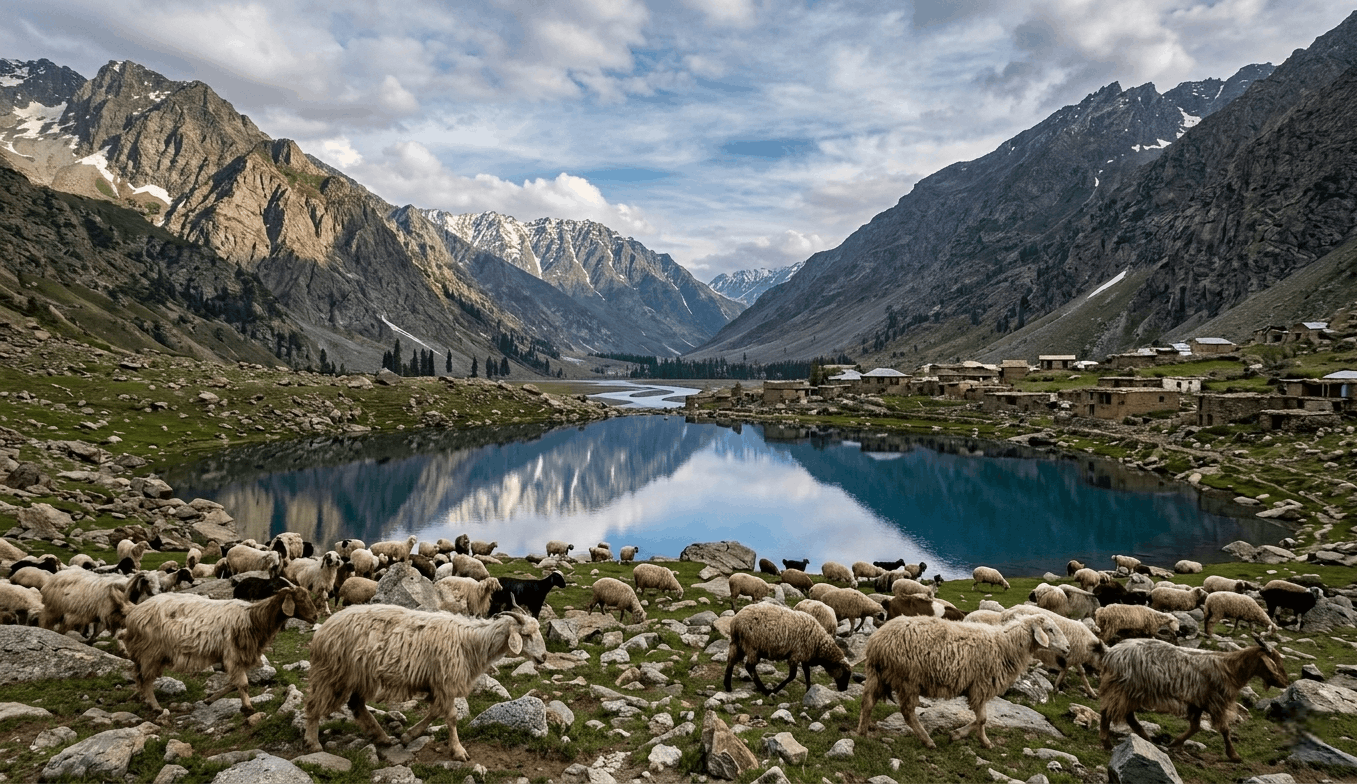
Mahodand is one of those places that rewards whatever effort is required to reach it. Situated 35 km beyond Kalam on an unpaved jeep track, the lake sits at over 2,800 metres above sea level, surrounded by wide-open pastures, glaciers, and some of the most imposing mountain scenery in Pakistan.
The river here divides into a series of interconnected lakes that historically teemed with brown and rainbow trout, introduced by the former ruler of Swat State. Local fishermen still work the water. Temporary restaurants and basic guesthouses operate near the lake during the summer months, and boating is available. The best season to visit Mahodand is July through September. Outside this window, snow makes the access road impassable.
Marghuzar and the White Palace
About 13 km from Saidu Sharif, the small town of Marghuzar sits at the foot of Mount Elum. Its signature landmark is the White Marble Palace, built by the ruler of Swat in 1940 as a summer residence and since converted into a heritage hotel. The palace setting, a compact valley of orchards and streams framed by the mountain, is one of the most serene spots in all of Lower Swat, and the building itself is genuinely beautiful in a quiet, understated way.
Miandam
Roughly 57 km from Saidu Sharif, Miandam is a hill resort known as one of the coolest spots in Swat during summer. The surrounding mountains shade the valley for much of the day, keeping temperatures reliably lower than anywhere else at comparable altitude. It is a quieter, less-visited alternative to the busier Kalam route, offering forested hillsides, streams, and a noticeably more tranquil pace of life. Travelers who have been to Kalam and want something calmer often end up here.
Gabin Jabba (Honey Marshes Meadows)
Perched at 2,582 metres above sea level, roughly 58 km north of Mingora, Gabin Jabba translates from Pashto as “Honey Marshes.” It is a highland meadow known for medicinal plants, wild honey, a freshwater trout farm, and mineral springs. Eco-camping pods are the primary accommodation here. There are no conventional hotels. The area is popular for paragliding and, on clear nights, for stargazing well away from any urban light pollution.
Archaeological Sites Worth Seeking Out
Beyond the flagship Butkara site, the valley holds several lesser-visited but historically significant Buddhist monuments:
Nimogram Stupa is a monastery complex 22 km from Barikot featuring three main stupas and 56 votive stupas, traceable to the second and third century AD.
Shingardar Stupa is linked by local tradition to a legendary relic-bearing white elephant, located 3 km northeast of Barikot.
Amlukdara Stupa is a well-preserved stupa with fine semi-ashlar masonry from the Kushana period, near Nawagai.
Tokar Dara (Najigram) Stupa is considered one of the best-preserved stupas in the valley, located 5 km south of Barikot.
Gumbatuna Stupa is a large Buddhist establishment on the right bank of the Swat River, 6 km west of Barikot.
Ram Takht (Ram’s Throne) is a sacred Hindu site at 9,200 feet on Mount Elum, considered second only to Amarnath Cave in sanctity for Hindu pilgrims, and accessible from Marghuzar via an approximately five-hour one-way trek.
If you have explored the lush green landscapes of Swat Valley and want to expand your travel itinerary to witness another raw paradise in Pakistan, then heading towards Gilgit-Baltistan is your absolute best next step. To plan the ultimate mountain expansion after your Swat trip, check out our newly updated Fairy Meadows Pakistan Travel Guide to lock in the exact coordinates, current seasonal weather charts, and local 4×4 jeep track costs right at the majestic foot of Nanga Parbat.
Adventure Activities in Swat
Trekking and Hiking
Swat’s trail network ranges from gentle afternoon walks to multi-day expeditions requiring guides and full camping gear. The variety is one of its genuine strengths.
Kalam to Mahodand (day trek or jeep road) is accessible and spectacular, and manageable for most reasonably fit travelers.
Ushu Forest to Gabral Valley takes you through dense conifer forest into high alpine pasture, and the transition between the two environments is striking.
Kundal Lake to Pari (Fairy) Lake is steep, demanding, and classified as difficult, but the reward is access to a lake that very few visitors ever see.
Bishigram Lake is a four to five hour approach from Bishigram Valley near Madyan.
Ram Takht via Marghuzar is approximately five hours one way, combining spiritual significance with excellent mountain scenery.
Practical note: For routes above 3,000 metres, altitude sickness is a real consideration, not a theoretical one. Allow genuine acclimatisation time in Kalam before attempting high-altitude trails. Bring warm layers regardless of the season, as temperatures drop sharply after sunset at any elevation.
Skiing and Snowboarding at Malam Jabba
Malam Jabba is Pakistan’s most developed ski destination, with chairlift infrastructure and equipment available for hire. The season typically runs December through February depending on snowfall. The resort attracts both domestic winter sports enthusiasts and a growing number of international visitors who have discovered that lift tickets and rentals cost a fraction of what comparable European resorts charge.
Camping
Designated and informal camping spots exist throughout upper Swat. Popular locations include the meadows near Mahodand Lake, Gabin Jabba, riverside spots at Fizagat Park, and the valleys around Kalam. Bring a four-season sleeping bag if camping above 2,500 metres during any shoulder season. Temperatures drop suddenly and dramatically at these elevations even in August.
River Activities
The Swat River and its tributaries offer opportunities for trout fishing, riverside picnicking, and in certain sections, river rafting (availability varies and should be verified locally before planning around it). The trout farms in Madyan and the Mahodand area allow visitors to observe and in some cases participate in fishing.
Jeep Safaris and Off-Road Driving
Privately arranged jeep safaris into remote valleys beyond Kalam are the practical way to access terrain that standard vehicles simply cannot reach. Local operators in Kalam can arrange full-day and multi-day jeep excursions into the surrounding mountain valleys. The Kalam Jeep Rally, typically held in winter, highlights Swat’s rugged off-road landscape and draws participants from across Pakistan.

Swat Valley Food and Cuisine
Swat’s culinary tradition is a genuine point of regional pride, blending Pashtun, Afghan, Persian, and Central Asian influences into a cuisine that feels both familiar and distinct from what you find in Lahore or Karachi. The cooking here is direct, generous, and deeply satisfying in a way that pairs perfectly with cold mountain air and long days of walking.
Chapli Kebab is arguably the most iconic dish of Khyber Pakhtunkhwa: flat, spiced minced-meat patties cooked in tallow or oil over a high flame. Swat’s version has its own regional spicing that differs subtly from what you might have tried elsewhere. Order one from a roadside dhaba and eat it immediately.
Kabuli Pulao is slow-cooked rice with lamb, caramelised carrots, raisins, and nuts, drawing on Central Asian culinary heritage that reflects the valley’s ancient position along trade routes.
Tikka and Charcoal Grills (skewered lamb, chicken, and beef cooked over charcoal) are staples at roadside dhabas and town restaurants throughout the valley.
Dum Pukht is a slow-cooking technique in which meat and aromatics are sealed and cooked in their own steam, producing intensely flavoured results that reward patience.
Swat Trout is one of the genuine highlights of eating in the valley. Locally farmed and wild-caught rainbow and brown trout, typically pan-fried with minimal seasoning, is available near Madyan, Kalam, and Mahodand. It is among the freshest fish you can find anywhere in Pakistan, and the simplicity of the preparation lets the quality of the fish speak for itself.
Chukand and Warjalay are regional specialities native to Swat’s culinary tradition, less commonly found outside the valley. Ask locally for seasonal availability.
Swati Honey is the valley’s forests and wildflower meadows produce a distinctive, highly regarded local honey sold in markets throughout the region. Buy it at the source if you can. It travels well.
Drinking Water: Always drink sealed bottled water. In remote trekking areas, carry a reliable water filtration system. The streams run clear but carry the usual mountain wilderness risks.
Where to Stay in Swat
Accommodation in Swat has grown substantially in range and quality over the past decade. Options now span luxury resort hotels to basic guesthouses and a few genuinely unique cultural experiences.
Luxury and Upper-Mid Range
Swat Serena Hotel (Saidu Sharif) is the valley’s flagship hotel, with around 55 rooms including suites, a restaurant, swimming pool, air conditioning, heating, and reliable WiFi. Part of the Serena Hotels group, it is the most consistently professional accommodation option in the valley.
White Palace Hotel (Marghuzar) is the converted royal palace of the former ruler of Swat, offering a distinctive heritage hotel experience 13 km from Saidu Sharif in a setting of orchards and mountain scenery.
Malam Jabba Resort offers mountain resort accommodation that is particularly useful for winter sports visitors who want to be on the slopes without a long daily drive.
Mid-Range
PTDC Motel (Saidu Sharif) is the Pakistan Tourism Development Corporation’s property: functional, reasonably priced, with a tourist information centre on site. Additional PTDC motels operate at Miandam and Kalam.
Swat Continental Hotel (Mingora) is centrally located, mid-range standard, and practical for transit stays.
Hotel Rock City (Fizagat, Mingora outskirts) is conveniently positioned on the main Mingora-Kalam road.
Budget
Dozens of budget hotels and guesthouses operate throughout the valley, particularly in Mingora, Bahrain, Madyan, and Kalam. Standards vary considerably. Kalam has a dense cluster of locally run hotels catering to domestic tourists, and prices are negotiable outside peak season.
Cultural Accommodation: The Hujra Experience
The hujra is a traditional Pashtun guesthouse, a dedicated room or structure within a home or village compound used to receive and host guests. Staying in a hujra, if the opportunity presents itself through local contacts or community tourism initiatives, offers something no commercial hotel can provide: direct immersion in Pashtun hospitality culture, home-cooked food, and genuine conversation with residents. No booking platform lists hujras. They are accessed through relationships and introductions, which is another reason to travel with a well-connected local operator.
Eco-Camping Pods
Gabin Jabba offers eco-friendly camping pod accommodation in an exceptional highland setting. For wilderness camping at Mahodand, Kundal Lake, and similar locations, bring your own equipment.
Shopping in Swat: Handicrafts, Emeralds, and Souvenirs
Swat’s artisan traditions are among the most distinctive in Pakistan, and the valley’s markets offer genuine regional craftsmanship for anyone willing to spend time looking.
Emeralds
Swat is globally recognised as one of the world’s finest sources of emeralds. The mines lie in the hills north of Mingora, and the stones are known for their vivid green colour and high clarity. Emerald jewellery set in gold or silver is available throughout Mingora Bazaar and in specialist gemstone shops. Be cautious about authenticity and pricing if you are not an experienced gemstone buyer. Ask for certificates where available, or buy from established dealers who can provide provenance.
Textiles
Swati embroidery, intricate needlework on dresses, shawls, tablecloths, and caps, is the valley’s textile signature. Hand-woven shawls in traditional patterns and Swati carpets with geometric designs reflecting local cultural heritage are among the best purchases in the market.
Woodwork
Carved wooden boxes, furniture, and household objects are a Swat speciality, made from local timber in traditional patterns. Quality ranges from tourist-grade trinkets to genuinely fine craftsmanship. It is worth taking your time to distinguish between the two. The best pieces are made by artisans who learned from their fathers, and you can often identify the difference in the weight and finish of the carving.
Other Finds
Antique pottery, brassware, traditional cultural items, locally produced honey, dried fruits, and semi-precious stones beyond emeralds (including tourmaline and rubies) are available in Mingora and other markets throughout the valley.

Swat Valley Culture and People
Pashtun Identity and Pashtunwali
The majority of Swat’s population is Pashtun, an ethnic group whose presence spans both sides of the Pakistan-Afghanistan border and whose culture is governed by a traditional code of conduct called Pashtunwali. This code centres on values of hospitality (melmastia), honour (nang), justice (badal), and the protection of guests (nanawatai).
For visitors, the practical expression of Pashtunwali is the extraordinary welcome extended to strangers. Being invited for tea by a shopkeeper, guided through town by someone with no expectation of payment, or fed a meal by a family you met an hour ago, these are not unusual experiences in Swat. They happen regularly, often without ceremony, as simple expressions of a culture that treats the care of guests as a matter of personal honour.
Language
Pashto is the dominant language, spoken by the majority Pashtun population. Kohistani is spoken in some northern areas. Urdu functions as the lingua franca across Pakistan and is widely understood. English is spoken at a functional level among younger generations and those involved in tourism or education, sufficient for most traveler interactions. Learning even a few words of Pashto, “staa shukriya” (thank you), for instance, earns a disproportionately warm response.
Dress and Social Norms
Swat is conservative by Pakistani standards. Both men and women dress modestly, and visitors should follow suit. For women, loose, covering clothing is appropriate throughout the valley. Women traveling without male companions may attract curiosity in more conservative areas, though this is almost always genuine curiosity rather than hostility. Organized tours or traveling with local contacts reduces any friction considerably.
Public displays of affection between couples are inappropriate. Photography of women or of anyone without explicit permission requires sensitivity and sound judgment.
Religion
Swat is overwhelmingly Sunni Muslim. The five daily prayers shape the rhythm of daily life, and businesses may briefly close at prayer times. During Ramadan, eating, drinking, or smoking in public during daylight hours is inappropriate for visitors. The month creates a different but deeply atmospheric way to experience the valley.
Can Foreign Tourists Visit Swat Valley in 2026?
Yes, and the practical barriers have improved meaningfully in recent years.
No special permit or NOC (No Objection Certificate) is currently required for foreign nationals to enter most areas of Swat. A permit requirement was in place for several years following the 2009 military operation, but it has been lifted for standard tourist areas. Remote trekking routes and border-adjacent valleys may still require local coordination, which is another reason to travel with a registered local operator.
Visa Situation for Foreign Nationals (2026)
Pakistan’s visa landscape shifted at the start of 2026. The free Visa Prior to Arrival (VPA) program that had been available to citizens of 126 countries was suspended on January 1, 2026, with no official explanation. As of mid-2026, travelers from most nationalities must apply for a standard paid Pakistani tourist visa through the Pakistan Online Visa System at visa.nadra.gov.pk. Pakistan’s e-visa system now covers nationals of 192 countries and territories, making the process accessible online from most parts of the world. Allow at least three weeks for processing, and begin your application well before your planned travel dates.
Indian nationals require a valid Pakistani visa. Given the historically complex relationship between the two countries, visa availability for Indian passport holders can fluctuate based on the political relationship. Check the current status with the Pakistan High Commission in New Delhi and your country’s travel advisories before planning.
US citizens require a valid Pakistan visa and should consult the current State Department advisory for KP province before departure.
UK citizens require a valid Pakistan visa. Check the FCDO website for the current KP-specific advisory level and apply through visa.nadra.gov.pk.
EU and European citizens should check eligibility and apply through Pakistan’s online visa portal. Most European nationalities are covered by the e-visa system.
GCC nationals (citizens of Saudi Arabia, UAE, Kuwait, Qatar, Bahrain, and Oman) do not require a visa to enter Pakistan.
Practical Notes for Foreign Visitors
Carry your passport at all times. Security checkpoints will want to see it.
Expect your details to be recorded at checkpoints along the Peshawar-Mingora road. This is standard procedure and is completed quickly.
Register with your country’s embassy or consulate before travel. This is standard practice for any Pakistan trip and takes only a few minutes online.
Some travelers are offered an armed police escort, particularly in more remote areas. You can decline politely. Most travelers working with local guides find this unnecessary.
Budget Travel Guide for Swat
Swat is one of Pakistan’s most affordable travel destinations by any regional standard. Costs are modest even by South Asian comparisons.
Estimated Daily Budgets (PKR approximate, 2026)
| Budget Level | Daily Estimate (PKR) | Includes |
|---|---|---|
| Shoestring | 3,000 to 5,000 | Local transport, budget guesthouse, local dhabas |
| Mid-range | 8,000 to 15,000 | Private car hire, 3-star hotel, restaurant meals |
| Comfort | 20,000 to 35,000+ | Luxury hotel, private driver, guided activities |
Exchange rates fluctuate. Check the current PKR rate against your home currency before travel and carry sufficient local currency, particularly for Upper Swat where cash is essential.
Key Cost Drivers
Transport is the biggest variable. Local minibuses between towns are extremely cheap. Private car or jeep hire for Upper Swat is the main expense for travelers who want flexibility and comfort.
Accommodation ranges dramatically. Budget guesthouses in Kalam or Bahrain start very low. The Swat Serena is the highest-end option and prices accordingly.
Food from local dhabas and small restaurants is extremely affordable. Three solid meals a day from local establishments costs a fraction of equivalent meals in any European city.
Activities are primarily guide and equipment-related for trekking. Malam Jabba ski passes and equipment hire are additional costs in winter.
Tips for Budget Travelers
Travel by local minibus between major stops (Peshawar to Mingora to Bahrain to Kalam). Eat at local dhabas rather than hotel restaurants. Stay in PTDC motels or locally run guesthouses in Kalam. Travel in shoulder season (September to October) when accommodation is cheaper and easier to negotiate. And consider hiring a local guide from a community operator. They charge fair rates and dramatically increase the depth and quality of the experience in ways that no guidebook or map can replicate.
Sample Itineraries: 2 to 7 Days in Swat
2-Day Weekend Trip (Lower Swat Focus)
Day 1: Arrive Mingora. Visit the Swat Museum and Butkara Stupa. Evening walk through Mingora Bazaar for shopping and chapli kebabs.
Day 2: Morning drive to Marghuzar and the White Palace. Afternoon at Fizagat Park. Return to Mingora and depart by evening.
3-Day Trip (Classic Swat)
Day 1: Arrive Mingora. Museum, Butkara, Fizagat Park. Evening in the bazaar.
Day 2: Day trip to Malam Jabba (hiking in summer, skiing in winter). Return Mingora.
Day 3: Drive to Bahrain (96 km), lunch with riverside trout, explore Madyan. Return or continue north to Kalam.
5-Day Extended Trip
Day 1: Arrive Mingora. History and culture orientation. Museum and old city.
Day 2: Malam Jabba day trip.
Day 3: Drive to Kalam via Bahrain and Madyan. Arrive Kalam by afternoon. Settle in.
Day 4: Kalam base. Ushu Forest walk, afternoon exploring the town.
Day 5: Jeep to Mahodand Lake (July to September only). Depart Kalam. Return toward Mingora.
7-Day Full Exploration
Days 1 through 5 as above, plus:
Day 6: Trek from Kalam toward Gabral Valley or Utror Valley. Camping option.
Day 7: Return to Mingora via Madyan. Final bazaar shopping. Depart.
For foreign travelers: A 7 to 10 day window is the recommended minimum. It allows proper acclimatisation, time for unexpected detours (which are often the best part of any mountain trip), and the pace needed to genuinely experience Pashtun hospitality rather than rushing through photo stops.
Practical Tips Before You Go
Mobile connectivity: Major Pakistani operators, Jazz, Telenor, and Zong, cover lower Swat well. Coverage becomes patchy in upper Swat and often absent in remote valleys. Download offline maps via Maps.me or Google Maps before leaving Mingora.
Cash: ATMs exist in Mingora and function reliably. In upper Swat (Bahrain, Madyan, Kalam), cash availability is limited and ATM reliability varies. Carry sufficient PKR in cash before heading north.
Weather preparation: Even in summer, evenings at altitude are cold and can surprise travellers who packed for the plains heat. Pack layers regardless of season. Waterproof outer layers are advisable in spring and autumn.
Medical considerations: The nearest well-equipped hospitals are in Mingora and Saidu Sharif. In remote areas, emergency services (1122 Rescue) provide first response. Carry a basic first aid kit. Travel insurance covering mountain-area evacuation is strongly recommended for anyone trekking above 2,500 metres.
Altitude: Kalam sits at approximately 2,000 metres. The high-altitude lakes and passes exceed 3,000 metres. Allow acclimatisation time before strenuous trekking.
Respect for local customs: Cover up, ask before photographing people, never photograph checkpoints or military installations, and learn a few words of Pashto and Urdu. “Shukriya” (thank you in Urdu) goes further than you might expect.
Water: Drink bottled or filtered water only.
Guide recommendation: For first-time visitors, particularly foreign travelers, working with a reputable local operator or guide is not simply practically useful. It transforms the experience. Community-based operators like Swat Valley Backpackers have established relationships with local families, knowledge of off-the-beaten-path spots, and the ability to facilitate genuine cultural exchange that no self-guided itinerary can replicate.
FAQ: Swat Valley Pakistan
What is Swat Valley most famous for?
Swat is known for its dramatic mountain scenery (earning it the nickname “Switzerland of Pakistan”), its extraordinarily rich Buddhist archaeological heritage from the Gandhara civilization, Pashtun culture and hospitality, adventure tourism including trekking and skiing at Malam Jabba, locally mined emeralds, and as the birthplace of Nobel laureate Malala Yousafzai.
Which is the largest city in Swat Valley?
Mingora is the largest city and economic hub of Swat. It is the primary arrival point for travelers and the main commercial centre of the district. Saidu Sharif, immediately adjacent, is the administrative capital.
When did Swat Valley become part of Pakistan?
Swat State formally acceded to Pakistan in 1969, when it was merged into what is now Khyber Pakhtunkhwa province. Prior to that, it operated as a semi-autonomous princely state with its own governance structures and administration.
Why is Swat called the Switzerland of Pakistan?
The comparison stems from the valley’s alpine scenery, including snow-capped mountains, green valleys, glacial rivers, and dense forests, and historically from its relative prosperity and orderly governance under the rulers of Swat State in the mid-twentieth century.
How far is Islamabad from Swat?
Approximately 247 km via the M-16 Swat Motorway route. The journey now takes roughly 3.5 to 4.5 hours by car under normal conditions, significantly faster than the old N-45 highway.
How far is Peshawar from Swat?
151 km, taking approximately 2.5 to 3 hours by road via Mardan and the Malakand Pass.
Is it safe to visit Swat in 2026?
Swat is considered safe for domestic and foreign tourists under current conditions. The Pakistani military operation of 2009 restored civil administration, security infrastructure has been significantly rebuilt, and a dedicated Tourist Police Force operates throughout the valley. Security checkpoints exist on entry routes and are routine. Always check your country’s current travel advisory for KP province before departure.
What language is spoken in Swat Valley?
Pashto is the dominant language. Urdu is widely understood as Pakistan’s national language. English is spoken at a functional level by many younger residents and those in the tourism sector. Kohistani is also spoken in some northern areas.
Can Indian tourists visit Swat Valley?
Indian nationals require a valid Pakistani visa. Given the political sensitivity of the India-Pakistan relationship, visa availability for Indian passport holders can fluctuate. Check the current status with the Pakistan High Commission and consult your country’s travel advisories before planning.
What are the hidden gems of Swat Valley?
Beyond the well-known spots, standout lesser-visited destinations include Gabin Jabba meadows at 2,582 metres, Janshae Meadows with their high-altitude wildflower fields, Pari (Fairy) Lake near Utror, Biskigram Lake, Ram Takht on Mount Elum (sacred to Hindu pilgrims), and Spin Khwar (White Stream) Lake, a rarely visited high-altitude lake north of Kundal.
What is the best hotel in Swat?
The Swat Serena Hotel in Saidu Sharif is the valley’s most established luxury property. The White Palace in Marghuzar offers a distinctive heritage hotel experience. For upper Swat, the PTDC Motel in Kalam and locally run guesthouses are the most practical options.
What food should I try in Swat?
Chapli kebab, Kabuli pulao, Swat trout, Dum Pukht-style meat dishes, charcoal-grilled tikka, and locally produced honey are the essential Swat food experiences. The regional speciality dishes of Chukand and Warjalay are worth seeking out if you encounter them on the menu.
Disclaimer:
This guide reflects conditions and policies as of 2026. Travel information, visa requirements, and safety conditions can change. Always verify current details through official channels and your country’s foreign ministry travel advisory before departure.


This Post Has One Comment