
Table of Contents
Overview: How Many Languages Are Spoken in Pakistan?
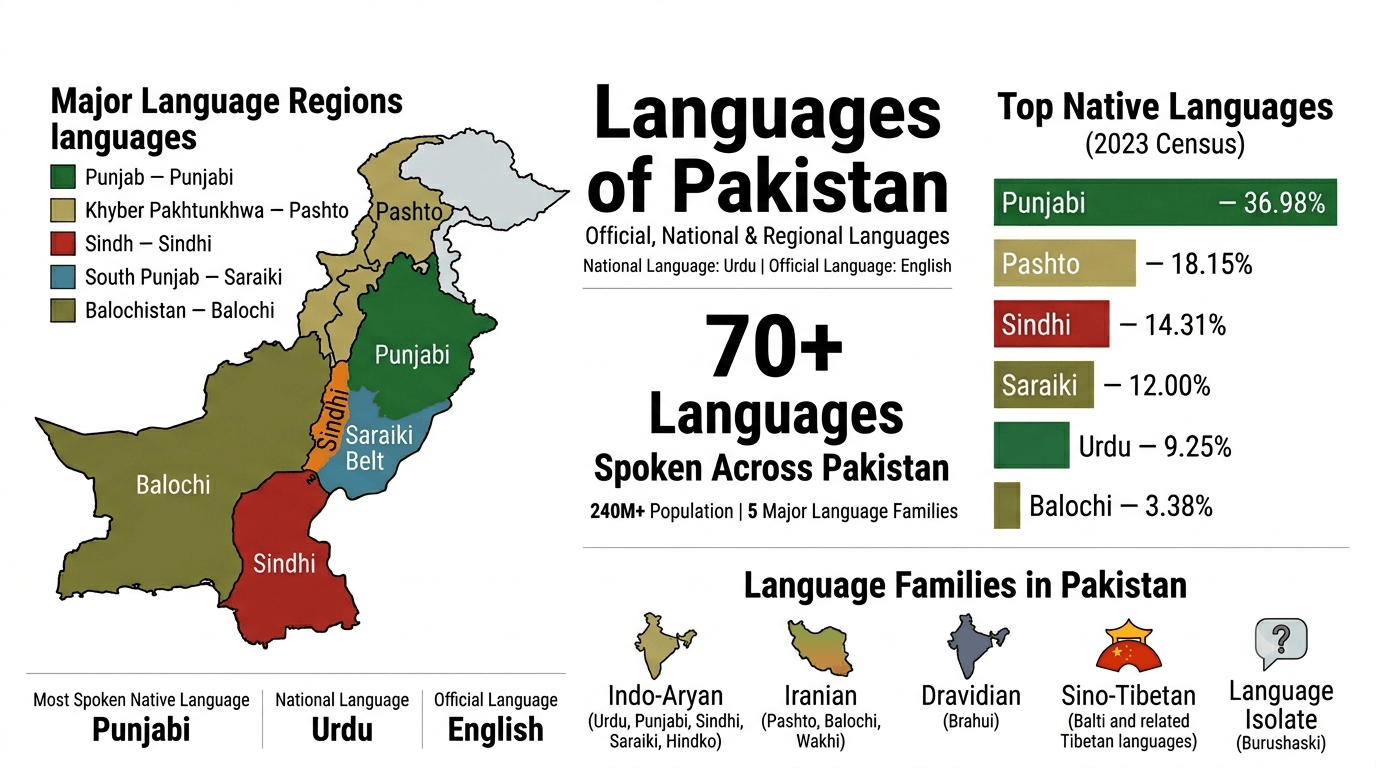
Pakistan is one of the most linguistically diverse countries in the world. Depending on the methodology used, between 70 and 80 distinct languages are spoken across its territory as first languages a number that places Pakistan in the top tier globally for linguistic richness relative to its geography.
According to the 2022 edition of Ethnologue, Pakistan has 80 established languages, of which 68 are indigenous and 12 are non-indigenous. Of the indigenous languages, 4 are classified as institutional, 24 as developing, 30 as vigorous, 15 as in trouble, and 4 as dying.
The 2023 Pakistani Census the most recent and comprehensive national count recorded 14 major languages spoken as mother tongues, with approximately 60 additional local languages having fewer than a million speakers each. Notably, the census data excludes Gilgit-Baltistan and Azad Kashmir, meaning languages like Shina and Balti may be underrepresented in official figures.
This linguistic complexity is not accidental. Pakistan sits at the crossroads of Central Asia, South Asia, and the Middle East a region that has seen waves of migration, empire-building, and trade for millennia. The result is a country where a Pashtun taxi driver in Karachi, a Baloch farmer in Turbat, a Punjabi shopkeeper in Lahore, and a Sindhi fisherman on the coast of the Arabian Sea all call different tongues their mother language.

Official vs. National Language: Understanding the Difference
A common point of confusion even among Pakistanis is the distinction between Pakistan’s national language and its official language. They are not the same.
Urdu is the national language (قومی زبان) of Pakistan, designated as a symbol of national identity and serving as the country’s primary lingua franca for inter-ethnic communication.
English is the co-official language, used alongside Urdu in the executive, legislative, and judicial branches of government, higher education, law, and the formal business sector.
This dual-language arrangement reflects a foundational tension in Pakistan’s post-independence history: the need for a unifying national identity on the one hand, and the practical weight of inherited colonial infrastructure on the other. The Constitution of Pakistan recognizes both, and neither has fully displaced the other in the seven-plus decades since independence.
Quick Answer: Pakistan has two official languages Urdu (national language) and English (co-official language) alongside over 70 regional and minority languages.

Urdu: The National Language and Lingua Franca
Origin and History
Urdu’s name derives from the Turkic phrase Zaban-e-Urdu, meaning “the language of the camp” a reference to the multilingual military camps of the Mughal Empire where speakers of Persian, Arabic, Turkish, and various Indian vernaculars intermingled. The word urdu itself is cognate with the English word “horde” and the Italian orda, all tracing back to the same Turkic root.
The language crystallized as a literary and administrative medium during the later Mughal period, drawing its grammar primarily from Khari Boli (a dialect of Western Hindi), while absorbing enormous vocabulary from Persian, Arabic, and to a lesser extent Chagatai Turkish. By the 18th and 19th centuries, it had become the prestige lingua franca of educated Muslims across northern and northwestern British India.
Why Was Urdu Chosen as Pakistan’s National Language?
When Pakistan was created in 1947, its founders faced an immediate and politically charged question: which language would unite the new nation?
The choice of Urdu was deliberate and ideological. Several factors drove the decision:
- Neutrality across provinces. Urdu was not the native tongue of any single dominant ethnic group in Pakistan, unlike Punjabi (spoken by the largest population) or Sindhi (the language of the region with the oldest continuous civilization). Choosing it avoided privileging one ethnicity over others.
- Muslim cultural identity. Urdu had long been associated with Muslim literary and religious life in South Asia, using the Perso-Arabic script and carrying extensive vocabulary from Islamic civilization.
- The role of the Muhajir elite. The founding political leadership, including Muhammad Ali Jinnah and many senior administrators, came predominantly from the Muslim educated elite of northern India communities for whom Urdu was the natural language of culture and public life.
- Lingua franca precedent. Urdu already served as a bridge language among Muslims across regions that would become Pakistan.
The decision was not without controversy. East Pakistan modern-day Bangladesh erupted in protest in 1952 when the government declared Urdu the sole national language, dismissing Bangla despite its vastly larger speaker base in that wing. The Language Movement (Bhasha Andolan) and the events of 21 February 1952 are now recognized internationally as International Mother Language Day, a UNESCO-designated observance.
Urdu by the Numbers
Despite its status, Urdu is not the most widely spoken first language in Pakistan. According to the 2023 census, only about 9.25% of Pakistanis report Urdu as their mother tongue a figure that has actually risen from around 7% in earlier censuses, likely due to urbanization and the growth of Muhajir communities in Karachi, Hyderabad, and other cities.
What makes Urdu indispensable is its role as a second language: it is widely spoken and understood across virtually all provinces and communities. Compulsory Urdu education through higher secondary school has produced generations of second-language Urdu speakers, and it remains the undisputed medium of national broadcasting, film (Lollywood), popular music, and inter-provincial communication.
Urdu’s Relationship with Hindi
Urdu and Hindi share almost identical grammatical structures and a common spoken base. In casual conversation, they are mutually intelligible to a high degree. The main divergences lie in formal vocabulary Urdu draws heavily from Persian and Arabic, while Hindi favors Sanskrit-derived terms and in writing system: Urdu uses the Nastaliq style of the Perso-Arabic script (written right to left), while Hindi uses Devanagari (written left to right).
This overlap explains why some international sources describe them as registers of the same language (Hindustani), a characterization that carries significant political sensitivity in both countries.
Allama Iqbal and Urdu
No discussion of Urdu in Pakistan is complete without acknowledging the poet-philosopher Allama Muhammad Iqbal, whose Urdu and Persian verse helped galvanize the Muslim identity that underpinned Pakistan’s creation. Iqbal’s Urdu poetry spiritual, philosophical, politically charged gave the language a sacred dimension in Pakistan’s national consciousness. He viewed Urdu not merely as a communication tool but as a vessel of Islamic civilization in South Asia.
English: The Co-Official Language
English arrived in the region through British colonial rule and was formally entrenched in administration, law, and elite education over roughly two centuries. When Pakistan was created, English was retained not as a permanent solution but as a transitional language a placeholder while Urdu was developed and standardized for official use.
That transition never fully happened. English today remains deeply embedded in:
- The written text of Pakistan’s Constitution and most federal legislation
- Superior court proceedings
- Higher education, particularly in science, technology, engineering, and medicine
- Corporate and international business communication
- Pakistan’s diplomatic corps and military officer training
English also functions as a marker of social status. Fluency in English signals access to elite education and urban professional networks. This dynamic sometimes called the “English premium” in Pakistani labor markets has made English acquisition both a practical goal and a social aspiration for millions of Pakistanis.
In 2015, the government announced plans to make Urdu the primary medium of official business, with English as a secondary bilingual option. Implementation has been slow and incomplete, and English continues to dominate in formal government output.

The Major Regional Languages of Pakistan
Punjabi
Punjabi is the most widely spoken first language in Pakistan. According to the 2023 census, it is the mother tongue of 36.98% of the population (around 89 million people), making it the country’s largest native language by a substantial margin.
Despite this numerical dominance, Punjabi has historically received limited official recognition. It is not a compulsory subject in schools, has no official provincial-language status in Punjab (where Urdu and English dominate formal education), and has struggled to gain traction as a language of administration or media. This stands in notable contrast to Punjabi’s status in Indian Punjab, where it holds official language status.
Punjabi is linguistically distinctive within the Indo-Aryan family for its use of lexical tone a feature rare among its relatives, more characteristic of East and Southeast Asian language families. It is written in the Shahmukhi script (a variant of the Urdu alphabet) in Pakistan, and in Gurmukhi in Indian Punjab.
The language has a rich oral tradition, including the classical love epics of Heer Ranjha (Waris Shah) and Sohni Mahinwal, and remains the dominant language of popular culture and domestic life for tens of millions of Pakistanis who switch to Urdu or English in formal settings.
Pashto
Pashto is spoken as a first language by approximately 18.15% of Pakistan’s population, primarily in Khyber Pakhtunkhwa province, northern Balochistan, and large urban Pashtun diaspora communities most notably Karachi, which by some estimates hosts the world’s largest urban Pashtun population.
Pashto belongs to the Iranian branch of the Indo-European family, making it linguistically closer to Persian and Balochi than to Urdu or Punjabi. It exists in three major dialect clusters: Northern (Pakhto, centered around Peshawar), Southern (around Quetta), and Central. The language has a literary tradition stretching back centuries and a strong oral poetic culture.
Pashto extends across the Pakistan-Afghanistan border it is one of Afghanistan’s two official languages creating a cross-border linguistic community of an estimated 60 million speakers in total. This shared language has significant implications for regional politics, migration, and cultural exchange.
Sindhi
Sindhi is spoken by approximately 14.31% of Pakistan’s population, predominantly in Sindh province. Its name derives from Sindhu, the Sanskrit name for the Indus River a reminder that Sindh was home to one of the world’s earliest urban civilizations, the Indus Valley Civilization.
As a language, Sindhi has undergone the full arc of Old Indo-Aryan (Sanskrit), Middle Indo-Aryan (Prakrits and Apabhramsha), and New Indo-Aryan development, entering its modern phase around the 10th century CE. It uses a modified Arabic script with 52 letters more than Urdu’s 38 to accommodate sounds specific to the language.
Sindhi has six major dialects: Siroli, Vicholi, Lari, Thari, Lasi, and Kutchi. It holds provincial official status in Sindh and is used as a medium of instruction in Sindh’s primary schools, making it one of the few regional languages with a meaningful foothold in formal education.
Saraiki
Saraiki occupies a fascinating middle ground in Pakistani linguistics. It is spoken by approximately 12% of the population around 30 million people primarily in southern Punjab, southern Khyber Pakhtunkhwa, and border areas of Sindh and Balochistan.
Until the 1981 census, Saraiki speakers were classified under Punjabi, and the two languages do share significant vocabulary and morphology. Where they diverge sharply is in phonology: Saraiki has distinct implosive consonants and a different prosodic structure that make it feel quite different to the ear. Linguists today generally treat it as a distinct language within the Lahnda group of Indo-Aryan languages.
The Saraiki-speaking belt sometimes called the Saraiki Wasaib has generated recurring political movements for a separate Saraiki province, arguing that its cultural and linguistic distinctiveness warrants administrative recognition currently denied to it.
Balochi
Balochi is the dominant language of Balochistan, Pakistan’s largest province by area, though it is spoken as a first language by only about 3.38% of Pakistan’s national population. This low percentage relative to Balochistan’s size reflects both the province’s sparse population density and the presence of Brahui, Pashto, and other languages within its borders.
Balochi is an Iranian language, related to Persian and Pashto, and exists in three main dialect groups: Eastern (Sulaimani), Western (Rakhshani), and Southern (Makrani). The language has a strong oral tradition of epic poetry and tribal storytelling. Written Balochi uses the Perso-Arabic script.
Hindko
Hindko is an Indo-Aryan language of the Lahnda group spoken in scattered areas of Khyber Pakhtunkhwa and Punjab particularly in Hazara, Peshawar, Abbottabad, and parts of Attock. It accounts for approximately 2.32% of Pakistan’s population.
The name Hindko likely originally meant “the Indian language,” distinguishing it from the surrounding Pashto. It is mutually intelligible with both Punjabi and Saraiki to varying degrees, and like Saraiki, was long grouped with Punjabi in census data.
Brahui
Brahui is linguistically one of the most remarkable languages in Pakistan and indeed in the world. It is a Dravidian language, belonging to the same family as Tamil, Telugu, and Kannada, spoken in the middle of a sea of Indo-Iranian languages in central Balochistan. How a Dravidian language came to be spoken in Balochistan has been debated for generations.
Two main theories exist: either Brahui represents a remnant of a once-broader Dravidian presence in South Asia before Indo-Aryan expansion, or it was brought to the region by relatively recent migration from the Indian subcontinent. The former hypothesis was long favored; the latter has gained traction in more recent scholarship based on comparative linguistic analysis. [CITATION NEEDED]
Brahui is spoken by approximately 1.16% of Pakistan’s population, mainly in the Kalat, Khuzdar, Mastung, Nushki, and Surab districts of Balochistan. Its vocabulary has been heavily influenced by neighboring Balochi. It is classified as Vulnerable on the UNESCO language endangerment scale.

Languages by Province: Who Speaks What, Where
| Province / Territory | Dominant Language | Other Significant Languages |
|---|---|---|
| Punjab | Punjabi (36.98% nationally) | Saraiki, Urdu, Hindko |
| Sindh | Sindhi (14.31%) | Urdu, Balochi, Punjabi |
| Khyber Pakhtunkhwa | Pashto (18.15%) | Hindko, Saraiki, Urdu |
| Balochistan | Balochi (3.38%) | Pashto, Brahui, Saraiki |
| Islamabad Capital Territory | Urdu / Punjabi | Pashto, Hindko |
| Gilgit-Baltistan* | Shina, Balti, Khowar, Wakhi | Burushaski, Urdu |
| Azad Kashmir* | Pahari-Pothwari, Gujari | Kashmiri, Urdu |
*Gilgit-Baltistan and Azad Kashmir were excluded from the 2023 census language data.

Language Families of Pakistan
The majority of Pakistan’s languages belong to the Indo-Iranian branch of the Indo-European family, itself split into two sub-branches:
Indo-Aryan languages dominate the eastern half of the country and include Punjabi, Urdu, Sindhi, Saraiki, Hindko, Pahari-Pothwari, Gujari, Kashmiri, Shina, and dozens of smaller languages. Modern Indo-Aryan languages descend from Old Indo-Aryan (Vedic Sanskrit) through the Middle Indo-Aryan Prakrits.
Iranian languages are predominant in the western regions and include Pashto, Balochi (in its three variants), Wakhi, and several smaller languages. Pashto and Balochi are the largest members of this group.
Beyond Indo-Iranian, Pakistan has several linguistically exceptional languages:
- Brahui — the sole Dravidian language in Pakistan, an outlier in the linguistic geography of the entire subcontinent.
- Burushaski — a language isolate spoken in Hunza, Nagar, Yasin, and Ishkoman valleys in Gilgit-Baltistan. It has no demonstrated genetic relationship to any other known language family, making it one of the world’s most intriguing linguistic mysteries.
- Balti — a Tibetan language of the Sino-Tibetan family, spoken in southern Gilgit-Baltistan. Its speakers are largely Muslims, unlike most Tibetan-language communities.
- Kyrgyz — a Turkic language spoken by a small Pamir Kyrgyz community in Broghil and Gojal.
This diversity of language families Indo-European (including both Indo-Aryan and Iranian), Dravidian, Sino-Tibetan, Turkic, and at least one isolate makes Pakistan’s linguistic landscape genuinely unusual even by global standards.

Writing Systems Used in Pakistan
The dominant writing system in Pakistan is the Perso-Arabic script, used for Urdu, Punjabi (Shahmukhi variant), Sindhi (with extended characters), Balochi, and Pashto. The specific calligraphic style most associated with Urdu is Nastaliq (Nastaʿlīq), a flowing, right-to-left script of remarkable elegance that developed in Persia and was adopted across Mughal South Asia.
Key features of writing systems in Pakistan:
- Urdu alphabet: 38 letters, a modification of the Persian alphabet (itself derived from Arabic), written in Nastaliq style. Right to left.
- Sindhi script: 52 letters 18 additional characters beyond standard Urdu accommodate sounds specific to Sindhi and neighboring Indo-Aryan languages. Uses Naskh style rather than Nastaliq.
- Punjabi (Shahmukhi): Essentially the Urdu alphabet applied to Punjabi phonology.
- Burushaski: Has no indigenous script; uses the Urdu/Perso-Arabic script today.
Roman Urdu — Urdu written in the Latin alphabet has grown substantially in the smartphone era, used widely in text messaging, social media, and informal digital communication. This has prompted concerns among Urdu language advocates about the erosion of Nastaliq literacy among younger Pakistanis.

Endangered and Minority Languages
Among Pakistan’s 80 languages, at least 19 are classified as endangered by Ethnologue, and UNESCO’s Atlas of the World’s Languages in Danger identifies a number at various levels of risk.
Some notable cases:
Badeshi (Khyber Pakhtunkhwa) was documented as having only three known speakers remaining as of 2018 a language on the very edge of extinction.
Burushaski, despite being a language isolate of exceptional scientific interest, is classified as Vulnerable, with its speaker base concentrated in remote Gilgit-Baltistan valleys. Efforts to document it have gained urgency in the linguistics community.
Torwali (Swat valley, KP) is classified as Definitely Endangered, with only an estimated 80,000–100,000 speakers. The Idara Baraye Taleem-o-Taraqi organization has worked to develop Torwali literacy materials, a notable grassroots preservation effort. [CITATION NEEDED]
Kalasha, the language of the Kalash people of Chitral one of the last non-Muslim communities in Pakistan is Severely Endangered. The Kalash cultural and linguistic community has attracted international attention for both its distinctiveness and its vulnerability.
Wakhi, spoken across a thin strip of territory extending through Pakistan, Afghanistan, Tajikistan, and China, is Definitely Endangered in the Pakistani context despite its transnational spread.
The drivers of language endangerment in Pakistan follow global patterns: migration to cities (where Urdu dominates), declining economic viability of rural livelihoods tied to minority communities, lack of educational materials in minority languages, and the social prestige attached to Urdu and English. Without active intervention literacy programs, media development, school curricula the loss of several of Pakistan’s smaller languages in the coming generations is a real prospect.
Language Policy: History, Politics, and Ongoing Debates
The Colonial Inheritance
When the British colonized the subcontinent, they systematically replaced Persian which had been the administrative and court language of the Mughal Empire and earlier sultanates with English and local vernaculars. Persian was abolished in Sindh in 1843 and in Punjab in 1849, marking the end of a centuries-long era in which Persian served as the high-culture language of South Asian Muslim civilization.
This displacement has had lasting consequences. Many educated Pakistanis still study Persian in religious schools (madrassas) and literary circles, and Persian influence saturates Urdu vocabulary, poetry, and cultural aesthetics.
The 1973 Constitution and Language Articles
Pakistan’s Constitution of 1973 addresses language in several places. Most significantly, it designates Urdu as the national language in Article 251 and mandates that its use in official proceedings be promoted, with a 15-year implementation window that was never fully realized. English remains the default language of legislation and court proceedings in practice.
The Constitution also protects the right of provincial governments to prescribe instruction in regional languages a provision that has been inconsistently exercised.
The Urdu Debate
Few topics generate more heated discussion among Pakistani intellectuals and educators than the question of Urdu’s role. Critics argue that promoting Urdu at the expense of regional languages has:
- Alienated ethnic minorities from state institutions
- Created educational disadvantages for children whose home languages are not Urdu
- Contributed to the political grievances that have fueled separatist movements, most tragically in former East Pakistan
Defenders respond that Urdu remains the only practical vehicle for national unity across Pakistan’s deep linguistic divides, and that its displacement would fragment public discourse.
The question of whether English should replace or supplement Urdu as the official language a position taken seriously in some professional and policy circles adds another layer of complexity. Proponents argue that English access is essential for economic mobility in a globalized world; opponents counter that making English the official language would deepen class divides and alienate the majority of Pakistanis from their own governance.
Provincial Language Rights
Each of Pakistan’s major provinces has its own linguistic dynamics:
- Sindh has been the most assertive in promoting its regional language: Sindhi is an official provincial language and a medium of primary education.
- Khyber Pakhtunkhwa has promoted Pashto to some extent, and there are ongoing efforts to expand Pashto in education and government.
- Punjab despite being home to Pakistan’s largest linguistic group has historically underinvested in Punjabi-medium education, a situation some Punjabi language advocates call paradoxical.
- Balochistan has linguistic complexity compounded by political tension, with Balochi, Pashto, Brahui, and other languages all present.
Can Punjabi Become the National Language?
It is occasionally raised: given that Punjabi is spoken by more Pakistanis than any other language, why is it not the national language?
The answer is primarily political. Making Punjabi the national language would be perceived as institutionalizing Punjabi ethnic dominance a particularly sensitive issue given Pakistan’s history with provincial autonomy and the memory of East Pakistan. Urdu’s advantage, from a unification perspective, is precisely that no dominant group owns it as a mother tongue. Whether that logic will hold indefinitely as Pakistani society evolves is an open question.
The Role of Persian, Arabic, and Other Languages
Arabic
Arabic occupies a unique position in Pakistani society it is widely studied, extensively heard, and almost universally understood in its recited Quranic form, but rarely spoken in everyday conversation. The vast majority of Pakistan’s Muslim population has received some formal or informal education in Arabic through religious instruction at mosques, schools, and madrassas.
Pakistan’s Constitution mandates Arabic instruction as part of Islamiyat (Islamic studies) from middle school to higher secondary level. Arabic grammar and literature are also offered as elective subjects. The language’s role is devotional and educational rather than communicative in a vernacular sense.
Persian
Persian (Farsi) has a historical depth in the region that predates Pakistan’s existence by over a millennium. As the court language of the Mughal Empire and the Delhi Sultanate before it, Persian was the prestige language of Muslim civilization in South Asia for centuries, and its influence permeates Urdu in vocabulary, poetic forms, and literary aesthetics.
Today, Persian as a spoken language survives in Pakistan primarily among Afghan refugees and small Hazara communities in Balochistan who speak Dari (the Afghan dialect of Persian) and Hazaragi respectively. In Chitral’s Madaklasht valley, a small community of descendants from Badakhshani settlers speaks a Tajik Persian dialect a linguistic island with centuries of history.
Mandarin
As Pakistan-China relations have deepened through the China-Pakistan Economic Corridor (CPEC), Mandarin has become an increasingly studied language, particularly among professionals, engineers, and businesspeople seeking to engage with Chinese infrastructure investment and trade. This trend is likely to continue as economic integration advances. [CITATION NEEDED]
Pakistan’s Linguistic Landscape Compared to Neighbors
| Country | Official Languages | Major Regional Languages | Approx. Total Languages |
|---|---|---|---|
| Pakistan | Urdu, English | Punjabi, Pashto, Sindhi, Saraiki, Balochi | 70–80 |
| India | Hindi, English (+ 22 scheduled) | Bengali, Telugu, Tamil, Marathi, etc. | 450+ |
| Afghanistan | Dari, Pashto | Uzbek, Turkmen, Hazaragi | 40+ |
| Iran | Persian | Azerbaijani, Kurdish, Arabic, Balochi | 70+ |
| Bangladesh | Bengali | Chittagong Hill Tracts languages | 40+ |
Pakistan’s position is distinctive: fewer total languages than India, but a far more complex official-versus-national language dynamic than most of its neighbors, and a greater proportion of speakers whose daily language differs from both official languages.
Frequently Asked Questions About Languages of Pakistan
What is the official language of Pakistan?
Pakistan has two official languages: Urdu, which is designated as the national language, and English, which serves as the co-official language used in government, law, higher education, and formal business.
What is the most spoken language in Pakistan?
Punjabi is the most widely spoken first language in Pakistan, with approximately 36.98% of the population reporting it as their mother tongue according to the 2023 census. However, Urdu is the most widely understood language across the country as a second language.
How many languages are spoken in Pakistan?
Between 70 and 80 languages are spoken in Pakistan as first languages. Ethnologue (2022) lists 80 established languages; the 2023 census recorded 14 with more than a million speakers, with approximately 60 additional smaller languages.
Why is Urdu the national language of Pakistan if so few people speak it natively?
Urdu was chosen in 1947 as a politically neutral lingua franca that could unite Pakistan’s diverse ethnic groups without privileging any single dominant community. Its association with Muslim cultural identity and its existing role as a bridge language among educated Muslims across northern India also contributed to the choice.
When did Urdu become the national language of Pakistan?
Urdu was designated as Pakistan’s national language at independence in 1947. The 1973 Constitution formally enshrined this status in Article 251.
Is English widely spoken in Pakistan?
English is used extensively in formal and professional contexts government, law, higher education, corporate business but it is not widely spoken in everyday life by the general population. It serves as a prestige language and marker of elite education in urban Pakistan.
What language is spoken in Peshawar?
Pashto is the dominant language of Peshawar and Khyber Pakhtunkhwa province broadly, alongside Hindko in certain communities and Urdu in formal/educational settings.
What is the oldest language in Pakistan?
Sindhi has one of the longest documented linguistic histories in Pakistan, traceable through Sanskrit and Prakrit to its modern form. Brahui’s Dravidian origins may represent even older linguistic continuity in the region, though this remains debated among linguists. Burushaski, the language isolate of Gilgit-Baltistan, may also have ancient roots with no known relatives.
Is Urdu a Persian language?
No. Urdu is an Indo-Aryan language its grammar and basic structure are derived from Khari Boli, a dialect of Hindi. However, a very large proportion of its formal vocabulary is borrowed from Persian and Arabic, giving it a Persian-influenced feel, especially in literary and formal registers.
Who founded the Urdu language?
Urdu did not have a single founder. It evolved organically from linguistic contact between speakers of local Indian dialects, Persian, Arabic, and Turkic in the urban and military environments of medieval and early modern India, gradually crystallizing as a distinct literary and administrative language during the Mughal period. Poets like Mir Taqi Mir, Mirza Ghalib, and scholars associated with Delhi and Lucknow shaped its classical literary form.
What is the language of Pakistan’s national anthem?
Pakistan’s national anthem, Qaumi Tarana, is written almost entirely in Persian, with only one word of Urdu ka (of). This makes it unusual among national anthems: a country whose national language is Urdu chose to write its anthem in the classical prestige language that preceded it.
Are there sign languages in Pakistan?
Yes. Pakistan Sign Language (PSL) is the principal sign language used by Deaf communities in Pakistan and is listed as an established language by Ethnologue. It belongs to the Indo-Pakistani Sign Language family.


