
Table of Contents
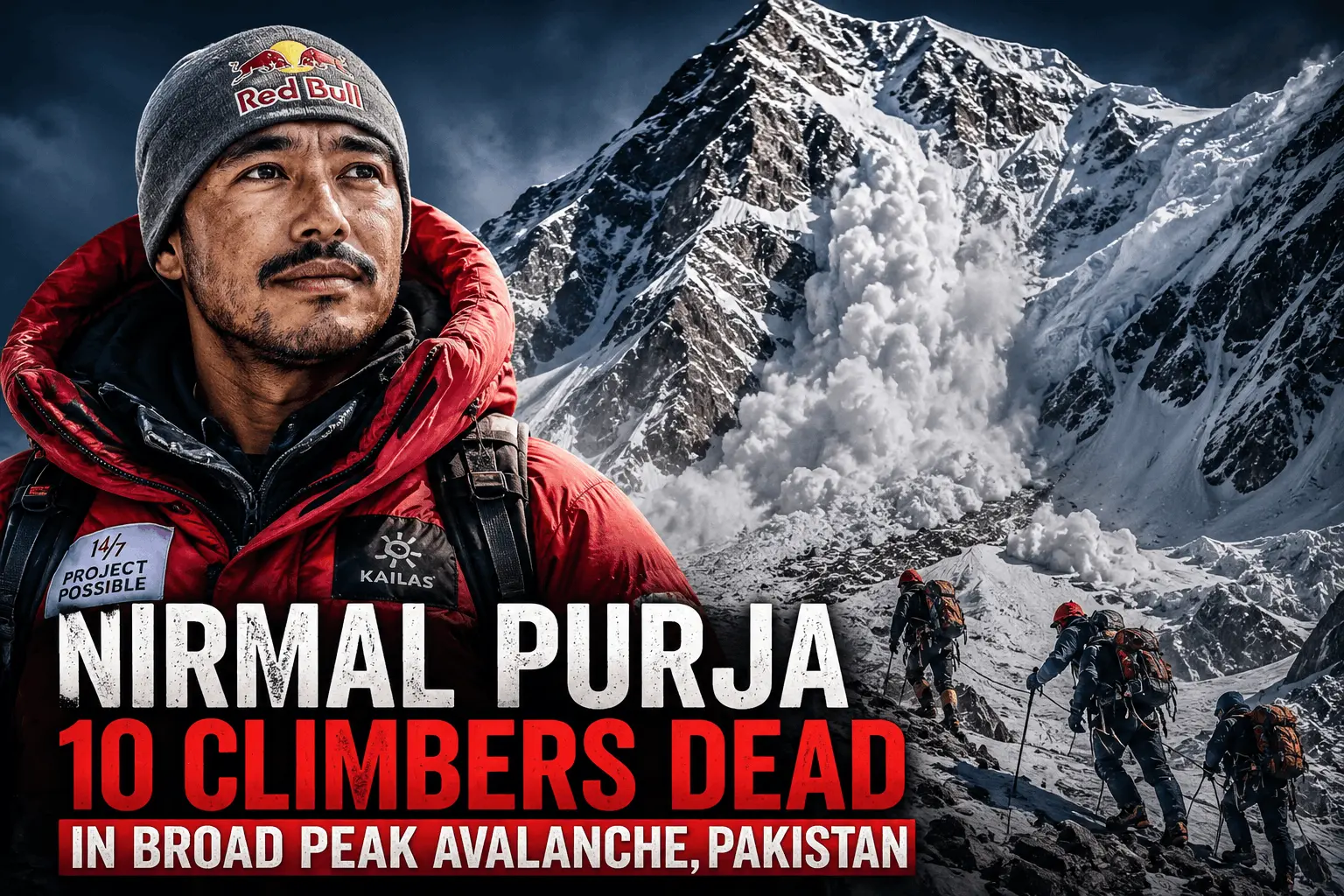
Nirmal “Nims” Purja died on July 30, 2026, after an avalanche struck his ten-member expedition on Broad Peak in Pakistan’s Karakoram range. All ten climbers, representing four separate expedition teams, were confirmed dead by August 1. Recovery efforts continued for days afterward, hampered by extreme altitude, unstable terrain, and repeated fresh avalanche activity.
This was not a single climbing accident involving one team. It was four expeditions Elite Exped, Seven Summit Treks, Imagine Nepal, and Moving Mountains caught by the same slide on the same stretch of mountain within the same few minutes. Below is what happened, who the ten climbers were, and what followed.
What Happened to Nirmal Purja on Broad Peak?
Purja was climbing Broad Peak, an 8,047-metre mountain in Pakistan-administered Gilgit-Baltistan, when a large avalanche hit the route between Camp II and Camp III at roughly 9 a.m. local time on July 30. His GPS tracker had last registered movement near 6,660 metres, the highest point recorded among the group that morning.

Communication with the entire ten-person team was lost within minutes of the slide. Search and rescue teams spent the following days working to locate trackers, deploy drones, and physically reach climbers scattered across a dangerous stretch of the mountain’s west-facing gully. Purja’s body was located on August 2 by a joint Nepali-Pakistani recovery team at around 5,700 metres, and the Alpine Club of Pakistan (ACP) formally confirmed the recovery of his remains on August 5.
The Broad Peak Avalanche: A Timeline
Reconstructing the event day by day explains both what happened and why the response took so long.
July 22–26: Heavy snowfall settled across the Karakoram in the days before the summit push a detail that later became relevant to discussions of slope stability, though no official cause has been confirmed.
July 28: The combined ten-climber group left Broad Peak Base Camp for the summit push.
July 29: The team advanced toward Camp II.
July 30, morning: GPS data placed the group at Camp II around 5:30 a.m., moving upward by 7:30 a.m. By approximately 9 a.m., an avalanche struck the route between Camp II and Camp III. A climber on a separate expedition on nearby K2 reportedly saw the slide descend Broad Peak’s slopes and tried unsuccessfully to raise the team on radio.
July 31: The Alpine Club of Pakistan declared all ten missing. Early reports of four recovered bodies were later revised; the club attributed the discrepancy to a communication error, and the confirmed figure that day was two bodies and a body part.
August 1: Purja’s expedition company confirmed that all ten team members had died. Search operations continued.
August 2–5: Ground teams reached higher, more dangerous sections of the mountain. Purja’s remains were recovered on August 2 and the recovery was officially confirmed on August 5.
August 8: Five bodies of foreign climbers were flown from Skardu to Islamabad for repatriation, according to Pakistani press reporting.
Who Were the 10 Climbers Who Died on Broad Peak?
The victims came from six countries and represented four different expedition operators a structure that is easy to miss if you only follow the headlines about Purja.

| Climber | Country | Team | Background |
|---|---|---|---|
| Nirmal Purja | Nepal/UK | Elite Exped | Expedition leader; held the record for climbing all 14 eight-thousanders in 189 days |
| Pur Bahadur Gurung (“Yukta”) | Nepal | Elite Exped | Guide; 10 Everest summits, 12 eight-thousanders, 28 total 8,000m ascents |
| Kili Pemba Sherpa (“Kilu”) | Nepal | Imagine Nepal | Guide; completed all 14 eight-thousanders on Nanga Parbat weeks earlier; member of the 2021 K2 winter ascent team |
| Nima Sherpa | Nepal | Elite Exped | High-altitude team member with Elite Exped |
| Gyaljen “Gyalu” Sherpa | Nepal | Seven Summit Treks | Guide; set a Guinness World Record by summiting Kangchenjunga three times in one season |
| Nawang Thindu Sherpa | Nepal | Seven Summit Treks | The expedition’s youngest member at 28, with five eight-thousander ascents already completed |
| Nadhira Al Harthy | Oman | Seven Summit Treks | The first Omani woman to summit Mount Everest, pursuing her own 14-peaks goal |
| Wang Zhong | China | Imagine Nepal | Cybersecurity entrepreneur; had climbed 12 of the 14 eight-thousanders |
| Sohail Sakhi | Pakistan | Moving Mountains | Hunza-based guide and rope-fixer with ascents of K2, Nanga Parbat, and Kangchenjunga |
| Mallory Geis | USA | Moving Mountains | American climber on her first 8,000-metre attempt |
The Four Expeditions
Understanding the team structure matters because it explains how ten strangers-turned-colleagues ended up on the same slope at the same moment.
- Elite Exped: Nirmal Purja, Pur Bahadur Gurung, Nima Sherpa
- Seven Summit Treks: Nadhira Al Harthy, Gyalu Sherpa, Nawang Thindu Sherpa
- Imagine Nepal: Wang Zhong, Kili Pemba Sherpa
- Moving Mountains: Sohail Sakhi, Mallory Geis
Each was a distinct commercial expedition with its own guides, clients, and permits, but weather and route conditions had funnelled all four onto the same summit-push window.
The Stories Behind the Names
Nirmal Purja was the internationally famous face of the group, but the other nine were far from anonymous support staff. Several were quietly among the most accomplished climbers of their generation.
Wang Zhong had spent over a decade climbing without publicising it on social media. A Shanghai Jiao Tong University-trained engineer who co-founded the cybersecurity firm Hillstone Networks, he had summited 12 of the 14 eight-thousanders by mid-2026. Broad Peak was meant to be his thirteenth; only Shishapangma remained on his list.
Nadhira Al Harthy became the first Omani woman to summit Everest in 2019 and had gone on to climb Manaslu, K2, and Nanga Parbat. Broad Peak was part of her own attempt at the full 14-peaks project, following an unsuccessful bid on Gasherbrum II earlier in the season.
Sohail Sakhi, from Aliabad in Hunza, had climbed K2, Nanga Parbat, Gasherbrum I and II, Manaslu, and Kangchenjunga, several without supplemental oxygen. He had recently left a long-time guiding role to start his own expedition company, and Broad Peak was reportedly intended as his final 8,000-metre climb inside Pakistan.
Kili Pemba Sherpa had completed his own 14-eight-thousander journey on Nanga Parbat just weeks before Broad Peak, joining a small group of climbers worldwide to have stood on every peak above 8,000 metres. He had also been part of the historic 2021 K2 winter ascent team.
Pur Bahadur Gurung, known as Yukta, was Purja’s longtime climbing partner. By mid-2026 he had ten Everest summits, twelve eight-thousanders, and 28 total ascents above 8,000 metres to his name, along with a freshly completed IFMGA mountain guide certification.
Gyalu Sherpa had set a Guinness World Record earlier in 2025 by summiting Kangchenjunga three times in a single season. His Broad Peak attempt was, in fact, his second of the season roughly ten days earlier he had guided an American client to within a few hundred feet of the summit.
Nawang Thindu Sherpa, at 28, was the youngest of the group, already carrying five eight-thousander ascents on his résumé, including Everest, Lhotse, Manaslu, Kangchenjunga, and Makalu.
Mallory Geis, from San Antonio, Texas, had recently closed her Pilates studio to pursue mountaineering. Broad Peak was her first attempt at an 8,000-metre peak, undertaken with Sohail Sakhi as her guide.
Nima Sherpa had less public documentation than his teammates, but was an experienced member of the Elite Exped team climbing alongside Purja and Gurung.
How Did Nirmal Purja Die?
Purja died after being caught in an avalanche that struck his team’s route on Broad Peak on July 30, 2026, at roughly 6,600 metres, between Camp II and Camp III. That is the confirmed account from the Alpine Club of Pakistan and his climbing company. No further medical detail about the cause of death has been officially released, and speculation beyond the avalanche itself is not supported by verified reporting.
Nirmal Purja Body Recovery and the Broad Peak Rescue Operation
Recovering the ten climbers proved to be one of the most technically difficult high-altitude rescue operations in recent memory, and it remains incomplete.
Search efforts relied on a combination of GPS trackers, radio contact attempts, and commercial drones. A drone search eventually located a cluster of bodies near 5,900 metres; one, in a distinctive teal climbing suit, was identified as Purja. Pakistan Army helicopters supported the operation, transporting recovered remains from Broad Peak Base Camp to Skardu, while ground teams including both Pakistani and Nepali climbers carried out the physical recovery in extremely difficult conditions.
As of the most recent detailed reporting, seven of the ten bodies had been recovered, including Purja, Wang Zhong, Nima Sherpa, and Kili Pemba Sherpa. Nawang Thindu Sherpa’s body was located but remained stranded in a highly dangerous, avalanche-prone section of the mountain that rescuers could not safely reach. Sohail Sakhi’s body had not been recovered as of the latest search update; his backpack and GPS tracker were found near the mountain’s base.
A second avalanche struck during the recovery operation, nearly catching two Sherpas who were attempting to reach Nawang Thindu’s body a reminder of how dangerous the retrieval work itself became.
Five bodies of foreign climbers were flown from Skardu to Islamabad on August 8 for repatriation. According to Pakistani press reporting, the remains of three Nepalese climbers were being sent to Nepal, Purja’s body was being sent to the UK, and Wang Zhong’s family was expected in Islamabad to collect his remains. Because the recovery situation continues to change, treat any specific figures here as accurate only as of the date listed above.
What Is Broad Peak and Where Is It Located?
Broad Peak is an 8,047-metre mountain in Pakistan’s Karakoram range, part of the Gilgit-Baltistan region and located a short distance from K2, the world’s second-highest peak. It ranks as the twelfth-highest mountain on Earth and takes its name from its unusually long summit ridge, which stretches roughly two kilometres.

The mountain was first summited in 1957 by an Austrian expedition. It is a popular objective for climbers pursuing the “14 eight-thousanders” challenge precisely because of its proximity to K2 many expeditions attempt both peaks in the same season, often sharing base camp logistics and acclimatisation routes. Its standard route passes through a series of camps before reaching the summit ridge, with the Camp II to Camp III section where the July 30 avalanche struck considered one of its more exposed stretches.
Broad Peak carries a real, if often underestimated, level of risk. As of past data cited in mountaineering research, the mountain has recorded a fatality rate of around five percent among climbers who have attempted it, a figure comparable to several other 8,000-metre peaks in the region.
What Caused the Broad Peak Avalanche?
No official investigation has publicly attributed the avalanche to a specific trigger, and this article will not speculate on one. What can be explained is the general science of why avalanches happen at this kind of altitude, and why the Karakoram in particular is prone to them.
An avalanche occurs when a slope’s snowpack becomes unstable enough that a section releases and slides downhill, often triggered by new snow loading on top of an older, weaker layer, by wind-transported snow accumulating on a lee slope, or by a sudden temperature shift that changes how snow layers bond to each other. High-altitude ranges like the Karakoram see frequent, heavy, and unpredictable snowfall, and steep faces above 6,000 metres rarely get the days of settling time that experts say fresh snow typically needs to stabilise. That combination heavy snowfall in the days before the climb, a steep route, and a compressed weather window is a known recipe for avalanche danger on 8,000-metre peaks generally, though it does not by itself prove what triggered this specific slide.
Why Was the Rescue So Difficult?
Broad Peak sits in one of the most logistically isolated high-altitude environments in the world. There is no reliable cellular coverage on the mountain, satellite communication is expensive and limited, and private helicopters have restricted access to the region. Rescue teams were effectively dependent on GPS trackers and radio contact from the outset.

The terrain compounded the problem. The stretch between Camp II and Camp III sits on steep, avalanche-exposed ground riddled with crevasses, meaning rescuers themselves faced serious danger simply reaching victims a risk that materialised when a second avalanche hit the mountain during recovery efforts. Pakistan’s military provided helicopter support for transport once bodies reached lower, safer ground, but the technical high-altitude recovery work itself had to be done on foot, by climbers, in conditions that repeatedly forced operations to pause.
Who Was Nirmal Purja?
Nirmal Purja, born on July 25, 1983, in Dana, a small village in Nepal’s Myagdi District, was a Nepali-British mountaineer widely regarded as one of the most accomplished high-altitude climbers of his generation. Before turning to mountaineering full time, he served 16 years in the British military first in the Brigade of Gurkhas, then in the Special Boat Service (SBS), becoming the first Gurkha to join that Royal Navy special forces unit.
He resigned from the SBS in 2018 to pursue climbing, giving up a substantial military pension and later remortgaging his family home to help fund what became his defining project.

Project Possible and the 14 Peaks Record
In 2019, Purja set out to climb all 14 of the world’s eight-thousanders mountains above 8,000 metres in under seven months, an objective he called Project Possible 14/7. He completed it in six months and six days, using supplemental oxygen, shattering the previous record by more than seven years. The achievement was documented in the Netflix film 14 Peaks: Nothing Is Impossible, released in 2021.
He did not stop there. In the years that followed, Purja set the record for the fastest ascent of all 14 eight-thousanders without supplemental oxygen, became the first person to summit Everest, Lhotse, and Makalu within 48 hours, and continued adding 8,000-metre summits well into 2026 reaching his 56th such ascent months before the Broad Peak expedition.
The First Winter Ascent of K2
In January 2021, Purja was part of a team of ten Nepali climbers who achieved the first successful winter ascent of K2, ending decades of failed attempts on one of mountaineering’s last great unclimbed winter objectives. He was the only member of that team to summit without supplemental oxygen, making him the first person to do so in winter conditions. Notably, Kili Pemba Sherpa one of the nine other climbers lost on Broad Peak in 2026 was also part of that historic K2 team.
14 Peaks: Nothing Is Impossible
Purja’s 2019 achievement was chronicled in 14 Peaks: Nothing Is Impossible, a Netflix documentary released in late 2021. The film follows Project Possible from its uncertain, underfunded beginning through its record-setting conclusion, and shows the toll the expedition took on Purja’s family, including his wife’s concerns about the risks and tension within his household over the decision to leave a secure military career. The documentary played a significant role in introducing Purja to a global audience beyond the climbing community.
Nirmal Purja’s Family and Personal Life
Purja married Suchi Purja, the daughter of a Gurkha soldier, in 2006. The couple settled in Eastleigh, near Southampton in England, and had one daughter. Suchi appeared alongside her husband in 14 Peaks, which portrayed how his climbing ambitions affected their family life.
Following his death, Prince William, Bear Grylls, and Nepal’s Prime Minister Balen Shah were among those who publicly paid tribute to Purja, describing him as one of the world’s most accomplished mountaineers. His brother Kamal was quoted saying the family would miss him every day a brief, human note in what became a widely covered international story.
Nirmal Purja’s Mountaineering Legacy
Purja’s death, alongside nine other highly accomplished climbers, represents one of the most significant single losses to high-altitude mountaineering in recent memory. Between them, the ten climbers held world records, historic firsts, and decades of combined experience on the world’s highest peaks from Yukta Gurung’s 28 eight-thousand-metre ascents to Nadhira Al Harthy’s Everest pioneering, Wang Zhong’s quiet 12-peak pursuit, and Sohail Sakhi’s rope-fixing work across Pakistan’s biggest mountains.
For Nepal’s mountaineering community especially, the loss carries weight beyond the ten individuals: it removed a concentrated amount of technical guiding expertise and leadership from an industry that depends heavily on relatively few elite high-altitude professionals. Purja’s own legacy turning a late-starting military career into a run of climbing records that redefined what was considered physically possible at extreme altitude will likely remain a reference point in mountaineering for years to come.
Frequently Asked Questions
What happened on Broad Peak on July 30, 2026?
An avalanche struck a ten-member international expedition team at roughly 6,600 metres, between Camp II and Camp III, killing all ten climbers, including Nirmal Purja.
How did Nirmal Purja die?
He died after being caught in the avalanche that hit his team’s route on Broad Peak on July 30, 2026. No further cause has been officially confirmed beyond the avalanche itself.
How many climbers died on Broad Peak in this incident?
All ten members of the combined expedition team died, representing four separate expedition operators: Elite Exped, Seven Summit Treks, Imagine Nepal, and Moving Mountains.
Has Nirmal Purja’s body been recovered?
Yes. His remains were located on August 2, 2026, at around 5,700 metres, and the Alpine Club of Pakistan confirmed the recovery on August 5.
Have all ten bodies been recovered?
As of the most recent detailed reporting, seven of the ten bodies had been recovered. Nawang Thindu Sherpa’s body was located but remained inaccessible in dangerous terrain, and Sohail Sakhi’s body had not been located, though his backpack and GPS tracker were found near the mountain’s base.
How high is Broad Peak and where is it located?
Broad Peak stands at 8,047 metres in Pakistan’s Karakoram range, in the Gilgit-Baltistan region, close to K2. It is the world’s twelfth-highest mountain.
What caused the Broad Peak avalanche?
No official cause has been confirmed. Heavy snowfall in the days before the climb and steep, high-altitude terrain are known general avalanche risk factors in the region, but no specific trigger has been established.
What was Nirmal Purja’s biggest achievement?
His best-known achievement was climbing all 14 of the world’s eight-thousanders in six months and six days in 2019, a record that stood until 2023. He also helped complete the first winter ascent of K2 in 2021.
Was Nirmal Purja a Gurkha?
Yes. He served in the Brigade of Gurkhas before joining the Special Boat Service, becoming the first Gurkha to join that Royal Navy special forces unit.
Who was Nadhira Al Harthy?
She was an Omani mountaineer and the first Omani woman to summit Mount Everest, in 2019. She was pursuing her own attempt at all 14 eight-thousanders when she died on Broad Peak.
Who was Wang Zhong?
A Chinese cybersecurity entrepreneur and mountaineer who had climbed 12 of the 14 eight-thousanders. Broad Peak was intended to be his thirteenth.
Who was Sohail Sakhi?
A Pakistani high-altitude guide and rope-fixer from Hunza who had climbed K2, Nanga Parbat, Gasherbrum I and II, Manaslu, and Kangchenjunga.


This Post Has 2 Comments