
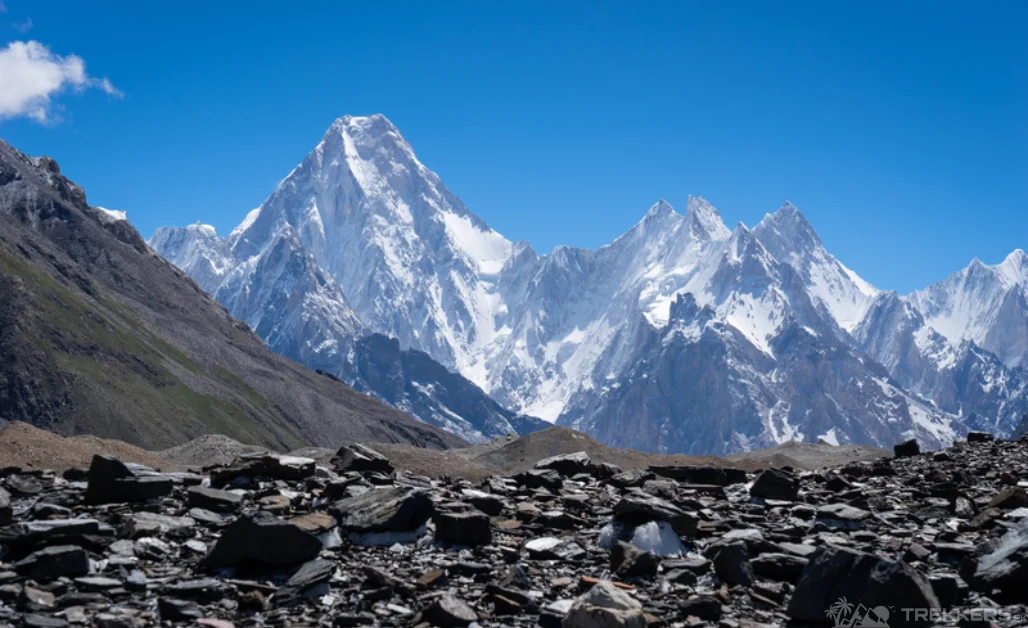
Gasherbrum II, also known as the Beautiful Mountain, is the 13th-highest mountain in the world, standing at an altitude of 8,035 meters. It is part of the Karakoram range (K4) and is located near the Pakistan-China border. Other than being the 13th-highest Peak, Gasherbrum II is the third-highest peak in the Gasherbrum Range. The grand structure of Gasherbrum II encompasses six routes to ascend the mountain.
Out of all the Gasherbrum Mountains, Gasherbrum II is the easiest eight-thousander. Now, that certainly does not mean just anyone can climb the mountain. You still need to have proficient mountaineering skills to be able to reach the top successfully.
Other than being a trained climber and having the essentials, a mountaineer needs to be aware of what they are signing up for. It is integral to know what you might witness and what measures you can take during any inconvenience.
Climbing Routes on Gasherbrum II:
Knowing which route is the most suitable for you is important. Gasherbrum II has six main routes that climbers can choose from while climbing the eight-thousander. It has the usual route (the Southwest Ridge), the West Ridge, the Northwest Ridge, the South Ridge, the East Ridge, and the Northeast Ridge.

All of these routes to the Gasherbrum II Mountain are singular in their way. A mountaineer needs to assess each route to choose what is best for them. Climbers can choose routes based on their preferences, as each route has its own difficulty level.
The Southwest Ridge is the most commonly used for climbing the Gasherbrum II Mountain. Climbers will have to start from Askole Village and then to the beautiful Baltoro Glacier. Despite being the easiest route, the Southwest Ridge of Gasherbrum II still comes with icefalls and unforeseeable weather conditions. Mountaineers still need to possess skills to succeed in climbing the Beautiful Mountain.
After the Southwest Ridge, the West Ridge is the more frequently used route. Harder than the Southwest Ridge, climbers face perilous terrain, steep slopes, and avalanche risks, and the vertical ascent needs exceptional skills. The constant vertical ascent forces climbers to climb a considerable distance before settling down to rest and acclimatize. A lot of notable climbers have climbed the mountain through the West Ridge, proving its reputation.
Located on the Northwest side of Gasherbrum II, the Northwest Ridge is a route known for its grueling ascent. The route can only be conquered by experienced climbers as the trail is full of risks and dangers. However, with sufficient training, conquering the route becomes possible. The South and East Ridge on the respective sides of the Gasherbrum II Mountain are pretty complex to climb. They are harder than the Northwest Ridge, but not as hard as the Northeast Ridge.
Northeast Ridge is the least accessible out of the six main routes. It is notorious for its grueling terrain, and climbers usually tend to avoid this route because of its extreme difficulty. Still, exceptional mountaineers have successfully climbed through this tough route.
While climbing through all of these routes, acclimatization and resting is integral. The campsites near and on the mountain are for this purpose. Climbers endure extended exposure to treacherous weather, requiring them to take breaks from the exhausting journey at camps situated at various elevations.

Campsites:
The base camp of the Gasherbrum II Mountain is at an elevation of approximately 5,100 meters. Climbing from the base camp to Camp 1 (6,000 m) requires efficient skills as the climbers must also pass the Baltoro glacier. From camp 1 to camp 2 (6,500 m), the climb gets a little easier for a while. The ascent gets progressively harder from Camp 2 to Camp 3 (7,400 meters) and then to the Summit of Camp 4 at an elevation of 8,000 meters.
By being aware of the campsites and the routes of the Gasherbrum II Mountain, this journey will go a lot smoother for you. The unpredictability of nature can cause difficulty at any point, so a mountaineer’s journey can be significantly easier by having a reliable strategy and awareness of the routes and what you might be facing.
To read a comprehensive guide on Gasherbrum II, click here.
To learn more about the Gasherbrum Range, check this article out:


This Post Has One Comment