
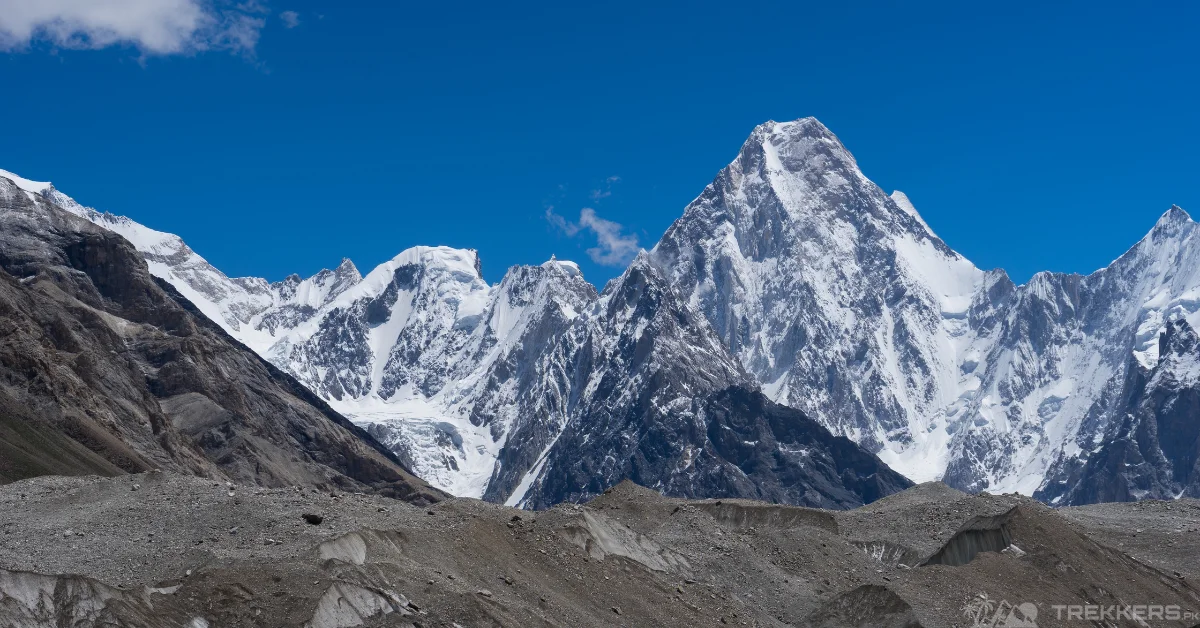
The Gasherbrum Range is the expression collectively used to refer to the four peaks that the Range possesses. It is nestled in the southern side of the central Karakoram range, Gilgit-Baltistan, Pakistan. The Gasherbrum Range has two 7000-meter mountains and two 8000-meter mountains, making it a significant range in the mountaineering world.
British explorers discovered the Gasherbrum Range in the 19th century during the Great Trigonometric Survey of British India. They conducted the survey to accurately map the Indian Subcontinent and the area near it, consisting of the Himalayan and Karakoram ranges.
The word Gasherbrum originated from the Balti language, where “Gasher” means beautiful, and “Brum” means mountain. Thus, the Beautiful Mountain name is accurate for its awe-inspiring beauty.
The four peaks are Gasherbrum I – the Hidden Peak (8,080 m), Gasherbrum II (8,035 m), Gasherbrum III (7,952 m) and Gasherbrum IV (7,925 m). The peaks were numbered based on their heights and the order in which they were surveyed. Gasherbrum I is the eleventh-highest mountain in the world; hence, it is the first in the range.

The mountaineers and explorers started noticing the breathtaking range in the 20th century. It led to various attempts to climb the 7,000-meter-plus summits. In 1958, Nicholas Clinch and his team successfully climbed the Hidden Peak, marking it as a remarkable milestone in the history of mountain climbing.
From that day on, notable mountaineering achievements have been made in climbing the mountains despite the region’s complex terrain and weather. Both successful and unsuccessful attempts have solidified the Gasherbrum Range as an integral destination in the mountaineering world.
The Gasherbrum Range is also quite important geographically. Its location near the Pakistan-China border makes it a pivotal point. The discovery of the range has also played a significant role in the development of accurate maps, ultimately making navigation easier in the Karakoram region.
Though the significance of this range has always been pretty apparent, tourism heightened after Pakistan’s independence. The government realized the potential of the range for tourism. They invested in the development of the infrastructure, such as the roads and the trekking trails.
The local community also economically benefits from it. It has provided them with quite a lot of economic opportunities. The employment rate increased exponentially once the locals began to establish local businesses, tour guide agencies, and hotels. Overall, the post-independence era worked in favor of the Gasherbrum Range as it got recognition economically, historically, and geographically.
Other than the Gasherbrum Range’s economic benefits, it has helped provide global exposure to Pakistan and awareness about conservation. It has helped mountaineers in skill development as the icy terrain and slopes are quite complex to climb on.
During these years, the Gasherbrum Mountains have changed quite a bit due to climate change and increased human activity in the region. Due to climate change, the range’s weather has transformed and resulted in glacier retreats, increased avalanches, ecological imbalance, and erosion. The increasing difficulty of the routes is a major reason for fatalities while climbing.
For the locals, it holds more importance than just being an important geographical landmark. It represents spirituality, the local myths and tales, and is their cultural identity. Their art, music, architecture, and tapestry greatly represent the Gasherbrum Range and how it is preserving the Balti culture.
The authorities have taken several preservation initiatives to conserve the breathtakingly beautiful range. Some of the initiatives are viable tourism development, protection of the flora and fauna, waste management programs to ensure cleanliness, projects that benefit the locals, and environmental education. These major initiatives, if followed accordingly, can improve the effectiveness of this majestic range.
As of right now, this place is a well-known destination for tourism and exploration. The initiatives can help this cause by making them more sustainable and reliable so more people can venture through the range.
The Gasherbrum Range has proved to be a vital destination point in Pakistan and will continue to do so. Its entrancing beauty attracts tourists other than mountaineers to revel in the striking scenery. The constant efforts made to conserve its environment epitomize the significance of the mountains.
To explore the mountains of Gasherbrum Range, read about Gasherbrum I: Soaring Up the Hidden Mountain & Gasherbrum II: A Guide to the World’s 13th Highest Mountain


