
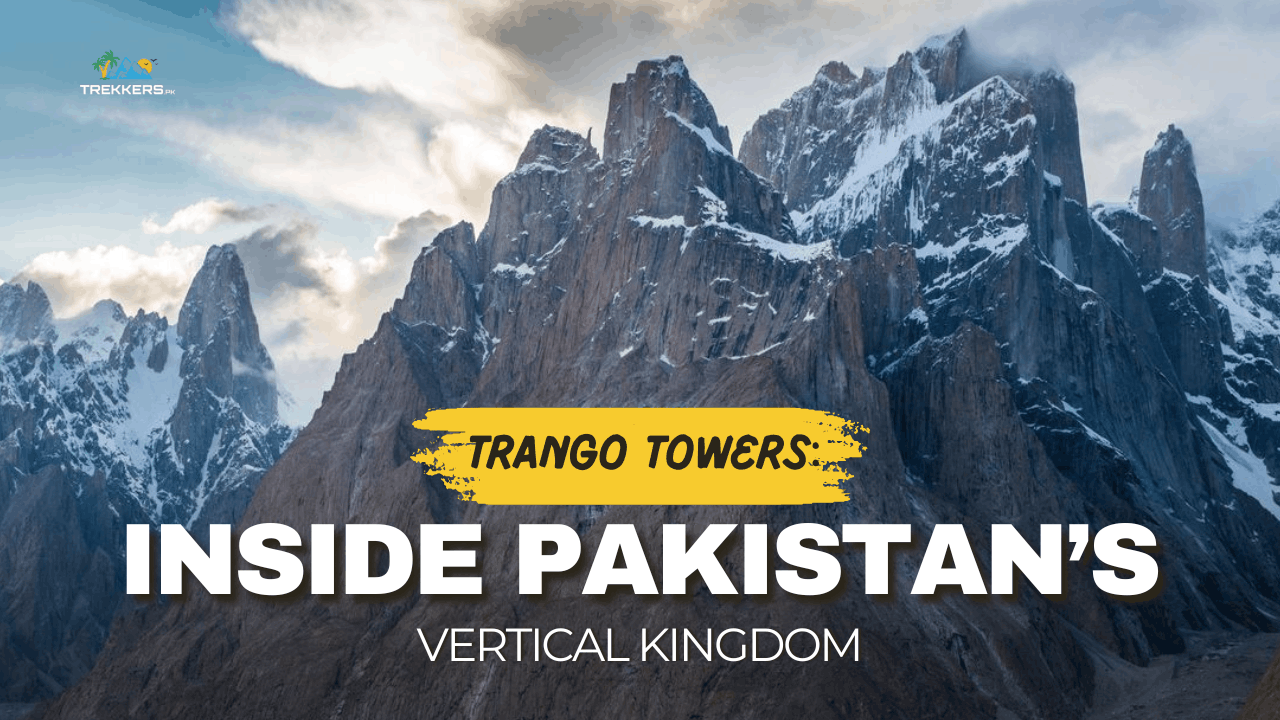
Few mountains on Earth command the same level of respect as the Trango Towers Pakistan is famous for. Rising dramatically above the Baltoro Glacier in the heart of the Karakoram Range, these immense granite spires represent the pinnacle of high-altitude big-wall climbing. For climbers, photographers, and mountain enthusiasts alike, the Trango Towers are more than a collection of peaks they are symbols of ambition, endurance, and the relentless pursuit of the impossible.
After days of difficult terrain, unstable weather, and arduous trails through Gilgit-Baltistan, mountaineers finally reach the Baltoro Glacier.
Then the Trango Towers come into view.
Not gradually.
Not softly.
They rise out of the glacier all at once, giant granite walls forcing themselves into the sky with a steepness that almost looks unnatural.
For a moment, they do not even resemble mountains.
They look vertical.
And that is exactly why climbers from around the world keep returning to them.
Trango Towers Quick Facts
| Feature | Details |
|---|---|
| Location | Baltoro Muztagh, Karakoram Range, Gilgit-Baltistan, Pakistan |
| Highest Summit | Great Trango Tower – 6,286 m (20,623 ft) |
| Famous Peak | Nameless Tower (Trango Tower) – 6,251 m |
| Terrain | Granite walls, glaciers, mixed alpine routes |
| Climbing Style | Big-wall climbing, rock climbing, alpine climbing |
| Difficulty | Extremely technical |
| Best Time to Visit | June to August |
| Nearest Major Town | Skardu |
| Trek Access | Baltoro Glacier Trek |
| International Reputation | Home to some of the world’s tallest and steepest rock faces |
An Overview of the Trango Towers
Located in the Baltoro Muztagh subrange of the Karakoram Mountains in Gilgit-Baltistan, the Trango Towers are a remarkable group of granite spires renowned for possessing some of the largest vertical rock faces on Earth.
The group includes several iconic formations, but none are more celebrated than the towering Great Trango Tower and the perfectly sculpted Nameless Tower.
For decades, these mountains have attracted elite climbers seeking some of the most demanding big-wall climbing challenges ever attempted.
What makes the Trango Towers unique is not simply their elevation.
It is the extraordinary combination of altitude, exposure, steepness, and isolation.
The Granite Giants of the Karakoram
At sunrise, the granite changes color.
Dark grey walls begin catching streaks of gold while the glacier beneath remains frozen in shadow. From a distance, the towers appear silent and motionless.
Up close, they feel overwhelming.
The scale is difficult to process.
Dominating the skyline are the Great Trango Tower (6,286 m) and its immense East Face, rising thousands of feet above the Baltoro Glacier. Nearby stands the legendary Nameless Tower, one of the most recognizable granite spires in the climbing world.
Nothing about these mountains feels forgiving.
The walls overhang.
The weather shifts violently.
The routes stretch for thousands of feet above the glacier.
Hazards remain present even for expert climbers.
Why Trango Towers Are Famous in the Climbing World
While Pakistan is home to many famous peaks, including K2, few mountains possess the mythical reputation of the Trango Towers.
Their granite walls have become legendary among climbers because they offer some of the most difficult and aesthetically striking big wall routes on Earth. Every expedition demands a combination of technical skill, endurance, route-finding ability, and mental resilience.
The towers are widely considered one of the ultimate destinations for high-altitude rock climbing.

Inside the World of Big-Wall Climbing in Pakistan
Unlike traditional trekking in Pakistan, Trango is not about scenic hiking trails or gradual ascents through valleys.
This is a place built around exposure, endurance, and technical climbing.
Expeditions often spend days or even weeks suspended directly on the rock face.
Some climbers sleep in hanging portaledges attached to the wall itself, thousands of feet above the Baltoro Glacier.
Below them is nothing but ice, rock, and empty air.
On Trango Towers, flat ground becomes a luxury.
As climbers move higher, freezing temperatures, thin air, exhaustion, and sudden storms transform even simple movements into difficult tasks.
Progress can slow to only a few meters per hour.
At certain points, survival matters more than the summit.
The Expeditions That Built Trango’s Reputation
The history of the Trango Towers is filled with ambitious expeditions and groundbreaking achievements.
The first successful ascent of Great Trango Tower was completed in 1977 by an American team led by renowned climber Galen Rowell alongside John Roskelley, Kim Schmitz, Jim Morrissey, and Dennis Hennek.
Their route involved navigating steep granite faces, snow gullies, and technical ice terrain before finally reaching the summit.
But success on Trango has never come without risk.
In 1984, Norwegian climbers Hans Christian Doseth and Finn Dæhli completed the first ascent of the East Face of Great Trango Tower. Tragically, neither climber survived the descent.
Even today, their expedition remains one of the most discussed chapters in Trango’s history.
Because on these mountains, reaching the summit is often only half the battle.
Eternal Flame: The Most Legendary Route on Trango Towers
The Route That Changed Big-Wall Climbing
Perhaps no route captures the reputation of the Trango Towers better than Eternal Flame.
First established in 1989 on the Nameless Tower, Eternal Flame quickly became one of the most iconic and feared climbing routes in the world. The route follows a stunning line of cracks and steep granite walls rising approximately 650 meters above the glacier.
There are sections where climbers remain suspended on the wall for days.
No roads.
No shelters.
No margin for error.
The Historic Free Ascent
For years, climbers considered a complete free ascent nearly impossible due to the combination of altitude, weather, and technical difficulty.
In 2009, German climbers Alexander Huber and Thomas Huber achieved the first free ascent of Eternal Flame, transforming the route into one of the most respected achievements in modern climbing.
Their success elevated Eternal Flame into mountaineering legend.
And somehow, the mountain still keeps raising the standard.
How to Reach Trango Towers
Step 1: Travel to Skardu
Most international visitors begin their journey by reaching Skardu, the main gateway to the Karakoram Mountains and Baltistan region.
Step 2: Drive to Askole
From Skardu, climbers and trekkers travel by jeep to Askole, the final permanent settlement before entering the Baltoro region.
Step 3: Trek the Baltoro Glacier
The classic Baltoro Glacier route follows one of the world’s most spectacular trekking corridors.
Key points along the route include:
- Jhola
- Paiju
- Urdukas
- Goro II
- Concordia
- Trango Base Camp
The trek usually requires 6–8 days depending on weather, fitness, and logistics.
Step 4: Reach Trango Base Camp
From the Baltoro Glacier, climbers establish base camp near the Trango Glacier before beginning technical climbing objectives.
The journey itself is considered one of the greatest trekking experiences in Pakistan.
Why Trango Towers Challenge Even Elite Climbers
What makes Trango Towers different from other mountains in northern Pakistan is not simply height.
There are taller mountains in the Karakoram.
More famous ones too.
But few places create this combination of exposure, isolation, and technical difficulty.
The towers demand far more than physical strength.
Climbers must manage fear, exhaustion, storms, freezing temperatures, altitude, and the constant awareness that mistakes can carry severe consequences.
The mountain never really allows comfort.
Even the weather becomes unpredictable. Clear skies can disappear within hours as clouds move across the Karakoram, bringing snow, high winds, and poor visibility.
And once climbers are committed high on a route, retreat is not always straightforward.
That uncertainty is part of the attraction.

Extreme Conditions, Records, and Mountaineering Legacy
Over the years, Trango Towers have evolved from a climbing destination into a symbol of elite mountaineering.
Numerous world-class climbers have attempted routes here, including Alex Lowe, Mark Synnott, and the Huber brothers.
Several routes on the towers have received international recognition for pushing the boundaries of high-altitude rock climbing. Routes such as Eternal Flame and Parallel Worlds remain benchmark achievements within the climbing community.
The towers also attracted global attention beyond climbing.
In 1992, Australian adventurers Nic Feteris and Glenn Singleman completed a then-record-setting BASE jump from Great Trango Tower, launching themselves from nearly 6,000 meters above sea level.
Few mountains inspire this level of obsession.
Why Climbers Around the World Keep Returning to Trango Towers
Standing beneath the towers, it becomes easier to understand why.
The granite walls do not blend naturally into the landscape like many other peaks in the Karakoram.
They dominate it.
Sharp ridges slice into the sky while enormous cliffs rise almost vertically above the glacier.
Everything about the mountain feels extreme.
The silence.
The scale.
The exposure.
Even watching the towers from a distance feels intimidating.
And maybe that is exactly what makes them unforgettable.
Frequently Asked Questions About Trango Towers
Where are the Trango Towers located?
The Trango Towers are located in the Baltoro Muztagh region of the Karakoram Range in Gilgit-Baltistan, northern Pakistan.
How high is Great Trango Tower?
Great Trango Tower stands at 6,286 meters (20,623 feet) above sea level.
What are the Trango Towers famous for?
They are famous for having some of the world’s largest vertical granite walls and for hosting legendary big-wall climbing routes such as Eternal Flame.
Can beginners climb Trango Towers?
No. Trango Towers are considered an elite-level climbing destination requiring advanced technical rock and alpine climbing experience.
What is Eternal Flame?
Eternal Flame is one of the most famous big-wall climbing routes in the world, located on the Nameless Tower. It was first climbed in 1989 and first free climbed in 2009 by Alexander and Thomas Huber.
What is the best time to visit Trango Towers?
The main climbing season typically runs from June to August when weather conditions are relatively more stable.
How long does it take to reach Trango Base Camp?
Most expeditions require approximately 6 – 8 days of trekking from Askole through the Baltoro Glacier region.
Are Trango Towers higher than K2?
No. K2 stands at 8,611 meters, making it significantly higher than Great Trango Tower.
Do non-climbers visit Trango Towers?
Yes. Many trekkers encounter views of the towers while completing sections of the Baltoro Glacier Trek.
Pakistan’s Most Extreme Vertical Landscape
The Trango Towers are not simply mountains hidden within the Karakoram. They are enormous vertical worlds built from granite, ice, and altitude places where climbers push themselves against walls that seem to defy gravity itself.
For decades, these towers have remained among the most respected and feared climbing destinations on Earth. Not because they are the tallest mountains in Pakistan, but because few landscapes demand this level of endurance, precision, and courage.
From the immense East Face of Great Trango Tower to the legendary Eternal Flame route on Nameless Tower, every wall tells a story of ambition, risk, and human determination.
In the world of climbing, Trango Towers are not just visited.
They are earned.


This Post Has 2 Comments