
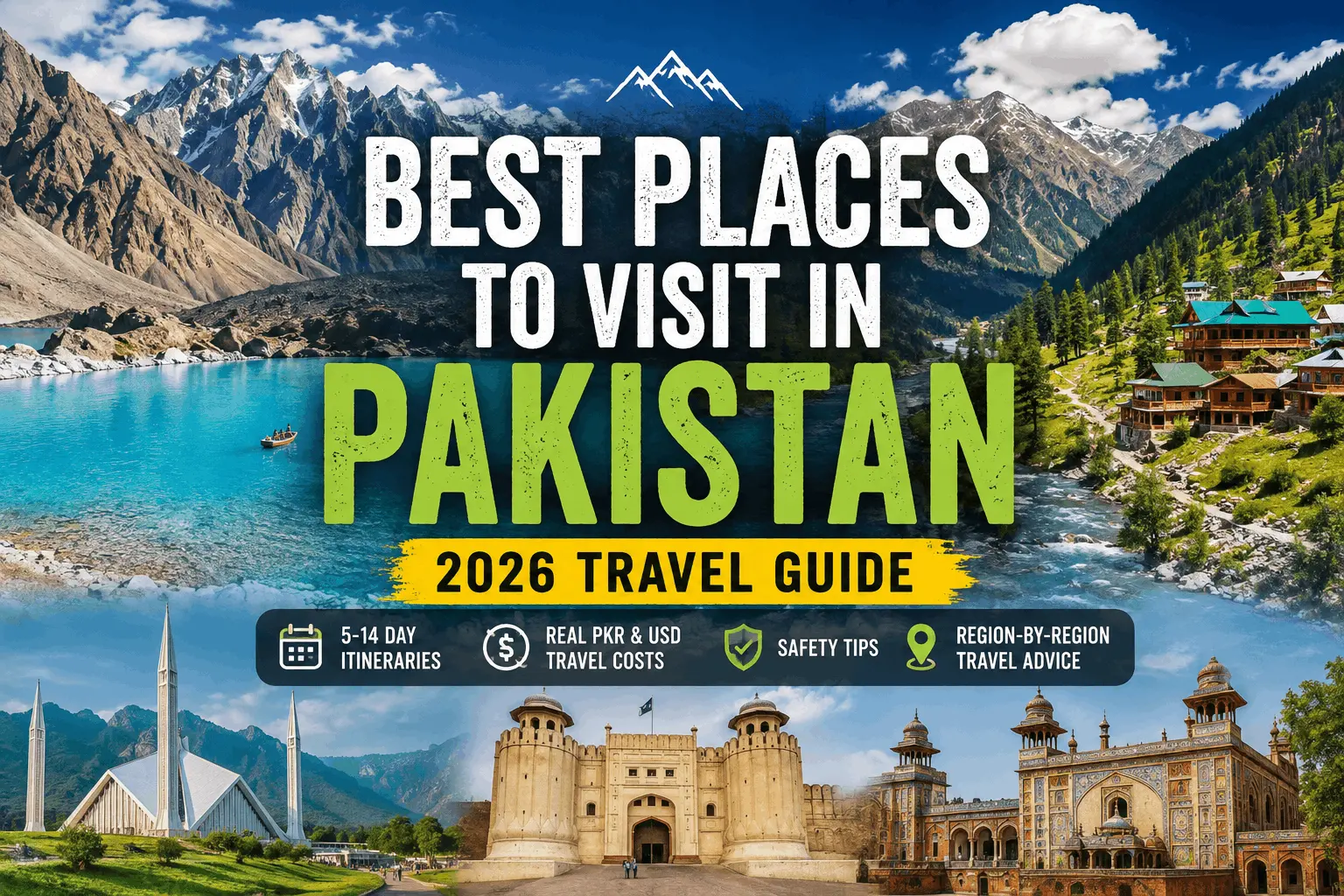
Hunza Valley, Skardu, and Lahore give you the fullest picture of Pakistan in a single trip mountains, adventure, and centuries of history in one loop. If you have more time, add Fairy Meadows, Swat, and Neelum Valley to round out the north, and Karachi if you want the coast and a genuinely different pace.
Pakistan isn’t a one-destination country the way Bali or Santorini is. It behaves more like a small continent: a five-hour drive can take you from a Mughal-era fort to a glacial lake sitting above 4,000 meters. That range is exactly why “what’s the best place to visit in Pakistan” doesn’t have a single answer, it depends on whether you want mountains, history, food, or a quiet honeymoon spot.
Table of Contents
Quick Answer: Top 10 Places to Visit in Pakistan for 2026
| Rank | Destination | Best For |
|---|---|---|
| 1 | Hunza Valley | First-time visitors, photography, cherry blossoms |
| 2 | Skardu | K2 base camp access, lakes, adventure travel |
| 3 | Fairy Meadows | Nanga Parbat views, trekking, camping |
| 4 | Lahore | History, Mughal architecture, food |
| 5 | Swat & Kalam | Family trips, skiing, river scenery |
| 6 | Neelum Valley | Kashmir landscapes, alpine lakes |
| 7 | Deosai National Park | Wildlife, high-altitude plateau |
| 8 | Islamabad | Easy access, modern amenities, gateway city |
| 9 | Chitral & Kalash Valleys | Indigenous culture, seasonal festivals |
| 10 | Karachi | Coastline, city energy, museums |
Each region rewards a different kind of traveler, so it’s worth understanding what each one actually offers before you build an itinerary.
Pakistan’s Regions at a Glance
Before diving into individual destinations, it helps to understand how Pakistan’s regions differ — first-time visitors often assume the country is more uniform than it actually is.
Northern Pakistan (Gilgit-Baltistan): High-altitude mountain territory where the Karakoram, Himalaya, and Hindu Kush meet. This is where most “best places to visit in Pakistan” lists concentrate, and for good reason it’s the region with the most dramatic scenery and the best tourism infrastructure relative to its remoteness.
Khyber Pakhtunkhwa (KPK): Forested river valleys, ski resorts, and the country’s most accessible alpine scenery. Culturally distinct from Gilgit-Baltistan, with its own Pashtun and Kalash traditions layered in.
Azad Kashmir: A separate administrative territory bordering Indian-administered Kashmir, known for emerald valleys and alpine lakes. Some areas near the Line of Control carry travel restrictions, though the popular tourist stretch is straightforward.
Punjab: The historical and cultural heartland — Mughal forts, gardens, and Pakistan’s best-known food cities. Flat terrain, good roads, and no altitude concerns make this the easiest region to travel independently.
Sindh and Balochistan: The coastal south and the country’s ancient-history core, anchored by Karachi and the Indus Valley ruins at Mohenjo-Daro. Balochistan itself carries significant travel advisories and sits outside the standard tourist circuit.
Is Pakistan Safe to Visit in 2026?
Yes, on the established tourist routes. The northern circuit — Hunza, Skardu, Naran, Swat — sees heavy domestic tourism and a steadily growing number of foreign visitors, and the region has a strong reputation for hospitality. Security along this corridor has improved substantially over the past decade, and travelers moving through it typically encounter more checkpoints than actual incidents.
Safety in Pakistan is regional, not national, and that distinction matters more than any single headline. Balochistan and the areas of Khyber Pakhtunkhwa near the Afghan border carry active travel advisories from Western governments, largely due to militancy and border-security concerns unrelated to the tourist trail. If your itinerary sticks to Gilgit-Baltistan, Punjab’s major cities, standard Sindh attractions, and the accessible parts of Azad Kashmir, you’re following the same route the overwhelming majority of foreign travelers already take without incident.
For US citizens: a visa is required in advance. Pakistan does not offer visa-free or visa-on-arrival entry for American passport holders. Most eligible travelers can apply through Pakistan’s official Online Visa System, where tourist e-visas are processed online. Approval generally covers a defined tourism stay window, but visa categories, eligibility, and validity periods can change, so always verify the latest requirements before booking your flights.
A few practical distinctions worth knowing:
- Border zones vs. tourist zones. Advisories that flag “Pakistan” as risky are usually driven by border areas and Balochistan, not by Hunza or Skardu, which sit in a different security environment entirely.
- Solo and female travel. Solo female travel through the north is widely reported as a positive experience. Dressing modestly, booking established hotels for your first nights, and using a recommended driver covers most of the practical bases.
- The real risks aren’t security. Mountain roads, altitude, sudden weather changes, and flight cancellations out of Skardu affect far more travelers than crime or terrorism ever do on this route.
Good to know: Most Western government advisories carve out the Karakoram and northern tourism corridor as significantly lower risk than the country-wide rating suggests. Read the specific regional guidance, not just the headline rating.
Best Time to Visit Pakistan
The right season depends entirely on which region you’re targeting, since the north and south run on almost opposite calendars.
Spring (March–May): Cherry blossoms bloom across Hunza, wildflowers appear in the lower valleys, and temperatures are mild everywhere except the high plateaus, which stay snowbound.
Summer (June–August): Peak season for the north. Hunza, Skardu, Fairy Meadows, Deosai, and Naran are all fully accessible, and this is also when most domestic tourists travel, so expect crowds at marquee spots like Attabad Lake and Saif-ul-Malook. Karachi and Lahore turn hot and humid in this window, making it the wrong time for a Punjab or Sindh-focused trip.
Autumn (September–October): Arguably the sweet spot for the north — golden foliage, thinner crowds, and generally stable weather, though nights turn cold fast at altitude.
Winter (November–February): High-altitude regions largely shut down; roads to Deosai, Fairy Meadows, and Khunjerab Pass close for the season. This becomes the season for Lahore, Islamabad, Karachi, and lower hill stations like Murree, which get pleasant days and occasional snowfall without summer’s heat.
Month-by-Month Planning Guide
| Month | Northern Areas | Punjab / South | Crowd Level | Notes |
|---|---|---|---|---|
| January | Mostly closed | Pleasant, cool | Low | Best window for Lahore, Karachi, Islamabad |
| February | Mostly closed | Pleasant, occasional rain | Low | Murree still holds snow |
| March | Roads reopening | Warming up | Low–Moderate | Early cherry blossoms possible in lower Hunza |
| April | Fully open, cherry blossoms | Getting hot | Moderate | One of the best all-round months for the north |
| May | Fully open, wildflowers | Very hot | Moderate | Last comfortable month before southern heat peaks |
| June | Peak season | Extreme heat | High | Book Hunza/Skardu/Fairy Meadows well ahead |
| July | Peak season, monsoon possible | Extreme heat, humid | High | Watch for flash-flood advisories in valleys |
| August | Peak season, monsoon possible | Extreme heat, humid | High | Domestic school-holiday crowds at their heaviest |
| September | Golden, thinning crowds | Cooling down | Moderate | Strong pick for photography |
| October | Best autumn colors | Comfortable | Moderate | Nights cold above 3,000m |
| November | Closing down | Comfortable, cool | Low | Last chance for Khunjerab before winter closure |
| December | Mostly closed | Cool, occasional smog in Lahore | Low | Focus itinerary on Punjab and the south |
Pro tip: If your dates are flexible, late April and mid-September consistently deliver the best combination of open roads, good weather, and manageable crowds across the northern circuit.
Northern Pakistan: Gilgit-Baltistan
This is the region most people picture when they ask about the best places to visit in Pakistan, and it earns that reputation honestly. Three major mountain systems — the Himalayas, the Karakoram, and the Hindu Kush — physically converge here, a geographic overlap that doesn’t happen anywhere else on Earth. The entire route in and out of the region runs along the Karakoram Highway, itself one of the world’s highest paved international roads and a landmark in its own right.
Hunza Valley
Hunza sits along the old Silk Road, roughly 600 kilometers from Islamabad via the Karakoram Highway. It’s the most infrastructure-ready part of the north, which makes it the sensible first stop for anyone new to travel in Pakistan.

What to see: Attabad Lake, a turquoise reservoir formed by a 2010 landslide and now popular for boating; Baltit Fort and Altit Fort, both centuries old, with panoramic valley views; and Eagle’s Nest at Duikar, the best sunrise viewpoint over the Karakoram peaks, where Golden Peak catches first light before neighboring summits follow in sequence. Photographers should note that Duikar’s light show is genuinely time-sensitive — arriving even twenty minutes after sunrise means missing the sequential ridge-lighting effect that makes the viewpoint famous. Further up the valley toward Gojal, the jagged Passu Cones and the slow-moving Hopper Glacier near Nagar reward travelers willing to add an extra day.
Base yourself in Karimabad for three to four days rather than day-tripping in and out. Road conditions and the valley’s pace both reward a slower visit.
Skardu
Skardu is the launch point for K2 expeditions, but you don’t need mountaineering ambitions to justify the trip. The town sits at roughly 2,286 meters, ringed by the Karakoram range, with a cluster of lakes nearby: Shangrila (Lower Kachura), known for a red-roofed restaurant built on a converted aircraft; the quieter Upper Kachura; and Satpara Lake, about 20 minutes from town. Shigar Fort, now a heritage hotel showcasing traditional Balti architecture, is a worthwhile half-day stop for cultural context. Serious trekkers use Skardu as the staging point for the multi-week approach to Baltoro Glacier and K2 base camp — not a casual add-on, but worth knowing if a future trip is on your mind.

One practical note that rarely makes it into glossy guides: Skardu flights cancel frequently due to weather, so never schedule them the same day as an international connection — build in a buffer.
Fairy Meadows
German climbers coined the name — “fairy tale meadow” — and it holds up. Sitting at about 3,300 meters at the base of Nanga Parbat (8,126 meters, nicknamed the “Killer Mountain”), Fairy Meadows requires a jeep ride on one of the more dramatic roads in the country, followed by a three-to-four-hour trek through pine forest. The payoff is camping under a clear sky with Nanga Parbat’s south face directly overhead. Book cottages or campsites ahead if you’re traveling in June through August, since options are limited and fill quickly.

For a quieter alternative with a similar payoff, Rama Meadows on the Astore side of the mountain offers comparable Nanga Parbat views with an easier approach and noticeably thinner crowds.
Deosai National Park

Deosai means “Land of Giants,” referring to both the scale of the plateau and its resident population of roughly 300 Himalayan brown bears — one of the region’s largest concentrations. Sitting at around 4,114 meters between Skardu and Astore, it’s a rolling alpine steppe dotted with wildflowers and glacial streams, with Sheosar Lake as its centerpiece. There’s no permanent lodging inside the park, so plan on camping or a day trip, and pack warm layers regardless of season — weather here turns quickly. Bear sightings are far more likely early morning or late afternoon; midday visitors mostly see marmots and the occasional golden eagle overhead.
Naltar Valley

Less visited than Hunza or Skardu, Naltar is known for three lakes of distinctly different colors — green, blue, and turquoise — caused by variations in mineral content. It doubles as a ski destination in winter, giving it a rare identity as both a summer trekking spot and a cold-weather resort.
Hunza vs. Skardu: Which Should You Choose First?
Both are essential, but if you’re short on time or building a first trip, this comparison helps decide which to prioritize.
| Factor | Hunza Valley | Skardu |
|---|---|---|
| Scenery style | Cultivated valley, forts, orchards | Raw high-altitude lakes and peaks |
| Accessibility | Easier — better roads, more hotels | More remote, flight-dependent |
| Crowd levels | Higher in peak summer | Slightly lower, spreads across a wider area |
| Photography | Strong — Duikar sunrise, Attabad Lake | Strong — Shangrila, Deosai access |
| Good for families | Yes, very manageable | Manageable with older kids |
| Honeymoon suitability | Excellent — boutique stays in Karimabad | Good, more adventure-focused |
| Adventure level | Moderate | High — K2 and Baltoro access |
| Budget friendliness | Slightly cheaper overall | Flights add cost if not driving |
| Best season | April–October | May–September |
Fairy Meadows vs. Deosai: Two Different Kinds of High-Altitude Trips
Both sit above 3,000 meters and both center on Nanga Parbat’s neighborhood, but the experience is quite different.
| Factor | Fairy Meadows | Deosai National Park |
|---|---|---|
| Landscape | Pine forest meadow with a single dominant peak view | Open plateau, wide horizons, wildlife |
| Access | Jeep + 3–4 hour trek | Jeep only, no trekking required |
| Altitude | ~3,300m | ~4,114m |
| Wildlife | Limited | Himalayan brown bears, marmots, golden eagles |
| Lodging | Cottages and campsites | Camping or day trip from Skardu |
| Best for | Trekkers, photographers chasing Nanga Parbat | Wildlife watchers, plateau landscapes |
| Best season | May–September | June–September |
Khyber Pakhtunkhwa: Swat, Kaghan, and Chitral
If Gilgit-Baltistan is Pakistan’s high-altitude showcase, KPK is where the country’s forested river valleys live.
Swat and Kalam Valley

Once nicknamed the “Switzerland of the East” by the British, Swat has rebuilt its tourism identity after a difficult security period in the 2000s and is firmly back on the standard northern circuit. Malam Jabba runs as Pakistan’s main ski resort in winter and offers chairlift rides in summer. Mahodand Lake, framed by forest, is one of the more photogenic stops in the region, and Mingora’s Buddhist archaeological sites — including the Butkara Stupa — add a historical layer most visitors don’t expect from a mountain valley.
Naran and Kaghan Valley

This is the most accessible alpine scenery in the country, following the Kunhar River for about 150 kilometers without requiring serious trekking experience. Saif-ul-Malook Lake, wrapped in local legend and framed by Malika Parbat, is one of Pakistan’s most photographed spots — arrive before 8 a.m. in summer if you want the lake without a wall of boats and selfie-takers in every frame. Babusar Pass, at around 4,173 meters, connects the valley to Chilas and the Karakoram Highway beyond.
Chitral and the Kalash Valleys

Chitral offers something genuinely distinct: the Kalash people, one of the smallest and most culturally distinct communities in Asia, who maintain pre-Islamic traditions and colorful seasonal festivals — Chilam Joshi in spring, Uchao in summer, Choimus in winter. Visiting respectfully means dressing modestly and asking permission before photographing residents.
Azad Kashmir: Neelum Valley
Running alongside the Neelum River for roughly 144 kilometers, this valley is often described locally as Kashmir’s most scenic stretch. Ratti Gali Lake requires a moderate trek through wildflower meadows, while Arang Kel, a hilltop village reached by chairlift, gives sweeping views without the physical effort. Sharda adds a historical dimension as an ancient Buddhist learning center with surviving ruins. Most of lower Neelum Valley is straightforward for tourism; the stretch beyond Kel sits closer to the Line of Control, so it’s worth checking local guidance before pushing further up the valley.

Swat vs. Neelum Valley: Two Accessible Alternatives to the High North
If Hunza or Skardu don’t fit your timeline, these two valleys offer strong scenery with far less altitude and logistics involved.
| Factor | Swat & Kalam | Neelum Valley |
|---|---|---|
| Distance from Islamabad | ~4–5 hours | ~6–7 hours (via Muzaffarabad) |
| Terrain | Forested valley, river, ski slopes | River valley, alpine lakes, hilltop villages |
| Cultural layer | Buddhist archaeological sites | Kashmiri culture, LoC-adjacent villages |
| Difficulty | Low | Low to moderate (Ratti Gali trek) |
| Family friendly | Yes | Yes, mostly |
| Best season | March–October | April–October |
| Standout site | Mahodand Lake | Ratti Gali Lake |
Punjab: History, Food, and Culture
Punjab runs on a completely different travel rhythm than the north — no jeeps, no altitude concerns, just cities rich in Mughal-era architecture.
Lahore
Lahore is Pakistan’s cultural capital, and locals will tell you so without hesitation. The Badshahi Mosque and Lahore Fort anchor the old walled city — the fort alone covers more than 20 hectares and includes the Sheesh Mahal (Palace of Mirrors), built for the imperial family’s private use. Lahore Fort and the adjacent Shalamar Gardens are jointly inscribed as a UNESCO World Heritage Site, one of several such sites scattered across Punjab and Sindh. Beyond the monuments, Lahore’s street food scene is frequently cited as the country’s best, and a half-day spent purely eating is not wasted time here. Early evening, just before the call to prayer, is when the old city’s lanes fill with the most energy and the light through the bazaar alleys photographs best.

Islamabad
Pakistan’s purpose-built capital since 1967, Islamabad reads as noticeably more modern and orderly than Lahore or Karachi. Faisal Mosque, one of the largest mosques in South Asia, is the city’s signature landmark, and the Margalla Hills behind it offer genuinely good day hikes — Trail 5 and the Daman-e-Koh viewpoint are the most walked routes. Islamabad also functions as the practical gateway to Taxila’s Buddhist ruins and the hill stations of Murree and Nathiagali, all within about ninety minutes’ drive. History-minded travelers with an extra day can also detour to Rohtas Fort near Jhelum, a 16th-century Sher Shah Suri fortress and another UNESCO-listed site, on the way toward the north.
Murree
Murree is the low-effort hill station option — two hours from Islamabad, with a colonial-era feel, decent winter snowfall, and Patriata’s chairlift as the main draw. It’s not a substitute for the drama of the north, but it’s the right call with limited time or travelers who don’t want a demanding itinerary.
Sindh: Coast and Ancient History
Karachi
Pakistan’s largest city and economic engine sits on the Arabian Sea. Clifton Beach, Mohatta Palace, and the Mausoleum of Muhammad Ali Jinnah are the standard stops, and the city’s diversity — a product of its port history — shows clearly in its food scene.
Mohenjo-Daro
Located in Sindh near Larkana, Mohenjo-Daro is one of the earliest major urban settlements in human history, part of the Bronze Age Indus Valley Civilization dating back roughly 4,500 years and inscribed as a UNESCO World Heritage Site. It’s a different kind of stop entirely — flat, archaeological, historically significant rather than scenic — worth the detour if ancient history interests you more than mountain views.

Beyond the Classics: Balochistan and the Coastal South
For travelers with extra time and a taste for the offbeat, southern Sindh and the Makran coast offer destinations well outside the standard circuit. The Makli Necropolis near Thatta, another UNESCO World Heritage Site, is one of the largest funerary sites in the world. Further along the Makran Coastal Highway, Hingol National Park delivers surreal mud volcanoes and lunar-style rock formations, while Gorakh Hill Station in Balochistan offers a rare high-altitude escape from Sindh’s heat. These sit closer to areas with active travel advisories, so check current regional guidance and travel with a knowledgeable operator rather than independently.
Choosing Places to Visit in Pakistan by Travel Style
Not every “best places” list applies equally to every traveler. Here’s how the destinations above map to different priorities.
Family travel: Naran, Swat, and Murree offer scenery without demanding treks or high-altitude camping. Good road access, established hotels, and shorter drive segments make them easier with kids than Fairy Meadows or Deosai.
Honeymoon: Hunza’s dramatic views paired with comfortable, boutique-style accommodation in Karimabad make it the most commonly recommended honeymoon base, with Neelum Valley as a quieter alternative.
Budget backpacking: Northern Pakistan is affordable by global standards — jeep hire, guesthouses, and local food keep daily costs low. Transport, not accommodation, is usually the biggest line item because of the terrain.
Adventure and trekking: Skardu and Deosai are the serious options — K2 base camp treks, Katora Lake in Kumrat Valley, and the Karakoram’s technical routes all start from this region.
Sample Pakistan Itineraries
These itineraries assume a Islamabad-based start and end, since it’s the main international gateway alongside Lahore and Karachi. Driving days are built in deliberately — rushing the Karakoram Highway is the single most common planning mistake covered later in this guide.
5-Day Pakistan Trip (Islamabad + Hunza Taste)
| Day | Plan |
|---|---|
| 1 | Arrive Islamabad, Faisal Mosque, Margalla Hills Trail 5 |
| 2 | Drive Islamabad to Naran (7–8 hrs) via Kaghan Valley |
| 3 | Saif-ul-Malook Lake, explore Naran, drive to Islamabad or overnight Naran |
| 4 | Return to Islamabad, afternoon in Rawalpindi bazaars |
| 5 | Departure |
Good to know: Five days is too tight for Hunza and back comfortably — this itinerary substitutes Naran/Kaghan as the realistic alpine taste within that window.
7-Day Pakistan Trip (Islamabad + Hunza)
| Day | Plan |
|---|---|
| 1 | Arrive Islamabad |
| 2 | Drive Islamabad to Karimabad, Hunza (10–12 hrs, or fly to Gilgit and drive 2 hrs) |
| 3 | Baltit Fort, Altit Fort, Karimabad Bazaar |
| 4 | Attabad Lake, Eagle’s Nest sunrise at Duikar |
| 5 | Optional day trip to Khunjerab Pass or Passu Cones |
| 6 | Drive back toward Islamabad, overnight en route |
| 7 | Arrive Islamabad, departure |
10-Day Pakistan Trip (Islamabad + Hunza + Skardu)
| Day | Plan |
|---|---|
| 1 | Arrive Islamabad |
| 2 | Fly or drive to Gilgit, continue to Hunza |
| 3–4 | Hunza: forts, Attabad Lake, Duikar sunrise |
| 5 | Drive or fly Hunza/Gilgit to Skardu |
| 6 | Shangrila Lake, Shigar Fort |
| 7 | Deosai National Park day trip |
| 8 | Fly Skardu to Islamabad (build in a buffer day if flights are weather-dependent) |
| 9 | Lahore day trip by air, or explore Islamabad and Taxila |
| 10 | Departure |
14-Day Pakistan Trip (Full Northern Loop + Lahore)
| Day | Plan |
|---|---|
| 1 | Arrive Islamabad |
| 2–3 | Drive to Naran/Kaghan via Kaghan Valley, Saif-ul-Malook |
| 4 | Babusar Pass to Chilas, continue to Hunza |
| 5–6 | Hunza: forts, Attabad Lake, Duikar |
| 7 | Day trip to Khunjerab Pass |
| 8 | Drive or fly to Skardu |
| 9 | Shangrila Lake, Shigar Fort |
| 10 | Fairy Meadows or Deosai (choose based on interest — trek vs. plateau) |
| 11 | Fly Skardu to Islamabad |
| 12 | Train or flight to Lahore |
| 13 | Lahore Fort, Badshahi Mosque, food tour of the old city |
| 14 | Return to Islamabad, departure |
Driving Distances and Travel Times
| Route | Distance | Driving Time | Notes |
|---|---|---|---|
| Islamabad – Naran | ~250 km | 7–8 hrs | Mountain road, slower in monsoon season |
| Islamabad – Hunza (Karimabad) | ~600 km | 10–12 hrs | Karakoram Highway; most travelers split into two days |
| Gilgit – Hunza | ~100 km | 2 hrs | Paved, straightforward |
| Hunza – Khunjerab Pass | ~130 km | 3–4 hrs | Border zone, day trip from Hunza |
| Skardu – Deosai (Sheosar Lake) | ~70 km | 2–3 hrs | Rough plateau track, 4×4 recommended |
| Skardu – Fairy Meadows (Raikot Bridge) | ~130 km | 4–5 hrs + trek | Jeep to Raikot, then 3–4 hr trek |
| Islamabad – Lahore | ~375 km | 4–5 hrs | Motorway, fastest and easiest route in the country |
| Islamabad – Murree | ~65 km | 1.5–2 hrs | Can double on weekends due to traffic |
What Pakistan Travel Actually Costs
Costs vary sharply by region and by whether you travel independently or through an operator. A few concrete reference points from the north:
- Deosai National Park entry: roughly 500 PKR for locals, around 40 USD for foreign nationals
- Khunjerab Pass entry: about 1,000 PKR for locals, around 30 USD for foreign nationals
- Jeep hire for rougher routes (Fairy Meadows, Kumrat, Minimarg): typically 12,000 – 25,000 PKR round trip, depending on distance and terrain
- Shangrila Resort entry: around 1,000 – 1,500 PKR
Foreign nationals should expect noticeably higher park and heritage-site fees than domestic tourists. This is standard practice across Pakistan’s tourism sector rather than an anomaly, and it applies consistently at national parks and historic forts alike.
Daily Budget Ranges
Exchange rates shift often enough that fixed USD conversions go stale fast, so these are framed in relative terms against local PKR pricing for accommodation, food, and transport.
| Budget Tier | Accommodation | Food (per day) | Local Transport | Overall Daily Feel |
|---|---|---|---|---|
| Backpacker | Guesthouses, shared rooms | Local dhabas, street food | Shared jeeps, public vans | Bare-bones but comfortable in the north |
| Mid-range | Private rooms, 3-star hotels | Mix of local and tourist restaurants | Private jeep hire, hired driver | Most common choice for first-time visitors |
| Luxury | Heritage hotels (Shigar Fort, Serena properties), boutique stays | Hotel dining, curated experiences | Private vehicle with dedicated driver throughout | Comfortable, minimal logistics stress |
Pro tip: Jeep hire, not hotels, is usually the single biggest cost driver in the north — routes to Fairy Meadows, Deosai, and Kumrat all require 4×4 vehicles that can’t be substituted with a regular car.
Practical Planning: SIMs, Cash, and Roads
A handful of practical details make a bigger difference to a Pakistan trip than most guides mention.
- SIM cards: Local SIMs (Jazz, Zong, Telenor) are available at Islamabad’s airport and in major cities; foreigners need a passport and, in some cases, a local contact for registration. Coverage is reliable in Hunza and along the Karakoram Highway but drops out completely in Fairy Meadows, Deosai, and other remote valleys.
- Internet access: Hotels in Karimabad, Skardu, and Naran generally offer Wi-Fi, though speeds are inconsistent. Don’t count on connectivity for work calls once you’re past Gilgit.
- Cash and ATMs: ATMs are common in Islamabad, Lahore, Gilgit, and Skardu town, but scarce beyond that. Carry enough cash for several days once you head into Hunza’s upper valleys, Fairy Meadows, or Deosai.
- Fuel stations: Reliable in Punjab and along the Karakoram Highway’s main towns; fill up before heading into side valleys like Naltar, Kumrat, or Shigar, where stations are sparse.
- Road conditions: The Karakoram Highway is paved and well-maintained for most of its length, but landslides and rockfall are genuine seasonal hazards. Side routes to Fairy Meadows, Deosai, and Kumrat require 4×4 vehicles and experienced local drivers.
- Electricity: Standard voltage is 220V with Type C/D/G sockets in use. Power cuts (load shedding) are more common in smaller towns — a power bank is worth packing for the north.
- Altitude preparation: Many northern destinations sit above 3,000 meters. Acclimatize gradually, and consider carrying altitude-sickness medication (available over the counter at pharmacies in major cities, but easier to bring from home).
Packing Checklist by Season
Spring (March–May): Layered clothing, light rain jacket, sturdy walking shoes, sunscreen, sunglasses.
Summer (June–August): Breathable daywear for the plains, warm layer for evenings above 3,000m, rain protection for monsoon-affected routes, reusable water bottle, insect repellent.
Autumn (September–October): Insulated jacket for cold nights at altitude, thermal base layers, gloves and a hat, sturdy trekking shoes.
Winter (November–February): Heavy insulated jacket, thermal layers, waterproof boots, and note that most high-altitude northern routes are closed — pack for Punjab’s mild but sometimes damp winter instead.
Year-round essentials for Northern Pakistan: Cash in small denominations, power bank, basic first-aid kit with altitude medication, headlamp, photocopies of passport and visa pages, and a printed or downloaded offline map, since signal coverage disappears in several valleys.
Common Mistakes First-Time Visitors Make
Underestimating travel time. Distances on a map look short until mountain roads enter the picture. Islamabad to Hunza is roughly 600 kilometers but takes most of a day; rushing this stretch to save a night’s hotel cost usually backfires.
Skipping altitude acclimatization. Many northern destinations sit above 3,000 meters. Ascend gradually where possible, and avoid scheduling Deosai or Khunjerab Pass immediately after a long travel day with no buffer.
Assuming ATMs will be available. Cash is scarce outside major towns in Gilgit-Baltistan. Carry more than you think you’ll need before heading into remote valleys.
Booking peak-season accommodation late. June through August fills fast in Hunza, Skardu, and Fairy Meadows, precisely because domestic travel volume overlaps with the shorter international season.
Treating “Pakistan” as one risk category. Advisories that flag the country broadly are usually driven by border zones and specific provinces, not the tourist corridor. Reading the actual advisory text — rather than the headline — saves a lot of unnecessary anxiety when planning.
Frequently Asked Questions
What is the best place to visit in Pakistan?
Hunza Valley is the most commonly recommended first destination, combining accessible infrastructure with the country’s signature mountain scenery. For history and food, Lahore is the equivalent single answer in the south.
Is Pakistan safe to visit in 2026?
Yes, along the established tourist corridor — Gilgit-Baltistan, Swat, Punjab’s major cities, and standard Sindh sites. Border-adjacent parts of Balochistan and Khyber Pakhtunkhwa carry advisories worth checking before travel.
Can Americans travel to Pakistan without a visa?
No. US citizens need an e-visa arranged in advance through Pakistan’s official immigration portal; there’s no visa-free entry for US passport holders.
What is the best month to visit Pakistan’s northern areas?
June through September gives full road access. April–May and September–October offer similar scenery with fewer crowds and milder conditions at high-traffic spots.
How many days do you need for a complete Pakistan tour?
Two weeks covers a solid northern loop (Islamabad, Hunza, Skardu) plus Lahore. A fuller trip that includes Swat, Kashmir, and the south typically needs three to four weeks.
Is K2 located in Pakistan?
Yes. K2, the world’s second-highest mountain, sits in the Karakoram range within Gilgit-Baltistan, on the border with China.
Which part of Pakistan is safest for tourists?
Gilgit-Baltistan and the established northern tourist circuit generally carry the fewest security concerns and the most consistent tourism infrastructure.
What are the must-see places in Pakistan for a first trip?
Hunza Valley, Skardu, Fairy Meadows, Lahore, and Islamabad cover the essential range — mountains, adventure, Mughal history, and a modern capital in one trip.
Is it safe to travel to Pakistan as a solo woman?
Solo female travel through the northern tourist regions is widely reported as a positive experience. Dressing modestly, booking established hotels for your first nights, and arranging a recommended driver cover most practical concerns.
Do I need a guide for Pakistan’s northern areas?
It’s not legally required on the standard tourist routes, but for jeep tracks, glacier crossings, and remote valleys, a local guide or driver who knows current road and weather conditions is genuinely worth the cost.
Can you self-drive in Northern Pakistan, or is a guide mandatory?
Self-driving on the paved Karakoram Highway is straightforward with an international driving permit. Side routes to Fairy Meadows, Deosai, and Kumrat require 4×4 vehicles and local knowledge of river crossings and track conditions, so most travelers hire a driver for those specific legs even if they self-drive the main highway.
What currency should I carry, and can I exchange money easily?
The Pakistani rupee (PKR) is the only currency accepted for most transactions. Currency exchange is easy in Islamabad, Lahore, and Karachi; in the north, exchange your cash before leaving Gilgit or Skardu town, since options thin out quickly beyond that.
Is altitude sickness a real concern for a standard tourist itinerary?
Yes, for destinations above roughly 3,000 meters — Deosai, Fairy Meadows, and Khunjerab Pass all qualify. Symptoms are usually mild with gradual ascent, but persistent vomiting, confusion, or breathlessness at rest warrant immediate descent.
What’s the difference between Gilgit-Baltistan and Azad Kashmir for tourism purposes?
Gilgit-Baltistan is the higher-altitude, more mountain-dominated region (Hunza, Skardu, Fairy Meadows), while Azad Kashmir centers on lower-altitude alpine valleys like Neelum. Both are federally administered territories separate from Pakistan’s four provinces, and both are generally safe for standard tourist routes.


