
Table of Contents
Skardu, in Gilgit-Baltistan, is the strongest documented candidate for Pakistan’s coldest inhabited, officially monitored location. Pakistan Meteorological Department (PMD) monthly climate summaries have named it the country’s coolest tracked station in several recent winters, including a verified −10.7°C reading on January 22, 2024. That’s solid evidence, but it’s not the whole picture PMD’s own January 2025 report put that month’s coldest night at Astore instead, and a widely repeated historical figure of around −24°C for Skardu traces back to sources that don’t cite a primary PMD document directly.
So the accurate answer isn’t a flat “Skardu, full stop.” It’s closer to: among places with a real weather station and a documented record, Skardu has the best-supported claim, but the title has shifted between Gilgit-Baltistan stations from year to year, and figures for more extreme, less-monitored terrain further north are harder to verify with the same confidence.
What Is the Coldest Place in Pakistan?
Skardu’s case rests on a run of PMD monthly reports, not one isolated claim:
- January 22, 2024: −10.7°C, the coldest reading recorded anywhere in the country that month. Skardu also had the lowest mean monthly minimum temperature nationally that January.
- December 2019: −20.7°C, reported by PMD’s National Forecasting Centre Director as breaking a roughly 40-year station record (the prior mark cited was −17.2°C from 1961).
These are the figures with the clearest paper trail. A commonly cited historical extreme of about −24°C for Skardu, dated to January 1995, shows up across many climate-data and travel sites, but the sources repeating it don’t point back to an accessible primary PMD document. Treat it as a widely circulated figure rather than a confirmed record on the same footing as the numbers above.
Is Skardu Really the Coldest Place in Pakistan?
Mostly, with two caveats worth stating plainly.
First, PMD’s own data shows the “coldest station of the month” title moving around. In January 2025, the coldest night nationally was recorded not at Skardu but at Astore (−12.0°C, on January 9), with Gupis posting the lowest mean monthly minimum that month. Skardu has the stronger multi-year track record, not a permanent hold on the title.
Second, PMD distinguishes a coldest day (lowest daytime maximum) from a coldest night (lowest overnight minimum), and these don’t always occur at the same station in the same month. Skardu’s evidence is strongest specifically for overnight minimums, which is also what most people mean when they ask how cold a place gets.
Beyond inhabited, station-monitored places, remote high-altitude terrain such as Deosai National Park and Khunjerab Pass is often described in travel writing as reaching far more extreme temperatures. That may well be true given their elevation, but reliable, dated station data for those specific locations wasn’t something this research could confirm, so exact numbers for them shouldn’t be repeated as fact. K2’s summit occasionally gets cited with wind chill figures near −65°C; wind chill measures how cold moving air feels against skin, not the actual air temperature, and the two shouldn’t be treated as equivalent.
Skardu vs Astore: Which Is Colder?

PMD’s January 2025 monthly summary recorded Astore, not Skardu, as the coldest station of that month, a night of −12.0°C on January 9. That single result doesn’t overturn Skardu’s broader case. Skardu has the deeper documented record: a confirmed −10.7°C in January 2024 and a −20.7°C reading in December 2019 described by PMD as breaking a 40-year station record, alongside a widely repeated (if unconfirmed) historical figure near −24°C from 1995.
What this shows is that “coldest” depends on which period and which metric you’re comparing. Over a single month, the title can shift to a neighboring Gilgit-Baltistan station. Over the documented periods examined here, Skardu has the stronger evidence base, including several notably low readings. Neither place is permanently colder than the other, the honest answer is that both are among Pakistan’s coldest inhabited locations, with Skardu holding the stronger long-run case based on the records available.
Lowest Temperatures Recorded in Pakistan
The table below separates figures with a direct, verifiable paper trail from ones that are widely repeated but not independently confirmed here.

| Location | Lowest Temperature | Date | Status | Source |
|---|---|---|---|---|
| Skardu | −10.7°C | January 22, 2024 | PMD primary document (directly verified) | PMD Monthly Climate Summary, Jan 2024 |
| Astore | −12.0°C | January 9, 2025 | PMD primary document (directly verified) | PMD Monthly Climate Summary, Jan 2025 |
| Skardu | −20.7°C | December 2019 | PMD-attributed, reported via named official and state broadcaster | Radio Pakistan, quoting PMD Director Zaheer Babar |
| Quetta | −18.3°C | January 8, 1970 | PMD-published extremes record, accessed via secondary citation | Wikipedia’s “Climate of Quetta,” citing PMD’s archived extremes page |
| Skardu | ≈ −24°C | January 1995 | Widely cited historical figure; primary PMD document not located in this research | Repeated across climate-data and travel sites without a traceable original source |
A December 2024 Skardu reading (reported as either −13.2°C or −13.0°C, depending on which table in the same government report you read) has been excluded from this table. The underlying source contains an internal inconsistency between its narrative text and its own summary table, and that inconsistency couldn’t be resolved against a primary PMD document in this research. Rather than picking one of the two figures, it’s left out until it can be confirmed directly against PMD’s own December 2024 monthly summary. See Sources and Methodology below.
A number of other figures circulate for places like Naran, Kalat, Dir, Gilgit, and Chitral, some through Wikipedia’s list of Pakistani weather extremes, which itself flags several of these entries as lacking a citation. Because they can’t currently be traced to a verifiable source, they’re left out of the table rather than repeated as established fact.
Coldest Region in Pakistan

At a regional level, Gilgit-Baltistan is the clearest answer, independent of which single station holds the monthly record. It contains Skardu, Astore, Gupis, Gilgit, and Hunza, and PMD’s monthly summaries consistently place multiple stations in this province near the bottom of the national temperature table. The pattern that matters here is regional, not a single record-setting town: sub-zero winter nights are standard across a wide range of Gilgit-Baltistan’s towns and valleys.
Coldest Places in Pakistan
Skardu. The strongest documented case among inhabited locations, and the most developed for winter travel flights from Islamabad, established hotels, and access to K2 base camp routes and the Katpana Cold Desert. See the Skardu winter travel guide for current planning details.
Astore. Verified as colder than Skardu in at least one recent month (January 2025). Quieter and less developed, and the usual gateway to Deosai in summer, though winter accommodation is more limited. See the Deosai National Park guide for why the plateau itself is largely inaccessible from roughly October through May.
Hunza Valley. Generally reported as milder than Skardu, sitting at lower elevation in a more sheltered valley, though still solidly below freezing on winter nights. See the Hunza Valley guide for more on what the region looks like in winter.
Quetta. Balochistan’s capital, with a long-documented cold-weather reputation and a reported historical low of −18.3°C. Worth including because current travel content skews so heavily toward the north that Quetta’s own cold-climate history tends to get skipped.
For a broader look at winter-friendly destinations beyond this list, see best places to visit in Pakistan.
Why Is Skardu So Cold?

Three factors combine to produce Skardu’s winters.
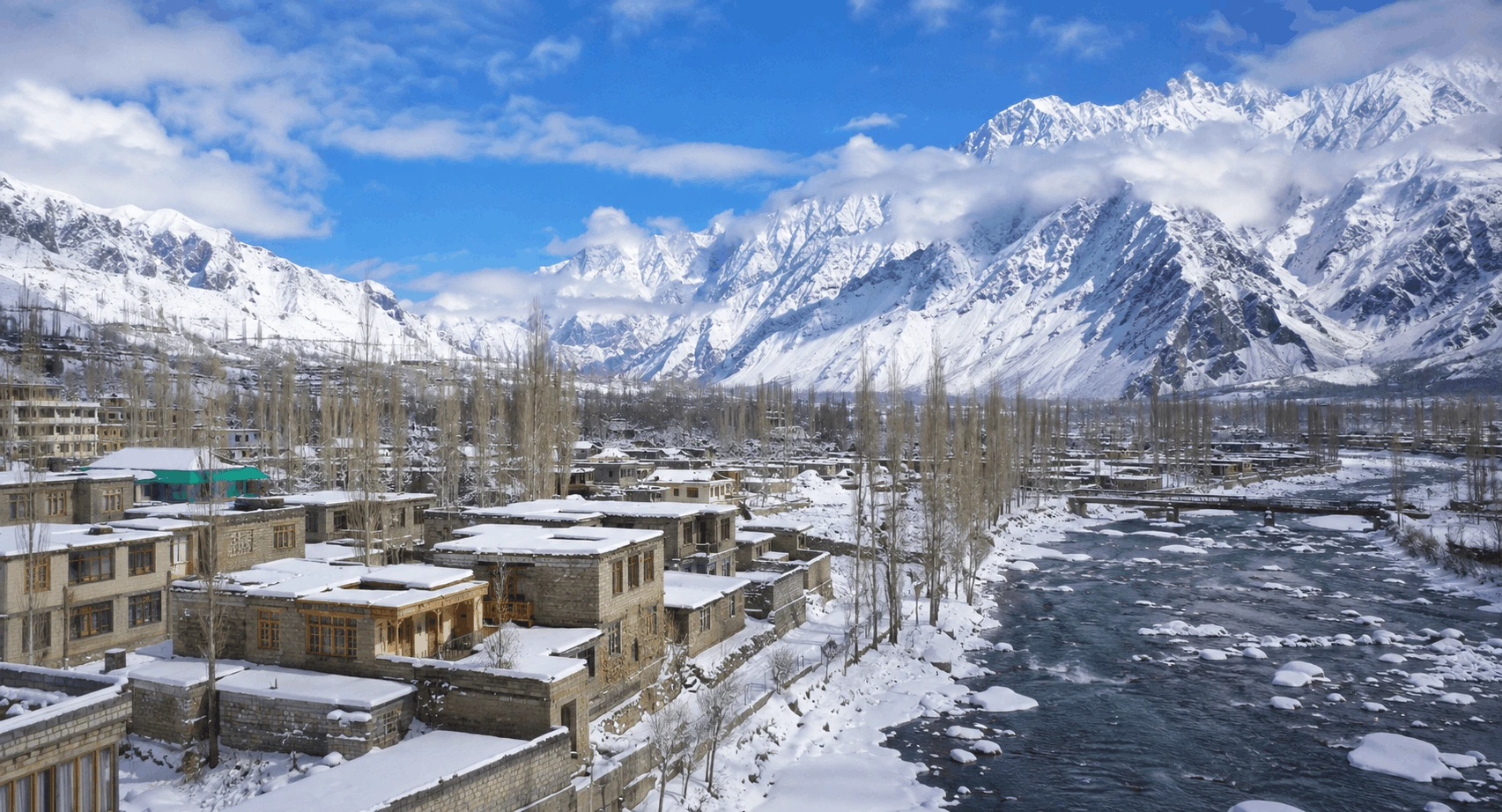
Elevation is the starting point. Skardu sits at roughly 2,200 to 2,300 meters, in a valley surrounded by the Karakoram range, home to K2 and several other eight-thousand-meter peaks. Temperature falls with altitude, and the surrounding peaks funnel cold air down into the valley overnight.
The region’s dry, continental climate adds to this. Gilgit-Baltistan sees relatively little cloud cover through winter, and clear nights let the heat absorbed during the day radiate back out quickly, a major reason overnight minimums drop so far below daytime highs.
Distance from moisture-bearing weather systems is the third piece. Mountain ranges largely shield the area from the monsoon patterns that bring more cloud cover elsewhere in South Asia. Less cloud cover at night means less atmospheric insulation, and colder lows.
Does the Coldest Place in Pakistan Get the Most Snow?

Not necessarily. In the same January 2024 PMD report that recorded Skardu’s −10.7°C reading, its coldest of that season PMD described most of the country, including the north, as largely snowless that month.
Extreme cold and heavy snowfall come from different conditions. Cold needs clear skies and dry air, which is also what suppresses snow. Snow needs enough atmospheric moisture, usually carried in by weather systems that tend to moderate temperatures somewhat at the same time. A dry winter can leave Skardu bitterly cold with bare ground; a wetter one can bring heavier snow alongside slightly less extreme overnight lows.
If snow itself is the goal, check recent snowfall reports for the specific travel window rather than assuming the coldest destination is automatically the snowiest.
Best Time to Experience Extreme Cold
PMD’s summaries consistently identify January as Pakistan’s coldest month nationally, though December has produced very low readings in some recent years, including 2019. February tends to run a little milder but is still solidly sub-zero overnight across Gilgit-Baltistan.
For the most extreme cold specifically, mid-December through late January is the strongest window. For guaranteed snow rather than the absolute lowest temperature, check seasonal forecasts closer to travel dates.
What Is Winter Like in Skardu?

Road and flight access can both be affected by winter weather. The Karakoram Highway is generally usable through the season, but sections can close temporarily after heavy snowfall, and flights between Islamabad and Skardu are sometimes cancelled or delayed in poor conditions. Neither mode of travel should be assumed guaranteed during peak winter check current flight schedules and road status close to your travel dates rather than relying on general seasonal expectations.
Hotel availability in Skardu is generally more limited in winter than during the summer trekking season, and it’s worth confirming that a specific property is open and heated before booking, rather than assuming year-round operation.
Travelers commonly describe the cold as sharp and dry rather than damp, manageable with the right layers, but noticeably harsher after dark. Daytime highs in direct sun can feel deceptively mild, followed by a steep drop once the sun sets.
Skardu vs Hunza: Which Is Colder?
Based on Skardu’s PMD-documented figures and the general seasonal pattern reported for Hunza across climate and tourism sources, Skardu generally experiences colder winter overnight temperatures than Hunza. Hunza sits at somewhat lower elevation in a more sheltered valley, which tends to moderate its overnight lows.
That doesn’t make Hunza mild, winter nights there still fall well below freezing. For the more extreme cold-weather experience, Skardu is the stronger choice. For dramatic winter scenery with a somewhat gentler climate, Hunza is the more forgiving option.
Sources and Methodology
The temperature figures above come primarily from Pakistan Meteorological Department monthly climate summaries, published by its Climate Data Processing Centre, and from official or state-media reporting that directly cites named PMD data. A few distinctions are worth being explicit about:
A historical extreme and a recent monthly record are different kinds of data. Skardu’s widely cited ≈−24°C figure, if accurate, would reflect the coldest reading across decades of monitoring; its −10.7°C reading is specific to January 2024 and can be exceeded or missed in other years.
Where a claim traces only to secondary sources that don’t cite a primary PMD document including the ≈−24°C Skardu figure and several entries found on Wikipedia’s list of Pakistani weather extremes, it’s flagged as such rather than presented with the same confidence as figures pulled directly from PMD’s own monthly summaries. Quetta’s −18.3°C figure sits in between: it traces to a PMD-published extremes page, but this research accessed that record via a secondary citation and archived snapshot rather than opening PMD’s own page directly.
Where two official-adjacent sources gave conflicting details for the same event, the primary PMD document was treated as authoritative. This came up with Astore’s January 2025 record, where a secondary government report cited a different date than PMD’s own monthly summary for the identical temperature reading, PMD’s own document (January 9) was used.
A similar conflict came up with a reported December 2024 Skardu figure, where the same secondary report gave two different numbers (−13.2°C in its narrative text and −13.0°C in its own summary table) for what appears to be the same night. Because this couldn’t be resolved against PMD’s own December 2024 monthly summary, that figure has been left out of the records table rather than guessed at.
Broad seasonal ranges common on travel sites (for example, “Skardu: −10°C to −25°C”) are useful for general planning but aren’t treated here as equivalent to a dated, sourced reading, and aren’t used in the records table above.
Frequently Asked Questions
What is the coldest place in Pakistan?
Skardu is the strongest documented candidate among inhabited, officially monitored locations, based on repeated PMD monthly reports naming it the country’s coolest station in several recent winters.
Which is the coldest city in Pakistan?
Skardu has the best multi-year evidence, though PMD’s own data shows the monthly record occasionally shifting to nearby stations like Astore.
What is the coldest region in Pakistan?
Gilgit-Baltistan. It includes Skardu, Astore, Gupis, Gilgit, and Hunza, and its stations consistently rank among the coldest in PMD’s monthly reports.
What is the lowest temperature ever recorded in Pakistan?
Among documented figures, Skardu’s −20.7°C reading in December 2019 and its widely cited historical figure near −24°C from 1995 are the lowest commonly referenced numbers, though the 1995 figure isn’t traceable to a primary PMD document in this research.
Is Skardu colder than Astore?
Usually, but not always. PMD recorded Astore as colder than Skardu in January 2025.
Why is Skardu so cold?
High elevation, a dry continental climate with clear night skies, and distance from moisture-bearing weather systems combine to push overnight temperatures well below freezing.
Does the coldest place in Pakistan always get the most snow?
No. Skardu recorded −10.7°C in January 2024, a month PMD described as largely snowless nationally.
Is Skardu colder than Hunza?
Generally yes. Hunza’s lower elevation and more sheltered valley tend to keep its overnight lows less extreme.
What is Pakistan’s coldest month?
January, according to PMD’s historical summaries, though December has produced very low readings in some recent years.
Can you visit Skardu in winter?
Yes, though access depends on conditions. Flights and road routes can both be affected by snowfall, so it’s worth checking current status before travelling rather than assuming standard schedules will hold.
What should I pack for winter in Skardu?
Thermal base layers, an insulated jacket, warm gloves, and thick wool or thermal socks form the core of a winter kit. Sturdy, waterproof footwear matters as much as insulation, since packed snow and ice are common underfoot. Because the cold in Skardu is driven by dry air and clear skies rather than humidity, a windproof outer layer is just as important as warmth.


This Post Has One Comment