
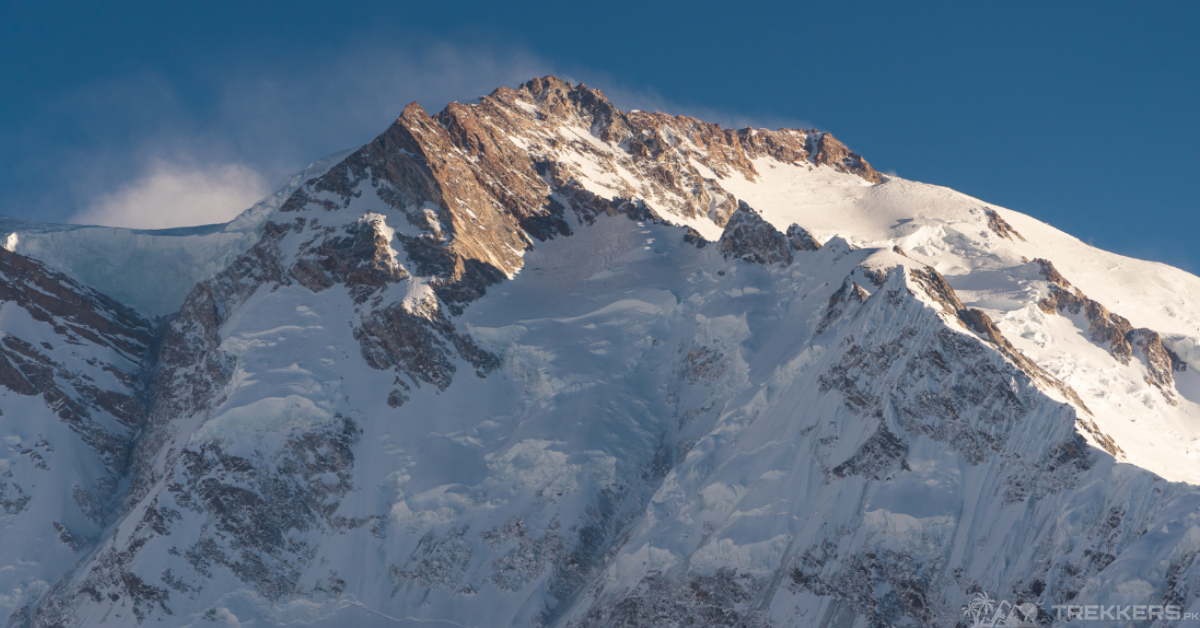
The Killer Mountain – Nanga Parbat is the ninth-highest mountain in the world, perched at the breathtaking elevation of 8,126 m. The Naked Mountain is situated in the western Himalayas, Gilgit-Baltistan region of Pakistan-administered Kashmir. Though it is notoriously known for being quite a challenging climb, it is still one of the best mountains to climb to the top. This guide to Nanga Parbat will tell you everything you need to know about the killer mountain!
Viewing the world from Pakistan’s second-highest mountain is every mountaineer’s dream. As it has one of the best sceneries you will ever get to witness. The eight-thousander is known for its constant rockfall and unpredictable weather, making the climb harder than other mountains.
Nanga Parbat, the mountain, got its name the ‘Killer Mountain’ because of the number of climber fatalities. Nonetheless, with sufficient training, information about the mountain, and suitable gear that I will provide here in this guide to Nanga Parbat, you can conquer the extremely grueling yet thrilling excursion. This is based on my personal experience of climbing the majestic Nanga Parbat!
Knowing and researching every route to the mountain is an integral part of planning to climb any mountain. So, let’s start our exhilarating guide to Nanga Parbat!

Faces of Nanga Parbat:
Nanga Parbat has three faces: the Rakhiot East Face, the Diamir West Face route, and the Rupal South Face. Each face has multiple routes that you can choose according to your safety and convenience.
The western side of Nanga Parbat is Diamir. It has about six routes: the Kinshofer Route (1962, original route), the Modern version of the Kinshofer route, the Route of the Messner brothers 1970, the Solo route of Reinhold Messner, 1978, the Slovenian Route, 2011, the Solo route of Reinhold Messner, 1978. And the Pre-summit section of the Schell route ( Schell route) which has a few rarely used variant routes.
The southern and easiest face of the Nanga Parbat is the Rupal face. The Rupal face has the following routes; South South East Spur (Messner Route), Upper Southwest Ridge (Schell Route), Southeast Pillar, Direct South –East Face, Direct South East Face – Central Pillar, and the South Face Direct route. Steep slopes and icy terrains make the Rupal face the least used face for ascent.
Rakhiot’s face is more popular than Rupal’s face, which is located on the eastern side. Mountaineers choose Rakhiot Face for its breathtaking and picturesque routes. It includes the Rakhiot Glacier and East Ridge, the Japanese route, and the Rakhiot Face – Pilar Val Fiemme route. Though Rakhiot Face has the best scenery, Diamir Face is still the most used route. It is because of its well-established routes, safer ascent, and enchanting view. Hence, I would recommend the Diamir face of the Nanga Parbat when climbing the heavenly mountain for the first time.
Having complete knowledge about all the routes, Diamir, Rupal, and Rakhiot, is beneficial to your journey. But there is always some fear of the unpredictable cold weather of Gilgit. It can make this trip more challenging than it already is. Prepare for every possible scenario to have a safe and successful trip because nature can be unforeseeable.
Appropriate Gear:
It is necessary to pack the appropriate gear like a helmet, ice axes, crampons, harnesses, ropes, a flashlight, a GPS device, food, water, a reliable backpack, sturdy hiking boots, and warm clothes, along with other necessities. These essentials will play a huge part in making your journey easier.
Weather at Nanga Parbat:
The Killer Mountain is on the list of the world’s most deadly mountains because of the perilous weather and the extremely hard route. While climbing the mountain, it is important to acclimatize as the weather can cause altitude sickness.
There are three base camps for acclimatizing during the climbing Nanga Parbat journey. They are the Rakhiot base camp on the north side, near Fairy Meadows, and the Diamir base camp on the west side. It is the most commonly used these days to climb the Kinshofer route and the Herrligkoffer base camp on the south side at the foot of the Rupal’s face.
Other than these campsites, there are multiple camps on different elevations to help you acclimatize and rest because overworking yourself during such a climb can be risky.

Conclusion:
Nanga Parbat, considered one of the most difficult mountains, takes almost more than a month to climb. It takes a lot to experience the glorious scenery at 8,126 meters. The remarkable sight is worth every minor risk during the climb. Surrounded by other majestic peaks and lush greenery, it finally feels blissful after a long trip.
Having a practical strategy about the routes and base camps you want to choose, along with strenuous training, will lead you to a victorious climb. You need to be an experienced Mountaineer to reach the top of the mystical Nanga Parbat. Because it is quite a complex journey to the summit, though it is one of the most breathtakingly beautiful mountains. It is still going to be one of the most dangerous climbs of your life.
So, to have a free-from-danger journey, prepare for the worst and be aware of everything with a proper guide to Nanga Parbat before stepping into the hike of your life.


This Post Has One Comment