
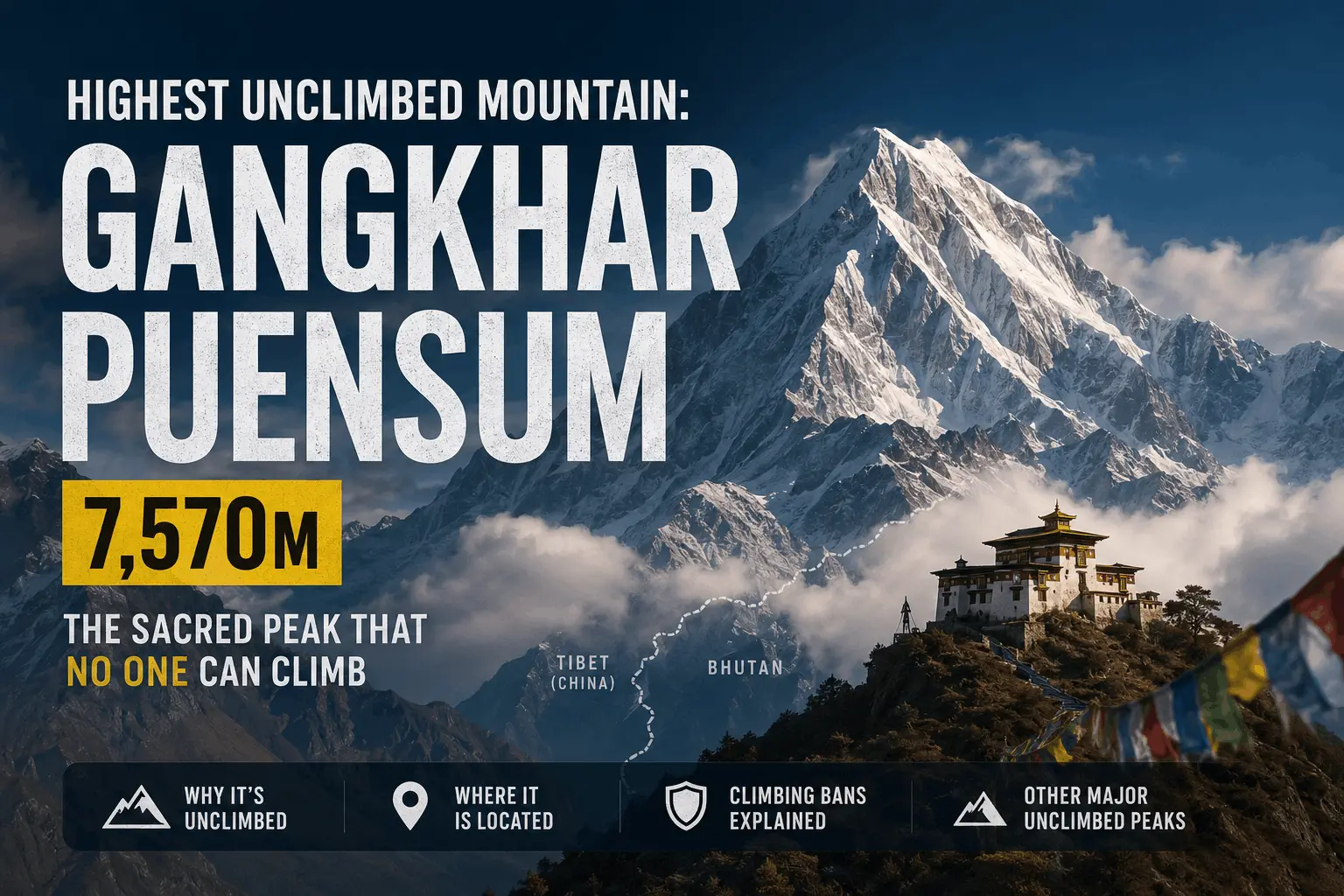
Gangkhar Puensum, rising 7,570 meters (24,836 ft) on the border between Bhutan and Tibet, is the highest unclimbed mountain in the world. It has never been summited, and a legal ascent is currently not possible under Bhutan’s mountaineering restrictions. Bhutan banned climbing above 6,000 meters in 1994 and banned mountaineering entirely in 2003.
That single fact answers the headline question, but it opens a much longer one: which unclimbed peaks can actually still be attempted, where are they, and what separates a mountain that’s simply hard from one that’s legally off the table? This guide covers both, using the most current, verifiable status of each peak so you’re not working from outdated claims.
Table of Contents
What Is the Highest Unclimbed Mountain in the World?

Gangkhar Puensum (7,570 m / 24,836 ft) is the highest unclimbed mountain in the world, sitting on Bhutan’s border with the Tibet Autonomous Region of China. It remains untouched because Bhutan’s government banned all mountaineering nationwide in 2003, following an earlier 1994 ban on peaks above 6,000 meters, out of respect for spiritual beliefs that hold the mountain sacred.
Ranking “unclimbed” mountains isn’t as tidy as it sounds. Mapping in remote parts of the Himalaya and Karakoram has historically been unreliable, and there’s no single accepted cutoff for when a subsidiary summit counts as its own mountain versus a bump on a larger massif. Topographic prominence, a separate measurement of how much a peak rises above the surrounding terrain and its nearest higher neighbor, is how researchers try to draw that line, but different organizations apply different thresholds, so the same summit can be called an independent mountain by one source and a subpeak by another. Under nearly every methodology, Gangkhar Puensum’s prominence of about 2,995 meters is high enough that it is universally treated as a genuinely independent mountain, and therefore the clear number one.
Why Has Nobody Climbed Gangkhar Puensum?

Two forces keep the summit untouched: a legal ban rooted in religious belief, and a mountain that beat back every serious attempt before that ban even existed.
Four failed expeditions in the 1980s. When Bhutan briefly opened to mountaineering in 1983, four separate teams tried for the top between 1985 and 1986:
- A 1985 Japanese team from the Himalayan Association of Japan turned back after a serac fall injured a climber and one member developed pulmonary edema.
- A 1985 American party, which included well known climbers Yvon Chouinard and John Roskelley, could not find a viable approach route to the peak itself and ended up climbing lower neighboring summits instead.
- A 1986 Austrian expedition abandoned its attempt when the monsoon arrived early.
- A final 1986 British American New Zealand team got closest, reaching a high camp before punishing wind stopped their summit push after just 120 meters of fixed rope.
The bans that followed. In 1994, Bhutan prohibited climbing on any peak above 6,000 meters, citing the belief that high summits are the homes of protective deities. In 2003, that was expanded into a complete nationwide ban on mountaineering. A brief loophole appeared in 1998, when China’s mountaineering association issued a Japanese team a permit to climb from the Tibetan side. Bhutan objected, the permit was withdrawn for the main peak, and the team instead summited the subsidiary peak Liankang Kangri, sometimes listed around 7,534 to 7,535 meters, separated from the main summit by a ridge to the north.
A practical reason, too. Beyond the spiritual rationale, Bhutan has cited its lack of high altitude rescue infrastructure. There is no equivalent of Nepal’s helicopter evacuation network anywhere near Gangkhar Puensum, which makes any accident on the mountain extremely difficult to respond to.
Where Is Gangkhar Puensum Located?

Gangkhar Puensum sits in Bhutan’s remote Gasa district, directly on the border with the Tibet Autonomous Region of China. For decades, its exact position and elevation were genuinely disputed. Early twentieth century maps placed it in different locations with different heights, and the nearby peak Kula Kangri (around 7,538 to 7,554 meters, depending on the source), long assumed by some to be Tibet’s tallest mountain, complicated the picture further since the two summits sit only about 30 km apart.
The border question isn’t purely academic. It’s the reason the 1998 Japanese permit fell apart: China could authorize a climb from its side, but Bhutan controls the main summit, and the two governments did not agree on exactly where the line runs.
Unclimbed vs. Forbidden: A Distinction Most Articles Skip

Not every unclimbed mountain is banned, and not every banned mountain is technically unclimbable. Conflating the two is one of the most common mistakes in coverage of this topic, and it matters if you are trying to figure out where an actual expedition could still happen.
| Aspect | Unclimbed Peaks | Forbidden Peaks |
|---|---|---|
| Definition | No recorded successful summit | Legally or culturally off limits to attempt |
| Why | Remoteness, technical difficulty, harsh weather, lack of documentation | Government bans, religious prohibition |
| Permits | Sometimes available, though access can be extremely limited | Not issued, or issued and then revoked |
| Example | Lapche Kang II, also called Labuche Kang III (Tibet), still unclimbed, no ban | Gangkhar Puensum (Bhutan), banned outright |
Gangkhar Puensum is both unclimbed and forbidden. A third category sits between these two and is easy to miss: peaks blocked mainly by military control of a contested border, rather than by any formal climbing ban. Apsarasas Kangri I, discussed below, is the clearest example. It is neither banned by any government nor genuinely accessible in practice.
The Highest Unclimbed Mountain Without a Known Climbing Ban

This is where the picture changes fastest, and it depends heavily on how a mountain gets counted.
By raw elevation alone, ignoring prominence, the two tallest currently reported unclimbed peaks after Gangkhar Puensum are Kunyang Chhish West (7,350 m) and Summa Ri (7,302 m), both in Pakistan’s Karakoram range. Neither is known to be subject to a government climbing ban, although the absence of a known ban does not automatically mean that an expedition can obtain all necessary permits or access. But both are low prominence summits, roughly 202 meters and 246 meters respectively, hanging off larger parent massifs. By the same reasoning that leads most specialist researchers to exclude Muchu Chhish from “highest unclimbed mountain” claims, since Muchu Chhish carried only about 263 meters of prominence, a number of mountaineering researchers, including Eberhard Jurgalski’s team at 8000ers.com, decline to count Kunyang Chhish West or Summa Ri as fully independent mountains either.
Under that stricter, prominence based definition of an independent mountain, the highest unclimbed peak that carries no government ban is a 7,250 meter summit in Tibet’s Labuche Kang massif, with about 570 meters of prominence. Sources disagree on what to call it. Guide operators and some travel focused sources usually label it Labuche Kang III or Labuche Kang III/East. The American Alpine Journal and Jurgalski’s research refer to the same mountain as Lapche Kang II. It is not the same peak as Lobuche East, a popular 6,119 meter trekking summit near Everest, despite the similar spelling. A Polish team attempted it in 2016 and retreated below 6,907 meters. Himalayan guide Luke Smithwick also led a reported 2018 expedition on the peak that turned back short of the summit due to a forecast of dangerous weather, though independent published documentation of that specific attempt is thinner than for the 2016 climb.
Two more names round out the discussion of highest unclimbed independent peaks, and both illustrate why “not banned” does not mean “accessible.” Apsarasas Kangri I (roughly 7,243 to 7,245 meters, sources vary slightly) sits in the militarized Siachen Glacier region on the disputed India, Pakistan, and China border. Its main summit has never been climbed, though a subsidiary top in the same massif, Apsarasas Kangri II, was reached by a Japanese team from Osaka University in 1976. That earlier ascent is why some older sources have mislabeled the whole massif as climbed. Ongoing military control of the area, not any single climbing law, is what has kept expeditions out for years. Tongshanjiabu (7,207 m) sits directly on the Bhutan side of the same border zone as Gangkhar Puensum and falls under Bhutan’s blanket mountaineering ban, which makes it forbidden rather than merely difficult.
One name that used to appear on every version of this list no longer belongs here. Karjiang I (7,221 m), also on the Tibet and Bhutan border, was widely cited through 2023 as the fourth highest unclimbed independent peak. Chinese climbers Liu Yang and Song Yuancheng made its first ascent on August 13, 2024, via a new route called Buzzer Beater on the southwest face, with a second ascent by a different Chinese team the following month. Any current source still listing Karjiang as unclimbed is working from data that predates that climb.
Given all of these caveats, the fairest summary depends on how you define a mountain. By raw elevation, Kunyang Chhish West at 7,350 meters is higher and has no known government climbing ban, although its low prominence makes its status as an independent mountain debatable. Under a stricter prominence based definition of an independent mountain, the 7,250 meter Lapche Kang II is the stronger answer. Kunyang Chhish West and Summa Ri stand taller in raw elevation and remain genuinely unclimbed, but their classification as separate mountains, rather than high points on a larger massif, is exactly the kind of question that made Muchu Chhish’s old claim to fame so contested in the first place.
The World’s Highest Unclimbed Peaks, Ranked

Quick answer: By raw elevation, Kunyang Chhish West at 7,350 meters is the highest currently reported unclimbed peak without a known government climbing ban. Under a stricter independent mountain definition based on topographic prominence, the 7,250 meter Lapche Kang II is the stronger answer. Gangkhar Puensum at 7,570 meters remains the world’s highest unclimbed mountain overall, but climbing it is prohibited under Bhutan’s mountaineering restrictions.
The table below uses a broader methodology than the strict independent mountain standard discussed above. It reflects a widely cited compilation, attributed to Eberhard Jurgalski and last updated around November 2025, that counts any summit with at least 150 meters of prominence as its own peak. Because that threshold is lower than the standard used in the previous section, this list includes summits such as Kunyang Chhish West and Summa Ri that a stricter definition would treat as subsidiary tops rather than independent mountains.
| Rank | Peak | Height (m) | Prominence (m) | Location |
|---|---|---|---|---|
| 1 | Gangkhar Puensum | 7,570 | 2,995 | Bhutan/China |
| 2 | Kunyang Chhish West | 7,350 | 202 | Pakistan |
| 3 | Summa Ri | 7,302 | 246 | Pakistan |
| 4 | Lapche Kang II (also called Labuche Kang III) | 7,250 | 570 | China |
| 5 | Apsarasas Kangri I | 7,243 | 607 | India/China |
| 6 | Tongshanjiabu | 7,207 | 1,757 | Bhutan/China |
| 7 | Skyang Kangri West | 7,174 | 194 | Pakistan |
| 8 | Chamar South | 7,161 | 219 | Nepal |
| 9 | Namcha Barwa II | 7,146 | 166 | China |
| 10 | Chongtar Kangri NE | 7,145 | 205 | China |
Under this methodology, at least 21 peaks above 7,000 meters were considered unclimbed in the November 2025 snapshot behind this table. That number is not fixed. It can change when a peak is climbed, when new expedition records are documented, or when researchers revise how individual summits are classified. Karjiang I, for example, was removed from older unclimbed lists after its first ascent in August 2024. Treat the 21 peak figure as a dated research snapshot rather than a permanent total. Rows 7 through 10 above have not been individually reverified beyond that snapshot, so their status should be treated as reported rather than independently confirmed here. Apsarasas Kangri I’s main summit, as explained above, is distinct from the already climbed subsidiary top Apsarasas Kangri II in the same massif.
Is There a Highest Unclimbed Mountain in North America or Europe?
Nearly every peak above 7,000 meters left unclimbed sits in the Himalaya, Karakoram, or the Tibetan Plateau. That concentration is worth explaining, because it is also why searches for unclimbed giants on other continents tend to come up short.
North America
There is no widely recognized unclimbed peak in North America anywhere close to 7,000 meters. Denali (6,190 m), the continent’s highest mountain, was first summited in 1913. While obscure and low prominence subpeaks may remain without well documented ascents, North America has no known unclimbed giant comparable in elevation to the major Himalayan and Karakoram peaks discussed here. What may remain are smaller, obscure subpeaks in genuinely remote corners of Alaska and the Yukon that have simply never been formally documented one way or the other, since proving a negative across an entire mountain range is not realistic. None of these carry the elevation or the notoriety of the Himalayan giants.
Europe
No widely recognized European peak with substantial topographic prominence is generally regarded as unclimbed. The major summits of the Alps, Caucasus, and Scandinavian ranges have long climbing histories, although minor subsidiary summits, rock towers, and poorly documented features may still lack recorded ascents. If you’re looking for a European equivalent of Gangkhar Puensum, no comparable high prominence unclimbed mountain is widely recognized.
Pakistan’s Untouched Giants

Pakistan’s Karakoram range holds more unclimbed 7,000 meter peaks with no government climbing ban than anywhere else on Earth outside Bhutan’s forbidden zone. Three names dominate the conversation.
Kunyang Chhish West (7,350 m) is the highest currently reported unclimbed peak in Pakistan by raw elevation and lies in the Karakoram of Gilgit Baltistan. It is not known to be subject to a government climbing ban, although its low prominence of about 202 meters means specialists disagree over whether it should be counted as a fully independent mountain. As explained above, its modest prominence of about 202 meters means specialists are genuinely divided on whether it counts as a fully independent mountain or a high subsidiary top of the larger Kunyang Chhish massif, whose main summit was first climbed in 1971.
Summa Ri (7,302 m, prominence about 246 m) sits within glaciated, crevasse prone terrain typical of the Karakoram, though detailed, publicly available route information for the peak remains limited. It has never been attempted, at least based on currently available expedition records.
Muchu Chhish (7,453 m) is the name people still search for most, but it’s worth being direct: it is no longer unclimbed. A three member Czech team reached its summit in July 2024, after a route described as less a technical climb than a grueling, oxygen starved hike across knife thin ice ridges near the top. Worth noting too: with only about 263 meters of topographic prominence, most specialist sources never counted Muchu Chhish as a fully independent mountain in the first place, even before it was climbed, since it is more precisely described as a high subsidiary summit of the Batura Wall. Any article still listing it as untouched, or as the definitive “highest unclimbed mountain,” is working from outdated or imprecise data.
The Karakoram’s dominance on this list comes down to geography. It is the second highest mountain range on Earth after the Himalaya proper, packed with peaks above 7,000 meters in a compact, glacier choked area with minimal infrastructure. Where Bhutan blocks climbers with law, Pakistan’s Karakoram blocks them with sheer physical difficulty: brutal approaches, avalanche prone faces, and short weather windows that leave little margin for error.
Overlooked insight: climbers researching genuinely unclimbed Karakoram objectives typically start with the American Alpine Journal or the Himalayan Journal to check whether a peak has any recorded attempt history, then check satellite imagery against expedition reports to assess access routes, since ground level route information for these peaks is often thin or nonexistent.
Frequently Asked Questions
Is Gangkhar Puensum the highest unclimbed mountain?
Yes. At 7,570 meters, it is the highest peak in the world with no recorded successful ascent, and the only major contender that is both physically forbidding and legally banned.
Why is Gangkhar Puensum unclimbed?
Bhutan banned all mountaineering nationwide in 2003, following a 1994 ban on peaks above 6,000 meters, based on the belief that high summits are sacred homes to protective deities. Four expeditions failed to reach the top in 1985 and 1986, before the ban existed.
Where is the highest unclimbed mountain in the world?

Gangkhar Puensum sits in Bhutan’s remote Gasa district, on the disputed border with the Tibet Autonomous Region of China.
What is the highest unclimbed mountain that’s legal to climb?
Kunyang Chhish West (7,350 m) in Pakistan is the highest unclimbed peak with no government ban, following Muchu Chhish’s 2024 ascent. Many specialists, however, reserve the stricter title of highest unclimbed independent mountain for a 7,250 meter summit in Tibet’s Labuche Kang massif, also called Lapche Kang II, since Kunyang Chhish West’s low prominence puts its status as a separate mountain in question.
Are there any unclimbed mountains left?
Yes. At least 21 peaks above 7,000 meters had no recorded successful summit under Eberhard Jurgalski’s November 2025 survey, a count that continues to shrink as ascents occur, including Karjiang I’s first ascent in August 2024.
What is the highest unclimbed mountain in North America?
None come close to the Himalayan giants. Nearly all major North American peaks have been climbed; what may remain are obscure, low elevation subpeaks in remote parts of Alaska and the Yukon.
What is the highest unclimbed mountain in Europe?
None with meaningful prominence. Europe’s mountaineering history is old enough that essentially every significant summit has been climbed; only minor technical subpeaks remain untouched.
What is the highest unclimbed mountain in Pakistan?
Kunyang Chhish West (7,350 m), followed by Summa Ri (7,302 m), both in the Karakoram range, though Kunyang Chhish West’s independence as a mountain is disputed due to its low prominence.
Which peak is called Killer Mountain?
Nanga Parbat (8,126 m), nicknamed for its historically high fatality rate and its notoriously dangerous Rupal Face, one of the tallest mountain faces on Earth.


This Post Has 3 Comments