
Table of Contents

What Is Hunza Valley?
Hunza Valley is a high-altitude mountain valley in Gilgit-Baltistan, Pakistan, carved out over millennia by the Hunza River as it winds through the western Karakoram range. It sits at a base elevation of roughly 2,438 metres (8,000 feet), with surrounding peaks rising well above 7,000 metres.
The valley has been called many things the Shangri-La of the East, the roof of Pakistan, the valley of long life and while every one of those labels carries some marketing weight, none of them are entirely wrong either.
What makes Hunza genuinely special is the combination of things that rarely exist in one place: dramatic mountain scenery on a scale that photographs simply cannot communicate, a culture distinctly unlike anything else in South Asia, food rooted in organic farming traditions, and an openness and warmth in the local people that disarms even the most cautious traveller.
The valley is divided into three geographic zones: Upper Hunza (Gojal), Central Hunza, and Lower Hunza (Shinaki). Most tourists spend the majority of their time in Central Hunza, based in the town of Karimabad, with day trips into Gojal (Upper Hunza) to reach Attabad Lake, Passu Cones, and the Khunjerab Pass.
Quick Answer: Hunza Valley is located in the Gilgit-Baltistan region of northern Pakistan, within the Karakoram mountain range, approximately 570 km from Islamabad by road.
Where Is Hunza Valley Located?
Hunza Valley lies in the far north of Pakistan, within the Gilgit-Baltistan territory an administratively distinct region that is neither a province nor a settled territory in the conventional sense. It shares its borders with China’s Xinjiang region to the northeast, Afghanistan’s Wakhan Corridor to the north (via the Chapursan sub-valley), and the Nagar district to the east across the Hunza River.
The valley runs roughly northwest to southeast, following the course of the Hunza River. The Karakoram Highway one of the highest paved roads in the world threads directly through the valley, connecting Islamabad to Kashgar in China’s Xinjiang province via the Khunjerab Pass.
Coordinates: 36.3°N, 74.6°E. It is geographically closer to Beijing than to Karachi.
A Brief History of Hunza Valley
The Hunza Valley has been inhabited for thousands of years, and its position along ancient Silk Road trade routes shaped its history as much as any single ruler or kingdom.
From Buddhism to Islam
Before Islam arrived in the region, Buddhism was the predominant faith. Evidence of that era survives in the form of petroglyphs at the Sacred Rock of Hunza near Ganish carved images of mounted horsemen, ibex, and inscriptions in the Brahmi and Kharoshti scripts, some dating back to the Kushan period. The rock also bears names of Saka and Pahlava rulers, pointing to trade and political contact that stretched across the Karakoram into Central Asia.
Islam gradually replaced Buddhism as the dominant religion, and today the valley’s ancient Buddhist sites are being carefully restored after centuries of neglect.
The Mirs of Hunza
Hunza developed as a distinct political entity around 997 CE and crystallised into a principality by the 15th century under the Ayash ruling dynasty. The rulers were called Mirs, and their two great strongholds Baltit Fort above Karimabad and Altit Fort further downstream still stand today.
For centuries, Hunza existed in a complex web of tribute relationships. It paid an annual token tribute (16 tolas of gold dust) to Chinese authorities in Yarkand in exchange for territorial rights in the Raskam Valley. The valley remained fiercely independent even as empires rose and fell around it.
The British Period
The late 19th century brought Hunza into conflict with the expanding British Raj. In 1891, British forces defeated the combined resistance of the Nagar and Hunza states in the Battle of Nilt a fierce engagement in which over 100 Nagaris lost their lives. Following victory, the British installed Mir Nazim Khan as a nominally independent ruler while exercising real control through appointed officers.
The princely states of Hunza and Nagar continued in that form until 1974, when Prime Minister Zulfikar Ali Bhutto formally dissolved them and integrated the region into Pakistan’s Northern Areas, now the Gilgit-Baltistan Assembly.
The 2010 Attabad Landslide
On 4 January 2010, a catastrophic landslide at Attabad blocked the Hunza River, killed 20 people, displaced hundreds of families, and submerged approximately 26 km of the Karakoram Highway. As the river backed up, it formed what is now called Attabad Lake an extraordinary, glacier-blue body of water stretching 30 km and reaching depths of over 100 metres.
It is, in a strange way, one of the most visited attractions in Hunza today. The human cost behind its creation should never be forgotten, but the lake itself has become undeniably beautiful.
Best Time to Visit Hunza Valley
| Season & Months | Key Visuals | Weather & Vibes | Best For |
| Spring (Mid-Mar – Mid-Apr) | Pink & white apricot blossoms | Mild days, freezing nights. Advance booking required. | Photography & Culture |
| Summer (May – Sep) | Green valleys & open high passes | Warm days (20 – 28°C). Peak crowds. July/August GLOF road risks. | Trekking & First-Timers |
| Autumn (Mid-Oct – Mid-Nov) | Golden poplar trees & amber leaves | Cold weather. Less crowds and cheaper hotel rates. | Solitude & Budget Trips |
| Winter (Dec – Feb) | Heavy snow & frozen lakes | Below-zero cold. Most shops closed. Deep discount prices. | Winter Enthusiasts |
No single “best” month suits every type of traveller, because Hunza’s seasons each offer something quite different. Here is an honest breakdown.
Spring: Mid-March to Mid-April
Cherry, apricot, and apple blossoms carpet the valley in white and pink. The scent of apricot blossoms fills the air, and the entire valley floor shifts from stark grey rock to vibrant pink. This is widely considered one of the two most visually spectacular periods of the year. Temperatures are mild but dip cold after sunset. Accommodation books up fast — plan at least two months in advance for popular guesthouses.
Summer: May to September
The peak season and the best time for trekking, glacier walks, high-altitude hikes, and visiting the Khunjerab Pass. Days are warm at valley level (20–28°C typically) and skies are clearest in the mornings. July and August allow swimming in Borith Lake. The one genuine risk: Glacial Lake Outburst Floods (GLOFs) are a real hazard in July and August, occasionally disrupting road access on the KKH. Keep flexible itineraries.
Autumn: Mid-October to Mid-November
The poplar trees turn gold and amber, which many experienced travellers consider the most beautiful season of all. Tourism drops sharply, accommodation is readily available and cheaper. Nights become cold. Some higher trekking routes start to close by November.
Winter: December to February
Cold, quiet, and surprisingly compelling if you are prepared for temperatures well below zero. Snow closes some passes but not the main KKH. Very few tourists. If you want to experience Hunza at its most intimate and local, winter makes a strong case. Prices drop significantly across the board.
The verdict: May to September for first-time visitors and trekkers. Mid-March to April for blossom season. Mid-October to November for fall colours and solitude.
Hunza Valley Weather Overview
Weather is one of the highest-intent searches related to Hunza travellers plan their trips around it, and understanding the climate patterns at different altitudes is genuinely important before you go.
Climate Type
Hunza sits in an arid to semi-arid mountain climate zone. The Karakoram range creates a pronounced rain shadow, meaning the valley receives very little monsoon rainfall compared to most of Pakistan. Precipitation falls mostly as winter snow at higher elevations and occasional summer thunderstorms at valley level.
Month-by-Month Temperature Guide (Karimabad, ~2,400 m)
| Month | Avg. High (°C) | Avg. Low (°C) | Conditions |
|---|---|---|---|
| January | 3–5 | -8 to -10 | Cold, possible snow, very quiet |
| February | 6–8 | -6 to -8 | Cold, early blossom signs in warm years |
| March | 12–15 | -2 to 0 | Blossom season begins mid-month |
| April | 16–19 | 3–5 | Peak blossom; warming days, cold nights |
| May | 22–25 | 8–10 | Excellent; comfortable, skies clear |
| June | 27–30 | 12–14 | Hot at valley level, trekking season opens |
| July | 28–32 | 14–16 | Peak summer; GLOF risk on KKH |
| August | 27–30 | 13–15 | Hot; apricot harvest; GLOF risk |
| September | 22–25 | 8–10 | Excellent; cooling, clear skies |
| October | 15–18 | 2–4 | Fall colours begin mid-month |
| November | 8–10 | -3 to -5 | Late autumn; some routes closing |
| December | 3–5 | -7 to -9 | Winter sets in; quiet |
Temperature figures are approximate averages for Karimabad. Higher areas such as Passu and Khunjerab will be 5–10°C colder at equivalent times of year.
Checking Hunza Weather Before You Travel
Search trends show strong growth in queries like “Hunza weather next 15 days” and “Hunza temperature today,” indicating that travellers actively monitor conditions during trip planning. The Pakistan Meteorological Department (PMD) website and AccuWeather both carry Karimabad and Gilgit forecasts. For road condition alerts specific to the KKH, the NDMA Pakistan social channels and the Gilgit-Baltistan Disaster Management Authority (GBDMA) provide real-time updates during summer.
Practical note: Weather at 2,400 m (Karimabad) and at 4,700 m (Khunjerab Pass) can differ dramatically on the same day. Always check conditions at both altitudes before driving to the pass.
How to Get to Hunza Valley
Getting to Hunza takes genuine effort, but the journey particularly the final stretch along the Karakoram Highway is part of the experience.
By Air to Gilgit
The closest airport is Gilgit Airport (GIL), about 100 km south of Karimabad (a 2-hour drive). PIA operates daily flights from Islamabad, taking roughly one hour. However, the flight is notoriously weather-dependent cancellations are common, sometimes for multiple consecutive days, due to the narrow mountain corridor the aircraft must navigate. Do not book this flight if you are on a tight schedule.
From Gilgit, shared vans and private jeeps connect to Karimabad.
By Air to Skardu
Skardu Airport (KDU) is a larger, more reliable alternative. A one-hour flight from Islamabad lands you roughly 4 hours from Gilgit and 6 hours from Central Hunza by road. This option works well if you plan to combine Skardu and Hunza on a single trip.
By Road from Islamabad
The most common overland route follows the Karakoram Highway (N-35) north from Islamabad or Rawalpindi. The journey takes 18–24 hours depending on vehicle type and road conditions. Daewoo and Faisal Movers buses run to Gilgit, after which you transfer onward. Private vehicles and hired jeeps can drive directly to Karimabad.
Road conditions on the KKH are generally good but can be disrupted in summer by landslides and GLOFs. The section between Raikot Bridge and Chilas warrants extra caution, as do stretches near active glacial streams in July and August.
🗺️ Live Navigation: Use this verified (Google Maps Islamabad to Hunza Valley Driving Route) to track real-time road conditions, fuel stops, and your live driving itinerary.
By Shared Transport / Coaster Vans
The cheapest option for domestic travellers. Shared coaster vans depart from Rawalpindi’s Pir Wadhai bus terminal and Faizabad, typically overnight. The journey is cramped but functional and popular among budget-conscious Pakistani travellers.
Distances from Major Cities
| Origin | Distance to Karimabad (approx.) | Typical Travel Time |
|---|---|---|
| Islamabad | ~570 km | 18–24 hrs by road |
| Rawalpindi | ~580 km | 18–24 hrs by road |
| Lahore | ~950 km | 26–32 hrs by road |
| Karachi | ~2,100 km | 36–48 hrs by road (fly to ISB first) |
| Faisalabad | ~1,050 km | 28–34 hrs by road |
| Gilgit | ~100 km | 2–2.5 hrs by road |
| Skardu | ~220 km | 4–5 hrs by road |
| Naltar Valley | ~75 km from Karimabad | ~2.5–3 hrs by road (via Gilgit) |
| Khunjerab Pass (China border) | ~130 km | 2.5–3 hrs by road |
7-Day Hunza Valley Itinerary
A week is the minimum anyone should plan for Hunza. The valley is larger than it appears on a map, side valleys alone could occupy weeks, and rushing through landmark to landmark misses the real texture of the place. This itinerary is structured for first-time visitors arriving from Islamabad, with a balance of the must-see attractions and room to breathe.

Day 1: Arrival in Karimabad — Settle In and Orient
Arrive in Karimabad (by road overnight or via Gilgit flight + onward jeep). Check in, rest, and resist the urge to immediately rush somewhere. Walk the Karimabad bazaar in the afternoon buy dried apricots, look at the gemstone stalls, observe the town. In the evening, find a rooftop or guesthouse terrace facing Rakaposhi and Ultar Sar. This view, at golden hour, is your introduction to the scale of what surrounds you.
Day 2: Baltit Fort, Altit Fort, and Eagle’s Nest
Start at Baltit Fort (open morning, buy tickets at the gate) and spend 60–90 minutes exploring the architecture and the views over Karimabad. Then descend to Altit Fort and the old Altit village wander the stone alleys slowly. In the late afternoon, arrange a jeep to Eagle’s Nest (Duikar) for sunset. This viewpoint simultaneously frames Rakaposhi, Diran, Ultar Sar, and Golden Peak six or seven 7,000 m peaks visible at once. Get there 30 minutes before sunset.

Day 3: Attabad Lake and Upper Hunza
Drive north on the KKH through the tunnel section into Upper Hunza (Gojal). Stop at Attabad Lake for a boat ride 45–60 minutes on the electric-blue water is the right amount of time before the tourist activity around the shore begins to feel busy. Continue north to Gulmit village for lunch at Bozlanj Cafe (female-run, exceptional local cooking). In the afternoon, take the short hike up to Ondara Poygah for wide valley views before returning to Karimabad or staying in Gulmit overnight.
Day 4: Passu — Cones, Bridge, and Glacier
The drive from Gulmit to Passu takes 20 minutes. Spend the morning at Hussaini Bridge (cross it if you have the nerve), with the Passu Cones forming a spectacular backdrop. Then walk toward the Passu Glacier via Borith Lake. The glacier walk requires no mountaineering skill but does require sturdy shoes and an early start by midday the surface is less stable. Spend the night in Passu; the village has several small guesthouses with cone-facing terraces.
Day 5: Khunjerab Pass and Khunjerab National Park
An early departure from Passu for the two-hour drive to Khunjerab Pass (4,693 m). The road passes through Khunjerab National Park scan the hillsides for Marco Polo sheep, Himalayan ibex, and marmots. At the pass, walk along the border monument area. The altitude will be immediately noticeable move slowly, drink water, avoid any strenuous exertion. Return to Aliabad or Karimabad in the evening.
Day 6: Hopar Valley and Hopar Glacier (Nagar District)
Cross the Hunza River into Nagar district and drive up to Hopar Valley. The Hopar Glacier is the most accessible glacier in the broader region vehicles can reach a viewpoint very close to the ice face. The scale of the glacier and the lateral moraines surrounding it is striking. Hopar itself is a quiet village with guesthouses if you want to stay overnight or return to Karimabad.
Day 7: Ganish Village, Karimabad Bazaar, and Onward
Use the final morning for Ganish village, often skipped but historically the most significant settlement in all of Hunza. Walk through the ancient lanes, examine the watchtowers and petroglyphs, and consider that people have lived here continuously for over a thousand years. Return to Karimabad for last purchases at the bazaar dried apricots, walnut oil, handmade caps, embroidered goods. Depart for Gilgit in the afternoon for an onward flight or overnight bus to Islamabad.
For visitors with 10+ days: Add a night in Shimshal (if physically prepared), explore Chapursan Valley, do the Rakaposhi Base Camp trek from Minapin, or extend time in Passu and Gulmit. The valley rewards patience.

Top Places to Visit in Hunza Valley
1. Karimabad
The main town of Central Hunza and the base for most visitors. Karimabad sits at around 2,400 m on a terraced hillside above the KKH, with unobstructed views of Rakaposhi (7,788 m) and the glaciated Ultar Sar (7,388 m) directly above the town. The bazaar sells handmade rugs, semi-precious stones (garnet is locally abundant), dried apricots, and traditional embroidery.
2. Baltit Fort
Built roughly 800 years ago and serving as the official residence of the Mirs of Hunza for centuries, Baltit Fort stands directly above Karimabad at about 2,700 m. The fort shows clear Tibetan architectural influences reflecting a period when Hunza maintained close cultural ties with kingdoms to the east. It was restored in the 1990s through a collaboration between the Aga Khan Trust for Culture and local authorities. Entry requires a fee (approximately PKR 500–700 for foreigners; verify current rates locally). Allow 60–90 minutes.
3. Altit Fort
Older than Baltit and situated at the valley floor near Altit village, this fort dates back approximately 900 years. The surrounding Altit village is one of the oldest continuously inhabited settlements in Hunza, with narrow stone-paved lanes, low wooden doorways, and traditional homes that reward slow exploratory walking. The royal gardens adjacent to the fort have been restored and are pleasant in spring.
4. Eagle’s Nest (Duikar)
A viewpoint at roughly 2,900 m above Karimabad offering a sweeping panorama of six or seven major peaks simultaneously including Rakaposhi, Diran, Ultar Sar, and Golden Peak as well as the full width of the valley floor below. Sunrise and sunset are the most popular visiting times. No public transport operates to this point; hire a jeep or negotiate at the Karimabad taxi stand. Camping and drones are prohibited here.
5. Attabad Lake
A striking turquoise lake in Upper Hunza (Gojal), formed by the 2010 landslide that blocked the Hunza River. The water’s colour an almost artificial-looking electric blue-green comes from glacial mineral suspension. Boating is the primary activity; kayaks and paddleboats are available for hire. The KKH now passes through a series of tunnels constructed to bypass the submerged section of highway. A growing number of guesthouses and newer resort-style hotels line the shore.
6. Passu Cones (Tupopdan)
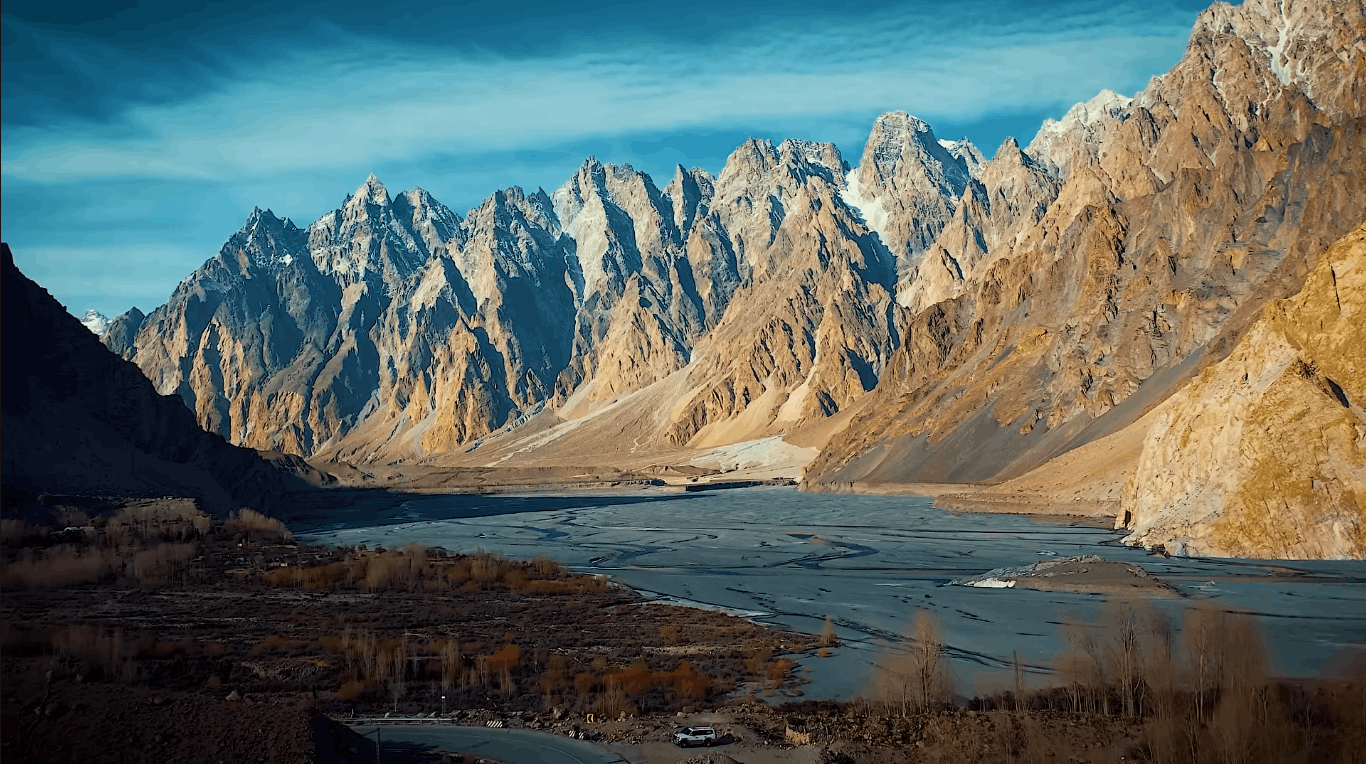
Among the most photographed formations in all of Pakistan, the Passu Cones are a cluster of razor-edged rock spires rising to around 6,106 m. They are visible from the KKH for several kilometres before you reach Passu village, and the views from Hussaini Bridge are particularly dramatic. No trekking permit is required for the village-level viewpoints.

7. Hussaini Suspension Bridge
A hand-built suspension footbridge spanning the Hunza River near Hussaini village, connecting the KKH side to the summer settlement of Zarabad. The bridge sways, the wooden planks have gaps, and crossing it requires genuine nerve though locals cross it daily without hesitation. A small fee now applies, and a zipline has been added. The Passu Cones form a dramatic backdrop.
8. Khunjerab Pass
At 4,693 m (15,397 feet), Khunjerab Pass is the highest paved international border crossing in the world, marking the boundary between Pakistan and China’s Xinjiang province. The drive through Khunjerab National Park home to Marco Polo sheep, Himalayan ibex, marmots, and the occasional snow leopard is itself an attraction. The pass is open seasonally (typically May to November). Pakistani nationals may visit the pass for a day; foreign tourists visiting the viewpoint area require a valid Chinese visa to cross into China.
9. Borith Lake
A naturally occurring saline lake situated between Ghulkin and Passu at high altitude, Borith Lake sits beneath snow-covered peaks and offers a rare combination of swimming (in summer), glacier access, and solitude. The lake is deep and cold even in July only confident swimmers should enter. Access via a short jeep track from the KKH.
10. Ganish Village
The oldest surviving village in Hunza, Ganish (also spelled Ganesh) contains ancient watchtowers, Buddhist petroglyphs, Silk Road-era caravanserai ruins, and traditional stone architecture that predates most of the well-known fortifications in the region. It is significantly undervisited relative to its historical importance and rewards slow, uncrowded exploration.
Hidden Gems and Overlooked Attractions
Shimshal Valley
A 45 km side road branching off the KKH leads to Shimshal, the highest permanently inhabited village in Hunza at over 3,100 m, and one of the most remote communities accessible by road in Pakistan. The road is unpaved, narrow, and genuinely demanding expect 4–5 hours of concentrated driving from the junction. There is no luxury accommodation, electricity is intermittent, and running water is unreliable. For serious adventure travellers, Shimshal offers access to some of the most demanding trekking terrain in the Karakoram, including routes toward Shimshal Pamir and the Chinese border.
Chapursan Valley
One of the least-visited sub-valleys in Hunza, Chapursan extends northwest from Sost toward the Afghan border (Wakhan Corridor). The valley is populated by Wakhi people and the landscape shifts from bare rock to wide alpine pastures with a distinct Central Asian quality. Yak herding is common, and the local culture feels very different from Central Hunza.
Ondara Poygah, Gulmit
An ancient fort in Gulmit village that local residents converted into a hiking viewpoint. The stone steps were constructed and funded by the community, and the views from the top offer an excellent overview of the Ghulkin Glacier and the Upper Hunza valley floor. Very few tourist itineraries include this stop.
Gulmit and Ghulkin Villages
Often bypassed by travellers focused on Attabad Lake and Passu, these two adjacent Upper Hunza villages are among the most characterful in the region. Gulmit contains the Korgah handicraft centre an entirely female-owned and operated carpet-making enterprise that is extraordinary in the context of Pakistani craftsmanship. Ghulkin offers easy access to the Ghulkin Glacier and a quiet village atmosphere far from the main tourist circuit.
Rush Lake
At approximately 4,694 m, Rush Lake is considered one of the highest alpine lakes accessible in the region. Reaching it requires a demanding two-day trek from Hopar Valley (technically Nagar district, directly across the Hunza River from Central Hunza). The route gains considerable elevation and should only be attempted by experienced hikers with appropriate gear.
Outdoor Activities in Hunza Valley
Hunza’s terrain supports a genuine range of outdoor pursuits, from casual village walks to multi-week mountaineering expeditions.
Trekking
The valley and its sub-regions offer trails ranging from half-day walks to multi-week wilderness routes. Popular options include:
- Ultar Meadow Trek — A day hike from Karimabad, moderately strenuous, with excellent glacier views.
- Rakaposhi Base Camp — A 2-day trek from Minapin, Nagar Valley; one of the most rewarding hikes in the region. Base camp sits above 4,000 m — not suitable for unprepared visitors.
- Hopar Glacier Walk — Easy to moderate; accessible from Hopar Valley, Nagar.
- Rush Lake Trek — 2–3 days; advanced difficulty due to altitude and terrain.
- Shimshal Multi-Day Treks — Advanced; requires a guide, permits, and solid fitness.
For any trek beyond a casual day hike, hiring a local guide is strongly advised both for navigation and because it directly supports the community. Hiring through Hunza-based operators rather than Islamabad agencies ensures guides who know the terrain intimately.

Glacier Walks
The Passu Glacier (best approached from Borith Lake) and the Hopar Glacier offer accessible ice-walking that does not require mountaineering skill. Start early in the morning glacial surfaces become unstable in afternoon heat. Wear sturdy footwear with grip and carry water.
Cycling
The Karakoram Highway is increasingly popular with long-distance cyclists. The section between Gilgit and the Khunjerab Pass is one of the great road-cycling routes in the world consistent elevation gain with extraordinary scenery. Bikes can be rented in Karimabad for local exploration.
Wildlife Spotting
Khunjerab National Park protects Marco Polo sheep, Himalayan ibex, snow leopards, wolves, and golden eagles. Early morning drives toward the pass offer the best wildlife windows. Marmots are essentially guaranteed sightings. Snow leopard encounters are rare but documented.

Nagar Valley: The Other Side of the River
Nagar district sits directly across the Hunza River from Central Hunza, separated by a short bridge near Aliabad. It is administratively distinct, culturally similar, and remarkably undervisited given what it offers. The Hopar Valley and its glacier are in Nagar. The Rakaposhi Base Camp trek begins from Minapin, in Nagar. Rush Lake is in Nagar. The terraced agricultural villages on the Nagar side of the valley Minapin, Hispar, Hoper are quieter and more photogenic than many Central Hunza sites that receive ten times the traffic. Add at least one day-trip across the river into your Hunza itinerary.
Hunza Valley Road Trip Guide
The Karakoram Highway road trip from Islamabad to Khunjerab Pass and back is one of the great overland journeys available anywhere in the world. What follows is a practical guide for anyone planning to drive it rather than simply passing through on a bus.
The KKH in Brief
The Karakoram Highway (also National Highway N-35) stretches approximately 1,300 km from Hasan Abdal near Rawalpindi to the Khunjerab Pass. It was built jointly by Pakistan and China between 1959 and 1979, at the cost of over 800 workers’ lives most of them local Gilgit-Baltistani labourers and Pakistani army engineers. The highway is engineered through some of the most unstable mountain terrain on Earth, and its ongoing maintenance is a continuous challenge.
For a road trip focused on Hunza specifically, the meaningful section runs from Gilgit north to Sost roughly 170 km passing through Aliabad, Karimabad, Hunza River gorge, Attabad tunnel section, Gulmit, Passu, and into the Gojal region.

Key Road Trip Stops North of Gilgit
Gilgit: The regional capital and logistics hub. Stock up on cash, fuel, and supplies here before heading north. The Gilgit River confluence with the Hunza River just north of town is worth a brief stop.
Nomal Valley junction: A short detour into Nomal leads toward Naltar Valley, home to one of Pakistan’s most celebrated ski resorts and extraordinary spring wildflowers. The 35 km jeep road from Nomal to Naltar is rough but driveable in a 4WD.
Aliabad: The commercial centre of Central Hunza, larger and less scenic than Karimabad but practical for fuel, ATMs, and SCOM SIM top-ups.
Karimabad / Baltit: The cultural heart of Hunza. Plan to spend at least 2–3 nights here.
Attabad Lake Tunnels: A dramatic 7 km section of tunnels cut through cliff faces above the drowned highway. The lake stretches alongside for several kilometres and the contrast between the dark tunnel interior and sudden views of electric-blue water is arresting.
Gulmit: A quieter alternative base to Karimabad, with direct access to Ghulkin Glacier.
Passu: The last major tourist settlement before Sost. Base for glacier walks, the suspension bridge, and the Cones.
Sost: The last Pakistani town before the Chinese border, housing customs and immigration. A staging point for onward travel to China or into Chapursan Valley.
Khunjerab Pass: The road trip’s natural endpoint in Pakistan. At 4,693 m, the pass is the roof of the KKH.
Driving Practical Notes
A 4WD vehicle is strongly recommended but not strictly required on the main KKH. For side valleys (Shimshal, Chapursan, Hopar, Naltar), a high-clearance 4WD is essential. Jeeps in Karimabad and Gilgit are available for hire with drivers, which removes the navigation burden and is how most independent travellers operate.
Fuel stations exist in Gilgit, Aliabad, and Sost but are sparse in between. Fill up whenever the opportunity arises. Carry a spare tyre.
The road is best driven northward in the morning and southward in the afternoon this is not a fixed rule but general road traffic patterns favour it, and morning light on the Rakaposhi face (visible on the south-bound drive) is outstanding.
Backpacking Hunza Valley: The Complete Guide
Hunza is more backpacker-friendly than its remote reputation suggests. The infrastructure for budget independent travel is well-established, the guesthouse network is solid, and the shared transport system while unpredictable is reliable enough for flexible itineraries.
Getting There on a Budget
The cheapest overland option from Islamabad/Rawalpindi is a shared coaster van from Pir Wadhai bus terminal (approximately PKR 1,200–1,800 one-way to Gilgit), followed by a shared Suzuki or coaster from Gilgit to Karimabad (PKR 300–500). The road trip is long 18+ hours minimum but very cheap. Book an aisle or window seat if possible; the road has enough turns to cause nausea for those prone to it.
Alternatively, the Daewoo bus to Gilgit (PKR 2,000–2,500) is more comfortable but only marginally faster. From Gilgit, onward shared transport runs throughout the morning.
Budget Accommodation
Karimabad has at least a dozen backpacker-friendly guesthouses charging PKR 1,500–3,000 per night for a dormitory bed or basic private room. Old Hunza Inn, Eagle Nest Guesthouse (not the hotel), and various unnamed family guesthouses in the old residential quarter of Karimabad offer clean rooms, shared bathrooms, and often include breakfast. Reviews change ask in the Karimabad bazaar or at other guesthouses for current recommendations.
In Passu, accommodation is even simpler but the setting directly below the Cones is worth it.
Moving Between Towns Cheaply
Within Hunza, shared Suzukis and coaster vans run between Aliabad, Karimabad, and all towns north to Sost along the KKH. Fares are PKR 50–300 depending on distance. Service runs from roughly 7 AM to 4 PM do not expect evening transport. Hitchhiking works reliably on the KKH itself and is a culturally normal practice in this region.
For side-valley trips (Eagle’s Nest, Attabad, Passu, Hopar), you either hire a jeep solo or find other travellers to split costs. Guesthouses are the best place to find other backpackers heading the same direction.
Backpacker Safety Considerations
- Keep a copy of your passport photo page separately from your passport.
- Carry at least PKR 10,000 in cash at all times — ATMs are unreliable.
- Tell your guesthouse your planned daily route.
- Carry a power bank. Power cuts are common in the evening, particularly in smaller guesthouses.
- Download offline maps (Maps.me or OsmAnd with Gilgit-Baltistan packs) before leaving Islamabad mobile data is too unreliable to navigate on.
Camping in Hunza Valley
Camping in Hunza is an increasingly popular option, particularly among younger domestic travellers and international backpackers wanting a closer relationship with the landscape. The options range from fully equipped glamping-style resorts to completely wild camping on high-altitude trails.
Camping Resorts and Organised Sites
A number of purpose-built camping resorts have opened in Hunza in recent years, responding to the surge in domestic tourism. These typically offer pitched tents or pre-erected canvas tents with bedding, basic bathroom facilities, and meals offering the camping experience without requiring your own gear.
Hunza Den Camping Resort has seen the most dramatic growth in search interest (+800%) of any accommodation brand in the valley, suggesting it has captured significant demand quickly. Located in Karimabad area, it offers a combination of tent accommodation and valley views. Offto Resort Hunza and several unnamed camps near Attabad Lake also operate in this space. Verify current operational status and booking options directly, as the camping resort sector in Hunza is evolving rapidly.
Wild and Backcountry Camping
For experienced campers, Hunza offers extraordinary wild camping opportunities, particularly in the following areas:
- Near Borith Lake — a flat area near the lake with glacier and peak views, popular among trekkers before or after the Passu Glacier walk.
- Ultar Meadows — reached via a steep day hike from Karimabad, the meadows above town offer dramatic camping with direct glacier proximity.
- Chapursan Valley — wide alpine pastures with minimal infrastructure; ask in Sost or Gulmit about conditions before heading in.
- Hopar Valley — several open areas near the glacier moraine system suit experienced campers.
- Shimshal approaches — high-altitude camping for serious trekkers, requiring guides and permits for restricted zones.
Practical Camping Notes
Bring all your own fuel, food, and waste disposal materials for backcountry camping Leave No Trace principles matter enormously in Hunza, where rapid tourism growth has already created visible littering problems at some popular sites. Fires should only be made in established fire zones, and wood is scarce at high altitude (bring a gas stove). Nights are cold even in July above 3,000 m a proper sleeping bag rated to -5°C at minimum is essential.
Eagle’s Nest (Duikar) explicitly prohibits camping, as the land is privately held. Do not camp there.
Camping cost: Organised camping resorts typically charge PKR 3,000–8,000 per night per tent depending on facilities. Wild camping has no cost but requires experience and gear.

Hunza Valley Trip Cost and Budget (2026)
Hunza can be managed on a shoestring or with considerable comfort the range is genuinely wide.
Budget Breakdown (Per Day, Per Person)
| Category | Budget Traveller | Mid-Range | Comfortable |
|---|---|---|---|
| Accommodation | PKR 2,000–4,000 (~$7–14) | PKR 4,000–10,000 (~$14–35) | PKR 10,000+ (~$35+) |
| Food (3 meals) | PKR 1,500–2,500 (~$5–9) | PKR 2,500–6,000 (~$9–21) | PKR 6,000+ (~$21+) |
| Local Transport | PKR 500–1,500 (~$2–5) | PKR 1,500–7,000 (~$5–25) | PKR 7,000+ (~$25+) |
| Activities | PKR 0–5,000 (~$0–18) | PKR 2,000–8,000 (~$7–28) | PKR 5,000+ (~$18+) |
| Daily Total | ~$14–46 | ~$35–109 | $99+ |
Approximate PKR/USD conversion: 1 USD ≈ 280 PKR. Verify current rate before travel.
One-Week Trip Cost Estimates
For domestic Pakistani tourists, a one-week trip from Islamabad covering transport, accommodation, food, and activities typically ranges from PKR 50,000–120,000 per person depending on travel style.
For international tourists, budget approximately $400–900 USD for one week covering overland transport, accommodation, food, entrance fees, and day activities excluding international flights to Pakistan and any high-end guided trekking expeditions (which can add $100–400+ per day with a licensed operator).
Cost-Saving Tips
- Hitchhiking between KKH towns is genuinely viable. Locals frequently offer lifts, and it is a meaningful way to have real conversations.
- Shared coaster vans are far cheaper than private jeep hire for point-to-point travel.
- Eating at local dhabas and guesthouses rather than tourist-facing restaurants cuts food costs significantly and the local food is often better.
- The cheapest travel window is November through March, when accommodation prices drop considerably.
- A hired private jeep split among four or five travellers often works out cheaper than individual shared transport for side-valley excursions.
Full Package Tours and Local Guides
What Is a Full Package Tour?
A full package tour for Hunza typically includes transport from a major city (usually Islamabad or Lahore), accommodation for each night of the trip, a local guide, and entrance fees to major sites. Meals may or may not be included confirm before booking. Package tours eliminate logistical friction for travellers unfamiliar with the region and can represent good value when transport costs are shared across a group.
For domestic Pakistani tourists, Islamabad-based operators frequently advertise 5-day and 7-day packages to Hunza that include Attabad Lake, Passu Cones, Baltit Fort, and the Khunjerab Pass. Prices for a 7-day package from Islamabad typically range from PKR 40,000–80,000 per person depending on accommodation quality and group size.
For international tourists, expect to pay significantly more not because the experience changes, but because accommodation upgrades, private transport, and English-speaking guide fees are factored in. A well-organised 7-day Hunza package for international visitors typically runs $500–1,200 USD per person, excluding international flights.
Choosing a Tour Operator: What Matters
The single most important criterion for choosing a guide or tour operator in Hunza is local origin. A guide who was born and raised in Hunza brings knowledge of the terrain, language, culture, and community connections that no mainland Pakistani operator can replicate. The difference in experience quality is significant.
Several reputable trekking and expedition companies operate out of Hunza itself, offering everything from day hikes and glacier walks to multi-week mountaineering expeditions on peaks like Ultar Sar and Bojahagur Duanasir II. When engaging operators, ask:
- Are guides from Hunza specifically, or Gilgit-Baltistan generally?
- Do guides speak Burushaski or Wakhi in addition to Urdu and English?
- Can they provide references from previous international clients?
- Are porter wages and treatment following fair local standards?
Booking Independently vs. With a Package
Independent travel in Hunza is entirely feasible, even for first-time visitors the guesthouse network is well-developed, shared transport options exist, and English is widely spoken in tourist areas. The case for packages is primarily logistical ease and time efficiency, not safety or access. If you are comfortable navigating shared transport and have flexible dates, independent travel usually delivers more authentic interactions and better value.

Where to Stay: Hotels in Hunza Valley
Accommodation in Hunza has expanded rapidly alongside tourism growth. Options now exist across every budget category, though quality and availability vary between seasons.
Budget / Backpacker
Local guesthouses in Karimabad, Passu, and Aliabad offer clean basic rooms for PKR 2,000–4,000 per night. Many include meals. Passu in particular has several small guesthouses with traditional Wakhi-style rooms and dramatic cone views worth the extra travel time from Karimabad.
Mid-Range
A number of solid mid-range hotels in Karimabad offer reliable hot water, Wi-Fi, and mountain views. Karim Hotel, located near Baltit Fort, is well-regarded among frequent visitors for its 24/7 hot water and fibre internet connection both relatively rare in Hunza. Expect PKR 5,000–10,000 per night.
Upper Mid-Range and Luxury
Serena Hotel Hunza (Hunza Serena) is the most internationally recognised name in the valley a comfortable base with reliable facilities and strong mountain views. Luxus Hunza and Hard Rock Hunza (locally owned, in Duikar village near Eagle’s Nest) are also popular. Offto Resort Hunza has seen notable search growth and is worth checking for current availability. Hunza Den and Qayam Hunza have similarly attracted increasing attention. Rates in the PKR 15,000–35,000+ range per night.
Principle worth applying: Prioritise locally owned guesthouses and hotels. Tourism revenue has a far greater impact on the community when it stays within local hands rather than flowing to outside investors.
Hunza Valley Food and Cuisine
Hunza food is genuinely distinctive it has almost nothing in common with the spice-heavy, oil-rich cooking typical of Punjab or Sindh. The cuisine is rooted in altitude, necessity, and centuries of agricultural tradition: organic, relatively simple, built around grains, dairy, dried fruit, and meat that could survive harsh winters.
Dishes to Try
Chapshoro is the dish most visitors encounter first a flatbread stuffed with minced meat, onions, and spices, cooked on a griddle. Think of it as a rustic meat pie. Filling, flavourful, and available at most restaurants in Karimabad.
Hoilo Garma is a pasta-like dish made with dough, spinach, and apricot seed oil unusual, hearty, and excellent.
Molida combines bread pieces, local yogurt, and apricot oil into a creamy, nutritious meal often eaten at breakfast.
Buroshapik is a spread of yogurt, local cheese, walnuts, and apricot oil on roti essentially a regional cheese board in flatbread form.
Gyaling (Gral) thin crepes served with apricot oil, closely resembling French crêpes but rooted in a culinary tradition that has nothing to do with France.
Apricots
Hunza’s apricots are extraordinary by any reasonable standard. The valley produces dozens of local varieties, many of which are dried and stored for winter consumption. In July, fresh apricots are abundant and cheap. The dried version is available year-round in the Karimabad bazaar. The apricot kernel is also cold-pressed into an oil used extensively in local cooking and widely exported as a cosmetic ingredient.
Hunza Water
Two different things share this name. The first is glacial runoff flowing through the valley’s irrigation canals cold, clean, and mineral-rich water that locals drink directly in summer. The second “Hunza water” is arak, a home-distilled fruit spirit made from fermented apricots or mulberries. Technically illegal under Pakistani law, arak is nonetheless produced quietly in some households and reflects the comparatively liberal social attitudes of this Ismaili Muslim community.
People, Culture, and Religion
Visiting Hunza genuinely feels like entering a different country not as a cliché but as a practical reality. The culture, faith, social structure, language, and cuisine all differ markedly from mainland Pakistan.
Ismaili Islam
The overwhelming majority of Hunza’s population follows the Ismaili branch of Shia Islam. The current spiritual leader (Imam) is His Highness the Aga Khan, who resides in Europe. Ismailis do not pray five times daily in the conventional Sunni form, and their places of worship are called Jamat Khanas (community centres) rather than mosques. Men and women pray together, and Hunza women participate actively in public life working in shops, driving vehicles, running businesses, and teaching in a way visibly different from many other regions of Pakistan.
The Aga Khan Development Network (AKDN) has made substantial investments in Hunza’s healthcare, education, and infrastructure over decades. The result is a literacy rate well above the national average, better-maintained healthcare facilities, and a level of institutional development that shapes daily life in tangible ways.
Longevity
Hunza’s reputation for exceptional longevity has circulated in international media since the early 20th century. What is clear is that the traditional Hunza diet high in fresh fruit, vegetables, whole grains, walnut and apricot oil, low in processed food aligns with modern nutritional science on longevity markers. The physical activity inherent in mountain village life plays a role as well.
Hospitality
The hospitality here is not performative. Visitors to residential quarters particularly in Altit and the older parts of Karimabad routinely report being invited in for tea, offered dried fruit, or greeted with a warmth that is difficult to prepare for after the more guarded interactions of urban Pakistan. This is not naivety; it is a cultural norm with deep roots.
Festivals
Nowruz (Persian New Year, 21 March) is widely celebrated in Hunza and across Gilgit-Baltistan, marking the arrival of spring with music, traditional food, and community gatherings.
Ginani is the local harvest festival celebrating the cherry and apricot seasons, typically occurring in June and July. Search interest for “cherry festival Hunza” has grown steadily, reflecting rising interest in agri-tourism and cultural authenticity.
Tagham is an ancient spring festival celebrated specifically in Shimshal Valley one of the most culturally intact communities in the entire Karakoram.
Traditional Dress of Hunza Valley
Hunza’s traditional clothing is distinctive, practical, and closely tied to altitude, climate, and cultural identity. Observing and respecting the traditional dress of the valley tells you more about the culture than most guidebook paragraphs.
Men’s Traditional Dress
The most iconic element of male dress in Hunza is the Pakol a soft, round-topped woollen cap with a rolled brim, typically in brown, grey, or off-white. Originally associated with the Chitral and Gilgit-Baltistan mountain regions, the Pakol has become broadly representative of northern Pakistan’s mountain cultures. In Hunza specifically, you will see it worn daily by older men and occasionally by younger men on cultural occasions.
The Shalwar Kameez (loose trousers and long shirt) is the standard everyday garment for men, worn in heavier fabrics during winter and lighter cotton in summer. A Chitrali coat a thick woollen overcoat with distinctive embroidered trim is commonly worn for warmth and remains a symbol of regional identity.
Women’s Traditional Dress
Women in Hunza traditionally wear long, loose dresses over shalwar, often in jewel tones deep burgundy, forest green, navy with distinctive machine or hand embroidery along the collar, cuffs, and hem. The embroidery patterns are specific to the region and differ from the embroidery traditions of Sindh or Punjab.
The traditional headwear for Hunza women is a flat, round cap adorned with embroidery and sometimes a flowing scarf pinned at one side. This cap is worn tilted slightly to one side and is one of the most recognisable visual markers of Hunza cultural identity. In older women and during festivals, you will see elaborately embroidered versions that take considerable time to produce.
Unlike in many other parts of Pakistan, women in Hunza do not typically observe strict purdah (facial covering). The Ismaili tradition places no such requirement on women, and faces are generally uncovered in public.
Buying Traditional Dress as a Visitor
The Karimabad bazaar sells traditional Pakols, embroidered caps, shawls, and women’s dresses. Prices are fair and the craftsmanship is genuine. Buying from local artisans and women’s handicraft collectives (such as the Korgah centre in Gulmit) supports the community directly. Machine-embroidered versions are cheaper; hand-embroidered pieces take weeks to produce and are priced accordingly.
Languages Spoken in Hunza Valley
Three distinct languages are native to different parts of Hunza none of them related to Urdu, and none related to each other:
Burushaski is spoken in Central Hunza (Karimabad and surrounding areas) and is one of the world’s genuine linguistic isolates a language with no demonstrated relationship to any other known language family. It is spoken by approximately 100,000 people globally, almost entirely in Hunza and adjacent communities.
Wakhi is spoken in Upper Hunza (Gojal). It belongs to the Eastern Iranian language branch and is shared with communities in Afghanistan’s Wakhan Corridor, Tajikistan, and China’s Xinjiang a living linguistic marker of the ancient Silk Road connections that defined this region.
Shina is spoken in Lower Hunza and Lower Nagar, and is also found across other parts of Gilgit-Baltistan. It belongs to the Dardic sub-group of Indo-Aryan languages.
In practice, most people under 40 in the main tourist areas are comfortable in both Urdu and English. Communicating with guesthouses, guides, and restaurants in English poses no real difficulty.
Ecology, Environment, and Climate Change in Hunza
The Karakoram range, often called the “third pole” in scientific literature, is undergoing measurable transformation. Visiting Hunza in 2026 means visiting a landscape in active, observable change and understanding that context makes the experience more complete, not more depressing.
Glacial Retreat and GLOF Risk
Hunza sits within one of the highest concentrations of glaciers outside the polar regions. The Karakoram glacier system including Batura, Passu, Ghulkin, Hopar, and dozens of smaller bodies has historically behaved differently from glaciers elsewhere, with some glaciers in so-called “surge” mode advancing even as the global trend reverses. However, overall mass balance in the Karakoram is now broadly negative, and the number of glacial lakes forming at glacier termini has increased significantly over the past two decades. (Verify current GLOF count with NDMA Pakistan / ICIMOD data)
The practical consequence for travellers is the GLOF risk discussed in the Safety section. The broader consequence is that some glacier viewpoints accessible in 2010 are now more distant, and some trekking approaches that were practical a generation ago now cross unstable moraine.
Tourism and the Fragile Environment
Rapid growth in domestic tourism since roughly 2016 has placed visible pressure on Hunza’s environment. The KKH roadside between Karimabad and Passu now shows significant litter accumulation at popular viewpoints. Attabad Lake’s shoreline carries plastic debris. Popular camping areas show fire scarring. None of this is irreversible, but it requires active effort from both visitors and authorities.
The Aga Khan Development Network has invested in waste management infrastructure in parts of the valley. Local community organisations have conducted cleanup drives. But infrastructure has not kept pace with visitor numbers.
As a traveller: carry your rubbish out. Do not build fires outside established sites. Do not pick wildflowers. The valley sustains itself, and the next traveller behind you deserves the same experience you came for.
Safety and Travel Tips
Hunza is, by any reasonable standard, one of the safest regions in Pakistan for both domestic and international travellers. Street crime is rare. Political instability that affects other parts of the country has historically not extended to Gilgit-Baltistan, and Hunza specifically has maintained a peaceful environment even during periods of national unrest.
Genuine Risks to Acknowledge
Glacial Lake Outburst Floods (GLOFs): In July and August, sudden outbursts from glacial lakes can temporarily wash out sections of the KKH. These events are unpredictable and can strand travellers for 24–72 hours. Keep flexible itineraries in summer, follow NDMA (National Disaster Management Authority) alerts where possible, and ask locally about current road conditions before undertaking any side-valley drive.
High-Altitude Effects: At 2,400–4,700 m elevation, altitude sickness is a genuine concern for visitors arriving from sea level without acclimatisation time. Ascend gradually, avoid strenuous activity on your first day, stay well hydrated, and recognise the early symptoms of AMS headache, nausea, unusual fatigue.
Mountain Roads: The KKH and side-valley roads involve narrow lanes, loose gravel edges, and no guard rails for long stretches. This is the normal condition, not an unusual hazard. Drivers who know these roads navigate them confidently every day. Avoid unfamiliar routes after dark.
Solo Female Travel: Hunza has a notably strong safety record for solo women travellers meaningfully better than most regions of South Asia. Women are visibly present in public life in a way that reflects the liberal Ismaili culture. Standard precautions remain sensible (modest dress, shared itineraries, reputable guesthouses), but the specific concerns that apply in some other areas of Pakistan are far less pronounced here.

Skardu vs. Hunza: Which Should You Visit?
This is one of the most frequent questions from travellers planning a northern Pakistan trip. The most complete answer is: both, if you have the time. If you must choose, the decision depends on what you are looking for.
| Factor | Hunza Valley | Skardu |
|---|---|---|
| Primary appeal | Culture, history, accessibility, villages | Raw wilderness, K2 base camp, Deosai Plateau |
| Cultural richness | Very high (Ismaili heritage, food, history) | High (Balti culture, ancient Buddhism) |
| Ease of travel | High (KKH runs through it) | Moderate (flight or long road from Gilgit) |
| Best for | First-time visitors to northern Pakistan | Experienced trekkers, K2 expeditions, Deosai |
| Minimum time needed | 5–7 days | 7–10 days |
For most first-time international visitors, Hunza offers the more rounded introduction to Gilgit-Baltistan. For those specifically drawn to K2, the Baltoro Glacier, or the Deosai Plains, Skardu is non-negotiable.
A popular combined route: Islamabad → Hunza (by road or via Gilgit flight) → Skardu (by road via the KKH then south) → Islamabad (by flight from Skardu).
Practical Travel Tips and Packing
Documentation
Foreign nationals require a valid passport. No separate NOC (No Objection Certificate) is currently required for Hunza itself it falls within standard Gilgit-Baltistan tourist access. However, trekking into restricted zones near the Chinese or Afghan borders requires an NOC.
Clothing
Pack for a wide temperature range. Valley-level summer days reach 25–30°C; evenings drop to 10–15°C even in peak summer. Above 3,500 m, temperatures shift rapidly. Always carry a down or synthetic insulated jacket, a waterproof outer layer, sun protection (UV intensity at altitude is significant), and sturdy walking footwear. Modest dress is appropriate light trousers and covered shoulders are both respectful and practical.
Health
No specific vaccinations are currently mandatory for Pakistan, but consulting a travel health clinic before departure is recommended. Carry a basic first aid kit including altitude sickness medication (Diamox/acetazolamide, on medical advice). Glacial stream water at source is clean; at town level, use bottled or filtered water.
Cash
ATMs exist in Karimabad and Aliabad but reliability is inconsistent. Carry sufficient Pakistani rupees before leaving Gilgit or Islamabad. Very few establishments accept card payments, and there are no international ATM networks reliably operating in the valley.
Photography
The valley is extraordinarily photogenic. Obtain permission before photographing individuals, particularly women. The old residential quarter of Altit has signage requesting no photography respect it. At Eagle’s Nest, drone use is prohibited.
Internet, SIM Cards, and Connectivity
Mobile coverage in Hunza and Gilgit-Baltistan is limited to SCOM (Special Communications Organisation) for 4G data. Telenor and Zong function adequately for voice calls but provide very limited data speeds in most of the valley.
For foreign visitors, SCOM SIM cards are available from SCOM franchise stores in Aliabad and Gilgit. A 25 GB data package costs approximately PKR 800, with an additional PKR 100 recommended for calls and texts. Foreigners must purchase from a franchise store but can top up anywhere thereafter.
Most guesthouses and hotels in Karimabad now offer Wi-Fi, and a growing number have fibre connections (particularly mid-range and above) that provide reliable speeds. Ask specifically when booking.
Interesting Facts About Hunza Valley
Some of the most genuinely surprising things about Hunza are not in the typical travel photography they are in the history, geography, and culture that sit beneath the visible surface.
Burushaski is a language isolate. The primary language of Central Hunza has no known relatives anywhere in the world. Linguists have been studying it for over a century and have not established a convincing connection to any other language family. It is one of perhaps a dozen genuine isolates on Earth, and it is spoken by around 100,000 people in a handful of high-altitude villages.
Attabad Lake is only 16 years old. One of the most photographed lakes in Pakistan did not exist until a landslide in January 2010 blocked the Hunza River. In geological and human terms, it is extraordinarily new formed within the memory of the people who live on its shores.
The Batura Glacier is among the longest in the world outside polar regions. At 57 km, it ranks fifth globally among non-polar glaciers. You can see its snout from the KKH just north of Passu.
Khunjerab Pass is the highest paved international border crossing on Earth. At 4,693 m, it sits higher than Everest Base Camp (5,364 m is higher, but Khunjerab is paved and vehicle-accessible).
The Hussaini Bridge has a UNESCO connection. The broader Hunza Valley, including its cultural landscape and historic forts, has been considered for UNESCO World Heritage nomination due to its concentration of Buddhist rock inscriptions, ancient trade route infrastructure, and living cultural traditions.
Hunza was officially an independent princely state until 1974. That is within living memory. People in Hunza today whose grandparents were adults remember a time when Hunza had its own ruling family, its own customs laws, and its own relationship with the government in Gilgit that was entirely separate from Pakistani national governance.
The Sacred Rock of Hunza near Ganish contains inscriptions in at least seven languages. Kharoshti, Brahmi, Chinese, Sogdian, Bactrian, Sanskrit, and others accumulated over centuries of travellers, traders, monks, and soldiers passing through on Silk Road routes. It is one of the most remarkable epigraphic sites in South Asia and receives a fraction of the visitors it deserves.
Hunza shares a border with three countries. Via its sub-valleys, Hunza (and Gilgit-Baltistan more broadly) borders China to the northeast, Afghanistan to the northwest, and Tajikistan is within 400 km to the north via the Wakhan Corridor.
The valley floor covers a wide elevation range. While Karimabad sits at 2,438 m, Shimshal village stands above 3,100 m, and the Khunjerab Pass technically within Hunza’s broader territorial area sits at 4,693 m. This creates dramatically different microclimates and ecosystems within a single valley system.
Hunza Valley FAQs: Everything You Need to Know
What is Hunza Valley famous for?
Hunza is famous for its dramatic mountain scenery, the Karakoram Highway, the ancient Baltit and Altit forts, Attabad Lake, the Passu Cones, its distinctive Ismaili Muslim culture, and its apricots. It is also associated with exceptional longevity in its people, though scientific documentation of this is limited.
What is the nickname of Hunza Valley?
Hunza has been called “Shangri-La” inspired by the mythical Himalayan valley in James Hilton’s 1933 novel Lost Horizon. Early travellers considered Hunza a likely inspiration for the story. “Valley of Long Life” is another common descriptor.
What is Hunza Valley’s old name?
The historic capital of the Hunza princely state was Baltit the town now known as Karimabad. The valley and state were simply called Hunza. The native Burushaski name is Hunza Dish.
Which lake is most famous in Hunza?
Attabad Lake, formed by the 2010 landslide, is the most visited and photographed lake in Hunza. Borith Lake near Passu is beloved by trekkers and swimmers. Rush Lake in Hopar Valley is among the highest alpine lakes accessible in the region.
Which lake was formed after a landslide in Hunza?
Attabad Lake. A massive landslide on 4 January 2010 blocked the Hunza River near Attabad village, displacing hundreds of families and submerging 26 km of the Karakoram Highway. The backed-up water formed a 30 km lake that now ranks among Pakistan’s most visited natural attractions.
Which glacier is in Hunza?
Hunza is home to numerous glaciers, the most visited being the Passu Glacier and the Hopar Glacier. The Batura Glacier, at 57 km, is the fifth-longest glacier outside polar regions in the world, located in Upper Hunza.
What is the famous fruit of Hunza?
Apricots. The valley produces dozens of local varieties, consumed fresh in summer and dried year-round. The apricot kernel is also cold-pressed into a prized oil used in cooking and cosmetics. Mulberries, cherries, apples, and walnuts are also grown extensively.
In which season does the cherry festival in Hunza occur?
The cherry harvest and associated local celebrations occur in early to mid-summer, typically June, when the cherry trees in the valley bear fruit. The broader blossom festival when cherry and apricot trees bloom occurs in spring, usually mid-March to mid-April.
What are the main festivals of Hunza Valley?
The main festivals are Nowruz (Persian New Year, 21 March), Ginani (the summer harvest festival celebrating cherries and apricots, June–July), and Tagham (an ancient spring festival in Shimshal Valley). Local Jamat Khana celebrations tied to the Ismaili calendar also bring communities together throughout the year.
What makes Hunza Valley a popular destination for tourists?
Hunza’s appeal rests on a combination that is genuinely rare: world-class mountain scenery concentrated in a valley accessible by paved road, a living cultural heritage rooted in Silk Road history, a cuisine and lifestyle distinctly different from the rest of Pakistan, a welcoming and safe environment, and enough range of activities from gentle village walks to serious mountaineering to suit travellers of any type.
What is special about Hunza Valley?
Several things simultaneously. The density of major peaks within view from a single valley floor Rakaposhi, Ultar Sar, Bojahagur Duanasir II, Diran is extraordinary by any global standard. The Ismaili Muslim culture, with its visible gender equality and deep emphasis on education, stands apart from most of the region. The food is entirely its own tradition. And the valley’s historical depth from Buddhist Silk Road inscriptions to independent 20th-century princely rule gives it substance that purely scenic destinations lack.
Why visit Hunza Valley?
Because it is one of the places where the journey changes your sense of what Pakistan is, what South Asia is, and what mountain civilisation looks like when left largely on its own terms. No photograph prepares you for the scale. No account prepares you for how genuinely different the culture feels. It earns its reputation.
What is the estimated expense for a whole tour with normal hotel stay?
For a 7-day trip from Islamabad with mid-range hotel accommodation (PKR 5,000–10,000/night), three meals per day at local restaurants, and shared or semi-private transport for excursions, budget approximately PKR 70,000–110,000 per person (roughly $250–390 USD). This excludes shopping and any premium guided treks. International visitors arriving by air to Pakistan should add flight costs separately.
Can Indian citizens visit Hunza Valley?
Indian passport holders can visit Pakistan only in limited circumstances, with a valid Pakistani visa, which has historically been difficult for Indian nationals to obtain. Visa-on-arrival is not available. This situation is subject to diplomatic developments.
How are the roads to Hunza from Islamabad?
The Karakoram Highway is generally well-maintained but involves steep drops, narrow sections, and occasional summer closures due to landslides or GLOF events. The road is safe when driven attentively during daylight. Avoid unfamiliar sections after dark.
What is the highest point of Hunza Valley?
Khunjerab Pass, at 4,693 m (15,397 ft), is the highest point accessible by paved road. The highest mountain within Hunza’s territory is Distaghil Sar at 7,885 m.
What province is Hunza Valley in?
Hunza Valley is not in a province. It is part of Gilgit-Baltistan, a federal territory of Pakistan with a separate governing structure. Its disputed territorial status means it does not have the same administrative standing as Pakistan’s four provinces.
Is it safe to travel to Hunza Valley?
As of 2026, Hunza remains one of the safest destinations in Pakistan for both domestic and international travellers. Standard travel caution applies: road safety, altitude awareness, GLOF risk in summer. Check government travel advisories for your country before departure.
What language is spoken in Hunza Valley?
Burushaski (Central Hunza), Wakhi (Upper Hunza/Gojal), and Shina (Lower Hunza) are the three native languages. Urdu and English are widely understood in tourist areas.


This Post Has 7 Comments