
Table of Contents
Why Northern Pakistan Builds What It Doesn’t Have
↳ A Landscape That Resists Flat Ground
↳ Necessity as the Foundation of Football Culture
Gilgit-Baltistan: Where the Self-Built Pitch Became Tradition
↳ The Hunza Method: Terracing the Pitch Like the Land
↳ Skardu and the Lakeside Pitches
↳ Smaller Valleys, Equally Determined Builders
Chitral and Ghizer: Building Football Grounds in the Most Remote Corners
↳ Chitral’s River-Adjacent Pitches
↳ Ghizer Valley’s Patchwork Pitches
Naltar, Yasin, and the High-Altitude Builders
↳ Naltar Valley: Building Above 10,000 Feet
↳ Yasin Valley’s Multi-Year Construction Effort
The Construction Process: How a Rocky Slope Becomes a Football Pitch
↳ Step One: The Community Decision
↳ Step Two: Clearing the Rock
↳ Step Three: Leveling and Filling
↳ Step Four: Marking and Equipping the Pitch
↳ Step Five: Ongoing Maintenance, Indefinitely
Football Culture Beyond the Pitch
↳ Matches as Community Events
↳ Rivalries Rooted in Shared Labor
↳ A Source of Regional Identity
Why This Matters for Pakistan’s Football Future
↳ Untapped Infrastructure, Untapped Talent
↳ A Different Kind of Football Development Model
Visiting These Football Grounds: A New Kind of Northern Pakistan Travel Experience
↳ Why Football Grounds Belong on Your Itinerary
↳ Best Activities and Places to Combine With a Football Visit
↳ Timing Your Visit
The Bigger Picture: What Self-Built Football Grounds Say About Pakistan
FAQ: Self-Built Football Grounds in Northern Pakistan
↳ How many self-built football grounds exist?
↳ Are these football grounds open to visitors?
↳ Best time to see a local football match?
↳ Government support for building these grounds?
↳ How does altitude affect grounds like Naltar’s?
↳ Combine a visit with other attractions?
↳ Why hasn’t the national program engaged with these communities?
You won’t find these football grounds on any official sports map. No architects designed them. No government department funded them. Yet across the northern areas of Pakistan, in valleys carved by glaciers and rivers that have run for millennia, communities have built football pitches with nothing but their hands, their will, and an unshakable love for the game.
This is not a story about stadiums. It’s a story about stone walls dragged uphill, about rocky slopes flattened over generations, about goalposts welded from scrap metal beside lakes so still they mirror the sky. It’s a story about how northern Pakistan, despite having almost none of the infrastructure associated with modern sport, has quietly built one of the most authentic grassroots football cultures anywhere in the world.
To understand it, you first need to understand the land itself, and the people who refused to let that land stop them from playing.
Why Northern Pakistan Builds What It Doesn’t Have
Ask someone unfamiliar with the region to imagine a northern area in Pakistan, and they’ll likely picture exactly what postcards show: towering peaks, glacial lakes, terraced farmland clinging to impossible slopes. What they won’t picture is a flat, level football pitch tucked into that same terrain, because nothing about this landscape suggests one should exist there.
A Landscape That Resists Flat Ground
The northern Pakistan map tells a story of extremes. Gilgit-Baltistan alone contains some of the highest concentrations of peaks above 7,000 meters anywhere on Earth. Valleys are narrow, steep-sided, and constantly reshaped by seasonal flooding, rockfall, and glacial melt. Flat land is not a given here, it is a resource, fought for and created.
This is precisely why football grounds in this region are so remarkable. Communities did not wait for naturally flat terrain. They made their own.
Necessity as the Foundation of Football Culture
In most parts of the world, football infrastructure follows population and wealth. In the northern areas of Pakistan, it follows something else entirely: collective will. When a village decides it wants a place to play, the absence of money or machinery has never been treated as a reason to stop.
This single cultural trait, building before waiting for permission or funding, explains almost everything about how football took root here.
Show Image
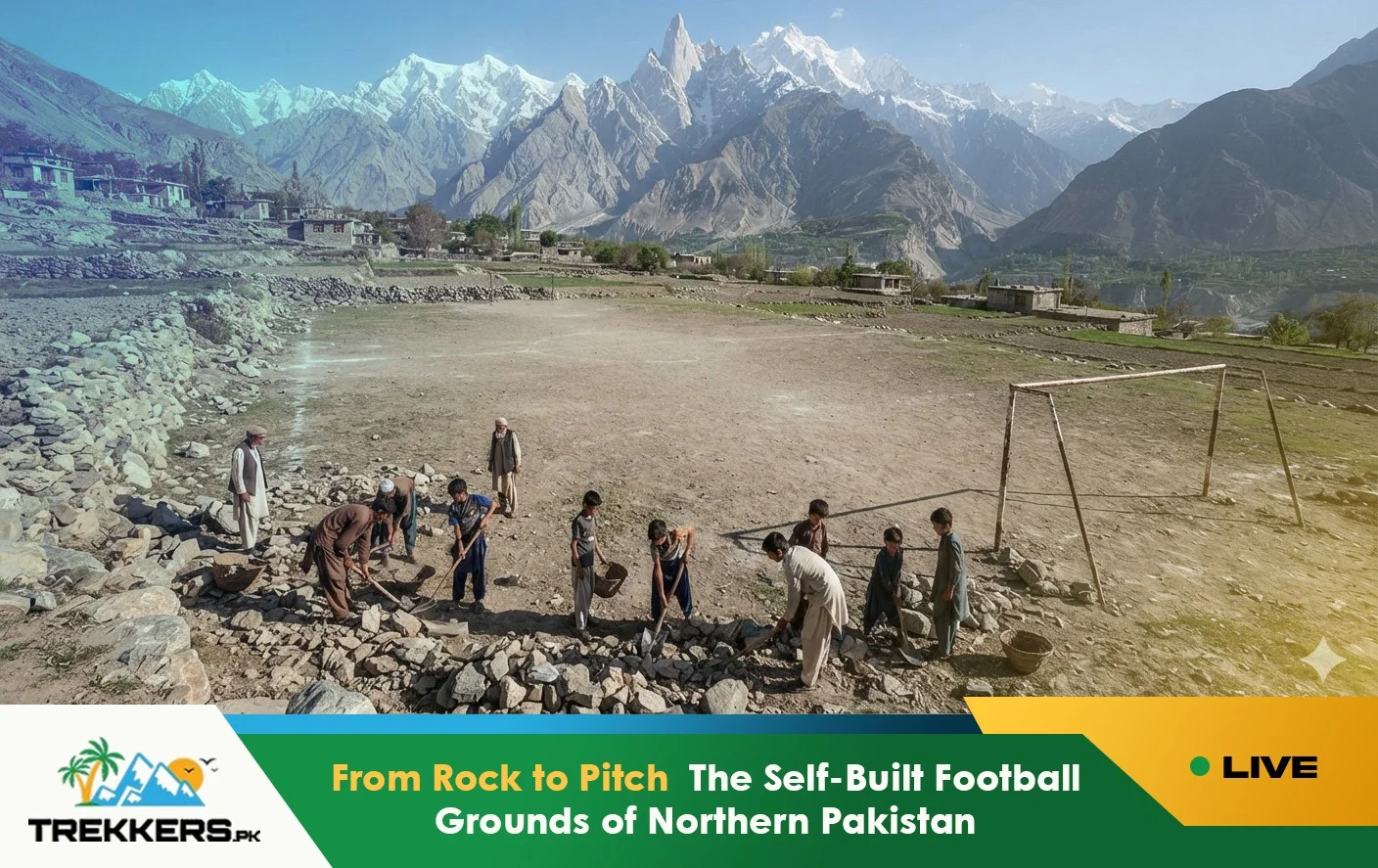
A community in Gilgit-Baltistan clears stone by hand, preparing the ground for what will become a village football pitch.
Gilgit-Baltistan: Where the Self-Built Pitch Became Tradition

If there is one administrative region that best illustrates this phenomenon, it is Gilgit-Baltistan. Spread across some of the most dramatic geography on the northern Pakistan map, this territory has produced dozens of community-built football grounds, each with its own story of construction and survival.
The Hunza Method: Terracing the Pitch Like the Land
In Hunza, where agricultural terracing has shaped the valley for centuries, football grounds were built using the same logic farmers had already perfected. Sloped land gets leveled in stages. Retaining stone walls hold soil in place. What results is often a pitch with a barely perceptible tilt, close enough to flat for football, built using techniques passed down through generations of farming families.
Villages near Karimabad and Aliabad maintain pitches this way, with maintenance treated as seasonal community labor, not unlike tending the orchards that surround them.
Skardu and the Lakeside Pitches
Further east, in the valleys around Skardu, some of the most visually striking grounds in the country sit beside cold mountain lakes. Communities here cleared rocky lakeside flats, hauling stones away by hand and filling depressions with soil carried from elsewhere in the valley.
The result is football played within view of water so clear it reflects the surrounding peaks, a backdrop no constructed stadium could replicate.
Smaller Valleys, Equally Determined Builders
Beyond the well-known names, valleys like Shigar, Ghanche, and parts of Astore have quietly built their own grounds using identical methods: community labor, local materials, and patience measured in years rather than weeks. These grounds rarely appear in any official list of cities in northern areas of Pakistan tourism guide, yet they represent some of the most genuine football culture in the country.
Chitral and Ghizer: Building Football Grounds in the Most Remote Corners

West of Gilgit-Baltistan, the valleys of Chitral and Ghizer present even harsher construction conditions, narrower valleys, fewer roads, and a shorter window each year when building is even possible.
Chitral’s River-Adjacent Pitches
In Chitral, several village grounds sit dangerously close to riverbanks, a deliberate choice given how little flat land exists elsewhere. Communities built retaining walls not just to level the pitch but to protect it from seasonal flooding. Every few years, sections need rebuilding after heavy monsoon rains, and every few years, the same volunteers who built it the first time return to fix it again.
Ghizer Valley’s Patchwork Pitches
Ghizer’s grounds are often described by locals as “patchwork” built in sections over multiple years as labor and materials became available. A pitch here might have been started by one generation and only completed by their children. This slow, intergenerational construction process reflects something deeper than sport: a long-term communal investment in shared identity.
Naltar, Yasin, and the High-Altitude Builders
Some of the most physically demanding ground-building efforts happen in the highest, most isolated valleys, places where altitude itself becomes an obstacle to construction.
Naltar Valley: Building Above 10,000 Feet
Naltar, known internationally for its skiing slopes, also hosts a community football ground built at extreme altitude. Construction here required not just clearing rock but compensating for an extremely short building season, snow covers the ground for much of the year, leaving only a brief summer window for labor.
Yasin Valley’s Multi-Year Construction Effort
In Yasin, locals describe their main football ground as a project that took the better part of a decade to complete. Early efforts focused on clearing the largest boulders. Later years addressed drainage, since poor water runoff had made the field unusable during certain months. The ground that exists today represents not a single construction effort but a sustained, multi-generational commitment.
Show Image
A community-built pitch in Naltar Valley, constructed above 10,000 feet, one of the highest grassroots football grounds in the country.
The Construction Process: How a Rocky Slope Becomes a Football Pitch
Understanding the human effort behind these grounds requires understanding the actual process, a process that has remained largely unchanged for decades.
Step One: The Community Decision
It begins, almost always, with a discussion among elders and youth representatives. A site is chosen, usually the flattest available land near the village, even if “flat” is generous terminology at this stage.
Step Two: Clearing the Rock
This is the most labor-intensive phase. Volunteers, farmers, students, shepherds, tradesmen, spend weeks or months removing stones by hand. Larger rocks are broken apart or rolled away using leverage and manpower alone. There is no excavation equipment involved at any point in this process.
Step Three: Leveling and Filling
Once cleared, the ground is leveled using shovels and basic hand tools. Low points get filled with soil transported from elsewhere in the valley, often carried in sacks on foot or by donkey where vehicle access doesn’t exist.
Step Four: Marking and Equipping the Pitch
Boundary lines are drawn using chalk dust, lime powder, or crushed white stone. Goalposts are typically welded from scrap metal or constructed from local timber. None of this equipment is purchased from a sporting goods supplier, it is fabricated locally, often by the same craftsmen who repair farm tools.
Step Five: Ongoing Maintenance, Indefinitely
Unlike a professionally built pitch, these grounds are never truly “finished.” Floods damage them. Winters freeze and crack the surface. Erosion shifts the boundary lines. Maintenance is permanent, communal, and unpaid, exactly as construction was.
Football Culture Beyond the Pitch
A football ground built by hand carries different social weight than one built by contractors. In these communities, the pitch becomes something closer to a shared monument than a sports facility.
Matches as Community Events
When a tournament takes place on a self-built ground, the entire village shows up, not just spectators interested in football, but people honoring the collective effort that made the match possible. Elders who helped clear the original rock often sit closest to the pitch, a position of informal honor.
Rivalries Rooted in Shared Labor
Neighboring villages that compete against each other on these grounds often share a strange duality: fierce competitive rivalry paired with mutual respect for each other’s construction effort. Beating a team from a neighboring valley carries extra weight when you know exactly how much physical labor went into the ground you’re standing on.
A Source of Regional Identity
In a country where the Pakistan football team has struggled to gain international traction, these self-built grounds represent something the national program has never quite replicated: football as an organic expression of community identity rather than an institutional project.
Why This Matters for Pakistan’s Football Future

It would be easy to view these grounds as charming but ultimately marginal, interesting cultural footnotes with no real bearing on Pakistan’s footballing prospects. That view misses something important.
Untapped Infrastructure, Untapped Talent
Every self-built ground in the northern areas represents existing football infrastructure that the Pak football team’s development system has never seriously engaged with. While national programs search for venues and budgets in major cities, hundreds of functional, if rudimentary, pitches already exist in the mountains, built, maintained, and actively used without a single rupee of federation funding.
A Different Kind of Football Development Model
These communities have, without realizing it, created a development model built entirely on community ownership rather than top-down institutional investment. There may be lessons here for how Pakistan approaches grassroots football nationally, not by importing foreign models wholesale, but by recognizing and supporting what local communities have already built themselves.
Visiting These Football Grounds: A New Kind of Northern Pakistan Travel Experience
For travelers searching for things to know about Pakistan travel places beyond the standard postcard images, these football grounds offer something genuinely different, a way to witness community life rather than simply observe scenery.
Why Football Grounds Belong on Your Itinerary
Most lists of best travel spots in Pakistan focus exclusively on natural beauty, lakes, peaks, meadows. Few mention that some of the most human, most authentic experiences in the north happen on a dusty football pitch during a village tournament. Watching a match here offers insight into community life that no viewpoint or trekking route can provide.
Best Activities and Places to Combine With a Football Visit
For travelers interested in pairing this experience with other best activities places in Pakistan, several northern grounds sit near well-known attractions. Hunza’s pitches are a short distance from Attabad Lake and Karimabad’s old town. Skardu’s lakeside grounds are easily combined with visits to Upper Kachura Lake. Naltar’s high-altitude pitch sits near the valley’s famous ski slopes and chairlift.
Timing Your Visit
Most local tournaments take place during summer months, typically June through August, when travel through the northern Pakistan road network is most reliable and villages have free time between agricultural cycles. Asking local guesthouse owners about upcoming matches is often the easiest way to find out about a tournament before it happens.
The Bigger Picture: What Self-Built Football Grounds Say About Pakistan
Step back from the individual stories, the rock-clearing in Hunza, the lakeside pitches in Skardu, the decade-long project in Yasin, and a larger pattern emerges. This is a region that has consistently solved its own problems without waiting for outside intervention.
That same spirit defines much of how the northern areas of Pakistan function more broadly. Roads get repaired by community labor after landslides. Irrigation channels get maintained by farmer cooperatives. Schools, in some valleys, were built the same way these football pitches were, community decision, community labor, community pride.
Football, in this context, is not separate from the broader story of how the north survives and thrives. It is one expression of a much larger cultural pattern: when the world doesn’t provide what you need, you build it yourself.
FAQ: Self-Built Football Grounds in Northern Pakistan
How many self-built football grounds exist in Northern Pakistan?
There is no official count, since most of these grounds were never registered with any sports authority. Local estimates suggest dozens exist across Gilgit-Baltistan and Chitral alone, with many more in smaller valleys that remain undocumented.
Are these football grounds open to visitors?
Yes, in almost all cases. These are community spaces, not private facilities, and visitors are generally welcome to watch matches, particularly during well-known tournament seasons in summer.
What is the best time to see a local football match in Northern Pakistan?
Summer months, roughly June through August, see the highest concentration of village and inter-valley tournaments, coinciding with the best travel season for the region overall.
Do these communities have any government support for building football grounds?
Generally no. Most grounds described in this article were built entirely through community labor, local fundraising, and occasional diaspora contributions, without formal government infrastructure funding.
How does altitude affect football grounds like the one in Naltar Valley?
High-altitude locations face a shorter construction season due to snow cover, more extreme weather damage requiring frequent repairs, and thinner air that affects both playing conditions and the physical effort required during construction.
Can I combine a visit to these football grounds with other Northern Pakistan attractions?
Yes. Many grounds are located near well-known sites, Hunza’s pitches near Attabad Lake, Skardu’s lakeside grounds near Kachura Lake, and Naltar’s pitch near its ski slopes, making them easy to add to an existing northern Pakistan itinerary.
Why hasn’t Pakistan’s national football program engaged with these communities?
There is no centralized program currently designed to identify or develop talent from these self-built grassroots grounds, despite their consistent activity and community engagement, representing an opportunity gap rather than a lack of football culture.


