
Table of Contents
You hear it before you see it.
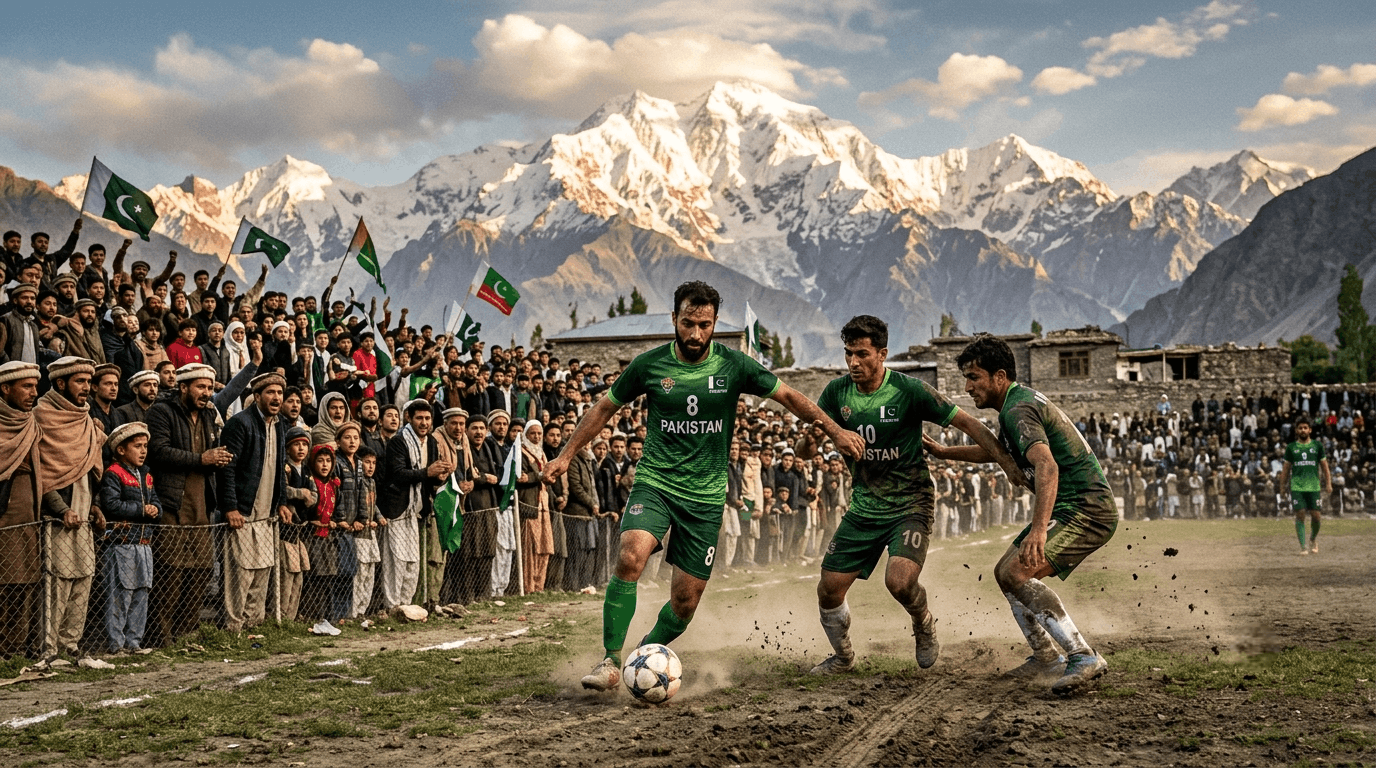
The crack of a football striking a boot made by a artisan in Sialkot. Shouts in Khowar mixing with Shina. The percussion of leather meeting stone as the ball rolls across a pitch that exists only because a community decided it must.
This is football in the valleys of Northern Pakistan not the choreographed spectacle of professional stadiums, but something rawer: a sport woven so tightly into daily life that it defines how communities gather, how rivalries are settled, and how young athletes dare to imagine futures beyond their mountains.
From Chitral’s cliffs to Hunza’s apple orchards, from Skardu’s high-altitude emerald valleys to the remote villages of Yasin and Gupis, millions of Pakistanis live in places where football grounds are built by volunteers, tournaments organize themselves, and the line between recreation and obsession has long since dissolved.
Yet there’s a paradox that haunts this story: In a nation where football passion runs deeper than almost anywhere on Earth, Pakistan’s national football team has never qualified for the FIFA World Cup. In valleys where young athletes possess genuine high-altitude physiological advantages, systematic talent development remains virtually non-existent. In mountains where community-driven sports models are creating models of athletic culture that urban centers struggle to replicate, institutional football has never capitalized on that advantage.
This article reveals both sides of that paradox and explains why Northern Pakistan represents perhaps the world’s most underutilized football talent ecosystem.
Why Northern Pakistan’s Football Culture Defies Convention
Northern Pakistan didn’t develop its football culture because it had resources. It developed it despite not having them.
Geographic Isolation as Unexpected Advantage
The Karakoram Highway connects the valleys, but remoteness is still tangible. When Chitral needs a football ground, it doesn’t wait for government infrastructure investment. The community builds it. Stone boundary walls get constructed by elder councils during off-season months. Pitch maintenance happens through coordinated labor. Tournaments organize themselves through family networks and local leadership structures.
This autonomy bred a foundational truth: Northern football communities don’t need permission to create football culture. They build it.
Compare this to urban Pakistan, where football often depends on institutional frameworks university programs, corporate clubs, federation structures. Those institutions bring standardization and sponsorship money. They also create bottlenecks. Access becomes conditional.
In the mountains, football is simply… available.
The Mountain Environment Reshapes the Game Itself
Football played at 8,000 – 12,000 feet elevation doesn’t follow sea-level logic.
The thin air means the ball travels differently it curves more dramatically, travels further, and behaves unpredictably to players accustomed to coastal conditions. Cardiovascular demands intensify exponentially. A sprint that exhausts a lowland player for 90 minutes becomes a sustainable rhythm for someone born in the mountains.
Over generations, northern players developed compensatory tactics shorter passing ranges that work in thin air, explosive sprinting capability that compensates for lower oxygen availability, and positional awareness calibrated for the physics of mountain football.
When Chitral’s best XI travels to Lahore for a regional tournament, that playing style looks distinctly different. Opponents often misunderstand it as unsophistication. It’s actually highly specialized adaptation.
Community as the Foundation
In many valleys, football matches serve roles that extend far beyond sport. They’re entertainment during months with limited outside cultural input. They’re dispute resolution mechanisms where village rivalries resolve on the field rather than through formal channels. They’re social gatherings where different castes, income levels, and families mix in ways that don’t happen anywhere else.
A match between Drosh and Mastuj isn’t just athletic competition. It’s an event where community identity gets publicly performed and affirmed. The stakes social rather than economic are nonetheless real.

Chitral: How Pakistan’s Valleys Built a Football Capital
Chitral District sprawls across a narrow north-south valley, hemmed by the Hindu Kush mountains and bordering Afghanistan. Demographically, it’s Pakistan’s smallest district. Economically, it’s among the poorest. Yet for football, Chitral has no equal in the mountains.
The Chitral Premier League: Creating Structure Without Institutions
Every summer, since its founding decades ago, the Chitral Premier League transforms the valley into a football stadium. Teams from across the district Drosh, Mastuj, Buni, Ghalween, Rumbur compete in a tournament that takes on almost religious significance.
The CPL isn’t sanctioned by Pakistan Football Federation (though they acknowledge it). It’s organized by local stakeholders elder councils, community leaders, team representatives. Sponsorships come from local shopkeepers and traders. Refereeing happens through community members with reputations for fairness. Prize money comes from match-day collections and contributions.
And it works. Year after year, the tournament attracts crowds that pack grounds with generations of families. Chitral’s football culture isn’t aspirational it’s ancestral. Your grandfather watched the CPL. Your father watched it. You’ve played in it.
This institutional achievement creating a legitimate, stable, competitive tournament without government or federation support is itself remarkable.
Muhammad Rasool: The Legend Nobody Outside Chitral Knows
Chitral’s football royalty is Muhammad Rasool, a forward who represents what’s possible when local talent gets any exposure at all. Rasool was a striker of genuine quality creative, intelligent positioning, finishing ability that impressed scouts who encountered him.
Yet despite clear talent, Rasool never became a household name in Pakistani football. He played at provincial levels. He might have represented Pakistan in international competition if institutional talent identification had reached his valley. Instead, he became a legend in Chitral known to everyone in the district, unknown virtually everywhere else.
Rasool’s story isn’t tragic in the traditional sense. He found dignity and community respect through football. But it illustrates a structural reality: The gap between grassroots excellence and professional opportunity remains a chasm for northern players.
Where Chitral Football Grounds Are Located
Grounds cluster in major valley settlements:
- Drosh (lower valley, most accessible)
- Mastuj (mid-valley, competitive hub)
- Buni (smaller grounds, community-level play)
- Ghalween and Rumbur (upper valleys, more remote)
Each ground tells a story of community investment. Stone walls protecting the perimeter took months to construct. Pitch conditions reflect the valley’s monsoon rains and high-altitude sun. Most grounds have no floodlighting matches happen in daylight or early evening.
Hunza Valley: Where Football Tourism Meets Mountain Culture
Hunza Valley has become synonymous with longevity and health. The narrative of “Hunza people live to 120” might oversimplify biology, but it’s driven Hunza into the global imagination. That international attention has changed how Hunza football develops.
Unlike Chitral, which remains relatively unexplored by international tourists, Hunza sits on the Karakoram Highway. Trekking routes crisscross the valley. Guesthouses cater to international visitors. The tourism economy is substantial and growing.
Football has become woven into that tourism narrative.
Football + Tourism = A New Model
In places like Karimabad (Hunza’s main settlement), grassroots football increasingly intersects with tourism. Visitors attend matches. Sports academies market themselves to tourists seeking authentic “high-altitude training experiences.” Local guides include football grounds on itineraries.
This creates economic incentive for infrastructure investment hotels near match grounds, food vendors at tournaments, transportation services catering to spectators.
It also creates tension: When football becomes tourism content, does it risk losing grassroots authenticity? When professional coaching arrives to serve tourist visitors, does it displace community-centered development models?
Hunza is navigating these questions in real time.
Notable Grounds and Tournament Structure
Hunza’s football calendar centers on summer tournaments:
- Hunza Valley Football Championship (typically June – July)
- Inter-valley derbies pairing Hunza against neighboring Nagar and Skardu
- Summer camps where coaches from major cities visit to develop local talent
Key grounds include facilities in Karimabad and smaller pitches in satellite settlements like Aliabad and Gulmit. The landscape surrounding these grounds snow-capped peaks, terraced agriculture, rushing rivers creates backdrops that no urban stadium can replicate.
The Pissan Valley Phenomenon
Pissan Valley, a remote settlement east of Gilgit, has gained specific reputation among northern football enthusiasts for possessing one of the region’s most distinctive grounds. The location, surrounded by dramatic topography, draws photographers and sports tourism operators.
The ground exemplifies a broader trend: Northern Pakistan’s football infrastructure increasingly doubles as tourism attraction.
Gilgit-Baltistan: The Emerging Football Ecosystem
Gilgit-Baltistan encompasses vast territory Gilgit proper, Skardu, Nagar, Gupis, Yasin, Astore, Diamer, Khaplu. It’s larger than many nations. It’s also more fragmented, with geography creating distinct micro-regions that develop football culture semi-independently.
Skardu: The Second Hub Rising
Skardu, capital of Baltistan, has emerged as Northern Pakistan’s second football power. The city enjoys advantages over more remote valleys larger population, administrative centrality, growing infrastructure, better accessibility.
Skardu’s football grounds handle larger crowds than typical valley fields. Inter-district tournaments increasingly center on Skardu as a neutral venue. The city’s schools have developed structured football programs that some remote valleys lack.
Critically, Skardu’s relative accessibility to major cities (compared to Chitral’s isolation) means players from Skardu have slightly better opportunities reaching professional pathways. Several Skardu-based players have represented regional departments or professional clubs.
Gilgit City: Administration Meets Football
Gilgit city the territorial capital serves as administrative hub but hasn’t yet replicated Skardu’s status as a grassroots football powerhouse. However, Gilgit’s role as transportation hub and communication center means matches here receive wider media coverage and tournament scheduling benefits.
The Unexplored Footballing Valleys
Yasin, Gupis, Astore, Diamer, and Khaplu represent perhaps Northern Pakistan’s least documented football communities. In these settlements, football culture is real and deeply rooted but visibility outside the valleys remains minimal.
Astore Valley, accessible via challenging mountain roads from Skardu, hosts annual inter-valley tournaments that draw passionate support. Yet international media coverage of Astore football is virtually non-existent.
Yasin and Gupis valleys similarly maintain football traditions without external documentation. For researchers and sports journalists, these regions represent genuine unexplored territory.
Diamer, bordering the Karakoram Range’s highest peaks, maintains a football community oriented toward seasonal tournaments and informal inter-settlement matches.
The implication: Northern Pakistan’s documented football culture (Chitral, Hunza, Skardu) represents perhaps 40 – 50% of the region’s actual grassroots activity. Smaller valleys maintain equally passionate football cultures that remain essentially invisible to outside observers.
Swat, Dir, and Kohistan: Football in Recovering Regions
These valleys carry heavier historical weight than Chitral or Hunza. They experienced decades of political instability that disrupted institutional structures.
Swat’s Recovery Narrative
Swat Valley endured the most intense security disruption of any major Pakistani region, with institutional sports structures nearly disappearing during conflict. Post-recovery efforts since 2014 have gradually revived football culture.
The valley’s heavy monsoon rains create seasonal pitch challenges waterlogging during June through August makes play impossible on natural grass. Communities have adapted by scheduling tournaments around weather patterns and, in some cases, investing in drainage infrastructure.
Swat’s football recovery is emblematic of broader post-conflict institutional rebuilding. Young people discovering football in contemporary Swat don’t have continuity with pre-2007 traditions. They’re building new football culture from relatively bare ground.
Dir: Football’s Quiet Persistence
Upper and Lower Dir districts experienced security challenges less severe than Swat but still disruptive. Today, Dir maintains grassroots football traditions centered on inter-village matches and smaller tournaments with limited external visibility.
Dir football culture remains understudied. Preliminary evidence suggests the region maintains distinctive playing styles and strong community engagement, but comprehensive documentation doesn’t exist in accessible English sources.
Kohistan: The Frontier of Football Documentation
Kohistan represents perhaps Pakistan’s most isolated footballing regions. Settlements are scattered across dramatic topography. Road infrastructure remains minimal. Media coverage is virtually non-existent.
Yet evidence suggests Kohistan maintains football communities young people play in small settlements, inter-village matches occur on improvised grounds, and football represents valued cultural activity.
Kohistan football remains genuinely unexplored territory for researchers and journalists.

The Grassroots Model: How Communities Built Football Without Institutions
Northern Pakistan’s football culture developed despite, not because of, institutional support. Understanding how communities engineered this development reveals principles applicable far beyond Pakistan.
Volunteer Infrastructure as Foundation
Imagine building a football ground with no budget. This is daily reality across Northern Pakistan.
The process typically unfolds like this: A community decides a football ground is needed. Elder councils or informal leadership structures emerge to coordinate effort. Young men and women volunteer labor clearing land, hauling stones, constructing boundary walls. Equipment comes through community contributions, business donations, or diaspora networks sending supplies from abroad.
The stone boundary walls surrounding northern pitches take weeks to construct. The volunteer labor represents real economic value if the community had to hire laborers, costs would be prohibitive. Instead, labor becomes collective investment in community resource.
Once a ground exists, maintenance becomes shared responsibility. After heavy rains, volunteers repair drainage. Before tournaments, groups mobilize to level and improve pitch conditions. Equipment (footballs, training cones, goal posts) gets pooled across clubs and tournaments.
This volunteer-infrastructure model has advantages and costs:
Advantages:
- Communities maintain ownership and autonomy
- Capital requirements remain manageable
- Social bonds strengthen through collective labor
- Responsiveness to local needs (pitch design reflects local geography)
Costs:
- Inconsistent infrastructure quality compared to professional facilities
- Pitch conditions remain variable and weather-dependent
- Equipment shortages persist
- Maintenance depends on continued volunteer motivation
Tournament Organization Without Federation Oversight
The Chitral Premier League exists and functions superbly without Pakistan Football Federation official recognition. Inter-valley tournaments organize themselves through local networks. Seasonal competitions happen because communities decide when to hold them.
This independence matters. Local organizers can:
- Set tournament schedules around agricultural calendars and weather patterns
- Design brackets reflecting local dynamics and competitive balance
- Allocate prizes according to community values (often equipment or recognition rather than cash)
- Include women’s and youth categories based on community interest
- Adapt rules for local playing conditions
The drawback: Without federation oversight, tournaments lack standardization. Refereeing standards vary. Record-keeping is inconsistent. Players lack official certification or ranking systems.
For local competition, this works adequately. For players aspiring to professional football, lack of standardized documentation creates barriers to institutional recognition.
Fundraising Through Community Mechanisms
How do northern communities fund football without institutional budgets?
Match-day collections: At organized tournaments, volunteer collectors circulate through crowds. Spectators contribute what they can afford. For significant tournaments, collections can generate 50,000 – 100,000 Pakistani rupees (approximately $180 – $360 USD). [Note: Figures based on typical observer reports; exact amounts vary by tournament and region]
Business sponsorships: Local shopkeepers, transporters, and traders sponsor teams or tournaments. Sponsorships typically range from 5,000 – 20,000 rupees and often get recognized through signage or public acknowledgment.
Cooperative contributions: In valleys with agricultural or grazing cooperatives, these organizations sometimes contribute to football infrastructure as community benefit investment.
Diaspora networks: This may be the single most important funding source. Pakistani emigrants working in Gulf countries, major Pakistani cities, or internationally send money to support hometown clubs and tournaments. Diaspora networks have funded ground construction, equipment purchases, and tournament prizes.
NGO and international donor support: International sports development organizations increasingly fund northern football infrastructure. These organizations target youth development, women’s participation, and conflict prevention through sports programs.
The funding model reveals something fundamental: Northern communities value football enough to prioritize spending on it. Despite limited cash economies, communities find ways to support the sport.
Mentorship Chains: How Knowledge Transmits Without Formal Coaching
Professional football development typically flows through formal coaching education certifications, coaching licenses, standardized curricula. Northern Pakistan’s grassroots systems operate through informal mentorship chains.
An experienced player retires from active competition and becomes a community coach. They teach the next generation through demonstration, correction, and repetition. Technical knowledge, tactical understanding, and football ethics transmit through relationship.
This model has been functional for decades yet it differs fundamentally from formal coaching education. Coaches may lack modern sports science knowledge. Training methodologies may not optimize for contemporary tactical systems. Nutrition, strength training, and injury prevention get limited attention.
However, informal mentorship also creates genuine advantages:
- Coaches understand local conditions and constraints
- Teaching is embedded in authentic community relationships
- Learning happens in realistic playing environments
- Mentors model not just technical skill but character and community values

The High-Altitude Athletic Advantage: Why Northern Players Should Excel
Northern Pakistan’s geography doesn’t just create unique playing conditions. It creates physiological advantages that competitive football should exploit but largely doesn’t.
How Altitude Reshapes Human Biology
Residents of high-altitude regions develop adaptations over generations:
Increased hemoglobin production enables oxygen transport efficiency at low atmospheric oxygen levels. More red blood cells mean better oxygen-carrying capacity an advantage that persists even when playing at sea level.
Enhanced capillary density in skeletal muscle allows oxygen delivery to working muscles more efficiently than in lowland populations. This microscopically dense network develops through sustained high-altitude living.
Mitochondrial efficiency improvements enable cellular energy production with less oxygen. The powerhouses of cells adapt to scarcity, becoming more efficient.
Cardiovascular adaptation includes lower resting heart rates and enhanced stroke volume the heart pumps blood more efficiently.
Individually, these adaptations seem incremental. Collectively, they represent genuine physiological advantage. A footballer born in Hunza carries these adaptations throughout life. Move them to sea-level competition, and these advantages remain.
Playing Conditions in Thin Air Reshape Technique
Ball physics change in thin air:
- Reduced air resistance makes the ball travel further and curve more dramatically
- Unpredictable trajectory at altitude differs from sea-level conditions
- Passing accuracy requires adjustmen a pass-weight effective at sea level may overshoot at altitude
Northern players compensate through technical adaptation:
- Shorter, more accurate passing ranges work better in thin air
- Ball manipulation becomes more delicate and precise
- Explosive movements gain advantage over sustained aerobic running
When northern players compete in sea-level tournaments, these technical adjustments become liabilities. A northern player’s passing style calibrated for altitude may seem overly conservative to sea-level players accustomed to longer passing ranges.
Yet the physiological advantages remain.
The Systematic Exploitation Opportunity
Here’s the critical insight: Pakistan’s national football program has never systematically exploited the high-altitude advantage.
A strategic framework would look like:
- Identify promising young footballers from northern valleys through structured talent identification programs.
- Provide extended high-altitude training in northern camps
- Develop coaching methodologies optimizing altitude advantages
- Create institutional pathways for northern talent to reach professional football
- Use altitude training to develop cardiovascular capacity in players from sea-level regions
Instead, the national program treats northern players as one possible talent source among many. Talent identification doesn’t specifically target high-altitude communities. Coaching doesn’t optimize for altitude-trained athletes. Training camps don’t leverage altitude advantages.
The physiological potential remains largely unexploited.

Women’s Football: The Barrier-Breaking Generation
Women’s participation in football was historically restricted across Northern Pakistan through cultural conservatism, family resistance, and institutional constraints. That’s changing. And the change is being led by remarkable young women willing to challenge traditions.
The Shimshal Breakthrough
The Shimshal women’s football team became a symbol of evolving attitudes. Young women from Shimshal Valley, in Hunza, organized structured football activities training at high altitude, competing in matches, wearing football kits in public.
This was cultural statement as much as athletic activity. In conservative valley communities, young women choosing football challenged expectations about gender roles, appropriate public activity, and family honor.
The backlash was real. Cultural criticism was harsh. Families debated whether to allow daughters’ participation.
Yet the team persisted. And crucially, they attracted international media attention. Foreign journalists came to document the story. Photos of Shimshal women playing football circulated through global media networks.
That visibility mattered. Within Chitral, Hunza, and Gilgit-Baltistan, young girls saw images of women playing football women who looked like them, lived in valleys like theirs, broke barriers successfully.
For girls growing up watching the Shimshal team, football became possible in a way previous generations couldn’t imagine.
Current Regional Landscape
Women’s football participation varies dramatically:
Chitral shows relatively higher participation, with school programs, local clubs, and inter-valley tournaments increasingly including women’s brackets.
Hunza benefits from tourism infrastructure and NGO support specifically targeting women’s sports development. Women’s participation here has grown visibly over the past decade.
Gilgit-Baltistan shows emerging participation in urban centers (Gilgit city, Skardu) with minimal participation in remote valleys.
Swat, Dir, Kohistan have minimal documented women’s football participation, though this may reflect documentation gaps rather than actual absence of activity.
Overall, women’s football remains grassroots. No women earn professional income from football in Northern Pakistan. Coaching remains male-dominated. Dedicated women’s facilities are rare outside major towns.
Yet the trajectory is unambiguously upward.
Persistent Barriers
Cultural conservatism remains the primary barrier. In some families and communities, women playing football conflicts with traditional gender role expectations. This isn’t universal attitudes vary by family, education level, and community but it remains real constraint.
Facility scarcity: Dedicated women’s football grounds barely exist in Northern Pakistan. Women typically train on grounds previously used for men’s play or train in school facilities during limited availability windows.
Coaching gap: Few women work as football coaches. The absence of visible female role models in coaching positions discourages girls from seeing coaching as career possibility.
Professional pathway absence: No domestic women’s professional league exists in Pakistan. Professional opportunities for women footballers are virtually non-existent. Girls can play for community pride and personal development, but the professional trajectory available to male players doesn’t exist.
NGO-Driven Progress
International sports NGOs increasingly support women’s football in Northern Pakistan. Organizations like [PLACEHOLDER: Research specific NGOs working in region] provide:
- Equipment donations
- Coaching training for women’s coaches
- Funding for women-only tournaments
- International coaching exchanges
- Advocacy challenging cultural restrictions
This external support matters because it provides resources communities alone can’t generate. It also signals global recognition of women’s football as legitimate, which helps shift local attitudes.

Youth Development: The System That Doesn’t Exist (Yet)
How does a talented 14-year-old from Gilgit with genuine football aptitude reach professional football?
The answer reveals Northern Pakistan’s fundamental institutional challenge.
The Grassroots Entry Point (Functionally Works)
Youth typically begin football through:
- School sports programs: Physical education classes introduce football
- Village play: Informal games with friends on community grounds
- Family influence: Older brothers or fathers introduce the sport
This phase works reasonably well. Most northern valleys have mechanisms for youth exposure to football. It’s not systematic participation depends on geography, family encouragement, and school quality but grassroots engagement happens.
The Regional Tournament Phase (Works Partially)
Progress requires visibility beyond one’s village. Regional tournaments provide this opportunity:
- School inter-school competitions: District or valley-level tournaments
- Seasonal CPL-style youth brackets: Smaller tournaments for younger age groups
- Community-level derbies: Inter-village youth matches
These tournaments create competitive experience and exposure to regional-level play. A talented young player excelling here might attract attention from coaches from larger towns.
However, tournaments remain geographically bounded. A standout player in Yasin Valley might never compete against players from Chitral or Skardu. Regional isolation limits competitive exposure.
The Academy Transition Phase (Mostly Broken)
Youth academies increasingly operate in Gilgit, Skardu, and larger valley towns. These institutions provide:
- Structured coaching (often trained coaches with certifications)
- Strength and conditioning training
- Tactical development
- Exposure to higher-level competition
But academy access requires:
- Financial resources (monthly fees averaging 3,000 8,000 rupees; approximately $11 $29 USD) [Note: Current ranges based on typical reporting]
- Family ability to support relocation (many academies serve boarding students)
- Academic flexibility (full-time football development competes with education)
For a talented player from a poor family in a remote valley, these barriers are substantial. Many never access formal academy development.
Those who do often experience coaching quality gaps. Academy coaches may be experienced but lack advanced certifications. Training methods might not align with international standards. Strength and conditioning may be rudimentary.
The Professional Recruitment Phase (Highly Uncertain)
Reaching professional football requires:
- Visibility to professional scouts: Scouts from major cities rarely travel to northern valleys. A player must either reach them (by playing in visible regional tournaments) or get recommendations through personal networks.
- Institutional trial opportunities: Professional clubs occasionally offer trial periods to promising young players. But these invitations flow primarily through established networks and referrals from coaches with professional connections.
- Geographic mobility: Professional football clusters in Lahore, Islamabad, and Karachi. Moving to a major city for a trial period requires family resources most northern families lack.
The result: Professional football recruitment is not systematic. It’s opportunistic.
A talented player from Chitral might reach professional football if:
- A scout happens to see them in a tournament
- A coach with professional connections notices them and makes recommendations
- They get financial support for relocation and trials
- They hit the competitive window when a professional club needs their position
Miss these conditions, and talent goes undeveloped.
Systematic Development Opportunity (Unrealized)
Modern professional football development would include:
- Regional talent identification camps run by major clubs or federation
- Coaching standardization ensuring grassroots coaches understand modern methodologies
- Scholarship pathways enabling talented youth from poor families to access academy development
- Documented player development systems tracking young talent through structured progression
- Professional club partnerships creating clear pathways from academy to professional opportunity
Pakistan Football Federation could implement these systems. Major clubs could establish northern recruitment pipelines. International football development programs could specifically target northern talent identification.
This hasn’t happened systematically. Northern youth development remains grassroots-driven, decentralized, and dependent on fortunate circumstance.
The National Team Paradox: Explaining the Gap
Here’s the central tension: Pakistan produces extraordinary grassroots football passion. Northern communities create distinctive playing cultures. Young athletes possess genuine high-altitude physiological advantages. Yet Pakistan’s national football team has never qualified for the FIFA World Cup and consistently ranks modestly in Asian competition.
How can a nation so football-crazy perform so modestly internationally?
Institutional Weakness in Coaching
Professional football coaching in Pakistan has historically lagged behind regional competitors. Coaching education focuses on practical experience rather than formal certification and continuing education. Technical systems and tactical methodologies often reflect older approaches rather than contemporary global football.
This matters because grassroots players, however talented, eventually need exposure to modern coaching. When they transition from village football to departmental or professional football, they encounter coaching that may not maximize their development.
Recent appointments including international coach selections represent efforts to upgrade coaching quality. Yet systematic improvement requires sustained investment and institutional commitment.
Domestic League Instability
Pakistan Premier League (the domestic top division) has experienced significant instability:
- Ownership changes affecting club stability
- Inconsistent funding affecting player compensation
- Organizational challenges creating uncertainty about season scheduling
- Reduced media coverage compared to South Asian competitors
A stable, professionally managed domestic league creates a competitive crucible where players develop at professional intensity. Pakistan’s league dysfunction means players lack consistent high-level competitive experience.
Contrast this with India’s Super League or Bangladesh’s Premier League, both increasingly professionalized with corporate ownership and media investment. Pakistan’s domestic football receives a fraction of that investment.
Structural Bias Toward Urban Football
Professional football structures clubs, academies, federation headquarters concentrate in Lahore, Islamabad, and Karachi. This creates structural advantages for players from these cities:
- Proximity to professional academies
- Access to established coaching
- Media visibility for urban players
- Natural networking within urban football communities
Northern players must migrate to these cities to access professional pathways. Migration requires family resources. It creates cultural dislocation. It subjects young people to unfamiliar environments.
Meanwhile, urban players develop within established ecosystems where infrastructure exists, coaching is available, and pathways are clearer.
Geographic Isolation and Political Instability Legacy
Khyber Pakhtunkhwa (encompassing Chitral, Swat, Dir) experienced decades of security instability. While security has improved, recovery remains incomplete. This history disrupted institutional sports development. Communities rebuilding after conflict prioritize basic services before investing in sports infrastructure.
Gilgit-Baltistan’s administrative status historically ambiguous, now clearer but politically sensitive affected institutional sports development. Governmental investment in sports infrastructure has been inconsistent.
Neither region has benefited from the institutional sports investment that major urban centers receive.
Untapped High-Altitude Training Potential
National team coaching has never systematically used high-altitude training camps in Northern Pakistan. Modern professional football uses altitude training to build aerobic capacity. Pakistan could use northern valleys as world-class altitude training centers.
A strategic national team development program would:
- Establish high-altitude training facilities in Hunza or Skardu
- Run regular national team camps at elevation
- Recruit promising northern-origin players for extended altitude-based development
- Leverage physiological advantages for competitive improvement
This hasn’t happened. High-altitude potential remains unexploited.
Why the Gap Persists
The paradox resolves when you understand that grassroots passion and professional success operate under different logics.
Grassroots football requires:
- Community engagement ✓
- Volunteer infrastructure ✓
- Local organization ✓
- Peer competition ✓
Professional football requires:
- Standardized coaching ✗
- Systematic talent identification ✗
- Financial stability ✗
- Professional infrastructure ✗
- Institutional commitment ✗
Northern Pakistan excels at the first list. The nation struggles with the second.
Closing that gap requires sustained institutional investment, coaching professionalization, and strategic commitment to northern talent development. It’s entirely possible. But it hasn’t been a priority for Pakistani football authorities.
Football Tourism: Experiencing Northern Pakistan Through Sport
Northern Pakistan’s combination of dramatic landscape and authentic grassroots football creates an emerging tourism niche: visitors traveling to attend matches in mountain valleys.
This isn’t stadium tourism. It’s community sports tourism experiencing football as local communities experience it.
Why Northern Football Attracts International Interest
Authenticity: Northern matches occur in community settings without commercialization. Spectators sit close to players. Crowd noise is organic and unfiltered. The experience feels genuinely communal rather than packaged.
Landscape drama: Football grounds in Hunza, Skardu, and Chitral sit amid spectacular scenery. Watching a match with snow-capped peaks as backdrop, river valleys framing the action, and mountain wind affecting ball trajectory creates aesthetic experience absent in urban stadiums.
Cultural immersion: Match days are major social events. Attending a match means engaging with local community buying food from vendors, discussing the sport with fans, experiencing cultural values around football.
Accessibility: Matches are free or minimally priced. Tourists can attend without commercial transaction. The experience feels open and welcoming.
Peak Tourism Season and Notable Tournaments
Chitral Premier League (June – August)
- The region’s premier tournament
- Matches typically occur in Drosh and Mastuj
- Attracts significant spectator crowds
- Accommodations in Chitral town (1 – 2 hours from match venues)
- Multiple matches allow multi-day festival experience
Hunza Valley Summer Tournaments (June – September)
- Seasonal competitions throughout the valley
- Matches in Karimabad and smaller settlements
- Combines football with hiking and trekking
- Abundant guesthouses cater to tourism
Skardu Tournaments (Seasonal, typically July – August)
- Growing tournament infrastructure
- Skardu city offers better accommodations than smaller valleys
- Multiple match days available
Inter-Valley Derbies (Ongoing throughout summer)
- Smaller, community-level matches
- Require local connections to access
- Often more intimate experiences than major tournaments
Practical Tourism Considerations
Getting There: Roads to northern valleys are challenging but accessible during summer. The Karakoram Highway provides main access, though weather and seasonal closures affect travel timing.
Accommodation: Ranges from basic guesthouses (200 – 400 rupees per night) to mid-range hotels (1,000 – 2,000 rupees). Chitral and Skardu have better infrastructure; Hunza offers abundant small guesthouses. Remote valleys may lack formal accommodations relying on community hosting or camping.
Match Schedules: Information is limited. Local contacts, regional websites, or travel operators planning football tourism trips provide best access to schedules. Pakistan Tourism Development Corporation increasingly includes northern football in tourism marketing.
Costs: Matches are free or minimally priced (100 – 200 rupees). Food and accommodation represent primary expenses. Transport between valleys is additional cost factor.
Language: Matches broadcast in Khowar, Shina, or local languages. Football transcends language, but English-speaking commentators are rare. Translation services might require local arrangement.
Tourism’s Developmental Impact
Football tourism creates economic opportunities for northern communities:
- Visitor spending on accommodation and food
- Employment as guides, vendors, accommodation staff
- Incentives for pitch and facility improvement
- Global marketing exposure for local communities
Yet development requires careful management:
- Infrastructure investment shouldn’t damage fragile mountain ecosystems
- Economic benefits must reach local communities rather than external operators
- Cultural authenticity shouldn’t become commercialized performance
- Environmental carrying capacity must be respected

Sialkot’s Football Manufacturing: How Northern Players Get Equipment
While Northern Pakistan produces football culture, Sialkot (located in Punjab, south of the mountains) manufactures the equipment enabling modern football.
Why Sialkot Dominates Global Football Production
Sialkot manufactures somewhere in the range of 40 – 60% of the world’s footballs a figure that consolidates in FIFA World Cup years. The city specializes in hand-stitched footballs that represent the global quality standard.
This concentration results from:
- Historical path dependency: Leather-working traditions from colonial era
- Artisanal expertise: Generations of specialized craftspeople
- Quality reputation: Sialkot-manufactured balls are synonymous with premium quality
- Scale economies: Cluster of manufacturers creates competitive advantage
Official FIFA World Cup balls are manufactured in Sialkot. So are premium balls for international professional leagues. The brand name might be Adidas or Nike, but the manufacturing likely happens in Sialkot.
Manufacturing Methods and Modern Innovation
Hand-stitching: Traditional technique employing skilled artisans who hand-stitch panels together. Labor-intensive but enables customization. Produces premium balls preferred by professional players who value consistency and feel.
Machine-stitching: Automated production using stitching machinery. Faster and cheaper than hand-stitching. Produces adequate quality balls for non-professional use. Enables higher volume production.
Thermo-bonding: Modern technique using heat and adhesive to bond panels instead of stitching. Fastest method, lowest labor cost. Quality adequate for mass-market consumer use. Increasingly dominant in high-volume production.
Modern Sialkot factories combine methods hand-stitched premium balls for professional markets, machine-stitched mid-range balls for semi-professional use, thermo-bonded consumer balls for retail markets.
Connection to Northern Football
The practical connection: Northern Pakistani grassroots communities use Sialkot-manufactured footballs. Local sports shops in Gilgit, Skardu, and Chitral stock Sialkot-made balls at various quality levels and price points.
Some grassroots clubs purchase premium hand-stitched balls for tournaments. Most use standard quality balls. Budget-conscious communities buy lowest-cost options.
The diaspora connection matters: Pakistani emigrants working in Gulf countries or major cities sometimes ship Sialkot-manufactured balls back to hometown clubs as equipment support.
Employment and Economic Scale
The Sialkot sports goods industry provides hundreds of thousands of jobs direct manufacturing employment plus indirect positions in supply chains, logistics, quality control.
The industry faces persistent challenges:
- Labor conditions: Historical concerns about fair wages and working environment standards, though recent audit improvements have addressed some issues
- Environmental sustainability: Leather processing and chemical use create waste management challenges
- Gender equity: Women comprise substantial workforce share but historically faced wage gaps, though recent years show improvement
- Child labor prevention: International pressure has largely eliminated child labor, though monitoring remains necessary
Recent years have seen improvement through international buyer pressure, certification audits, and Pakistani government oversight.
International Icons and Their Impact on Northern Youth
Football’s globalization means superstars playing in European leagues Cristiano Ronaldo, Lionel Messi, Mohamed Salah profoundly shape athletic aspiration in remote northern valleys.
The Ronaldo vs. Messi Rivalry Across Northern Communities
Pakistan’s football fanbase divides sharply between Ronaldo and Messi supporters. This isn’t mere celebrity following it reflects deeper identity. Online forums, social media groups, and match-day conversations feature passionate debates between rival fan camps.
In Northern Pakistan, the rivalry manifests visibly. Young players wear Ronaldo or Messi jerseys. Conversations feature comparisons. Local players identify with one icon or another.
The phenomenon reveals how globalization penetrates even isolated mountain communities. Digital connectivity means a boy in Yasin Valley can watch Ronaldo’s training highlights and aspire toward his training methods.
Functional Learning From International Models
Beyond celebrity worship, watching international players serves genuine educational function. Coaches use video clips of Messi’s dribbling technique to teach footwork. Players study Ronaldo’s header mechanics to understand jumping technique. Tactical innovations in European football eventually influence how local coaches structure play.
Digital access democratized this learning previous generations couldn’t study international players in real time. Contemporary northern youth can.
Potential Tension: Icon Worship vs. Realistic Career Planning
One concern: Whether aspirational focus on becoming “the next Ronaldo” might distort realistic career planning. If youth see professional football narrowly (through European superstars) rather than understanding diverse professional pathways available, they might pursue unrealistic dreams.
However, aspirational inspiration is valuable. It motivates fitness, skill development, and athletic dedication. The challenge is channeling that inspiration toward reachable goals first becoming a district-level player, then regional, then departmental or professional level.
That’s institutional coaching’s role: transform inspiration into realistic development pathway.
FAQ: Common Questions About Northern Pakistan Football
How can a young talented player from Gilgit-Baltistan get noticed by professional scouts?
Visibility requires competing in regional tournaments that attract scout attention. The Chitral Premier League, inter-valley derbies, and district-level championships get watched by coaches from major cities. Consistent standout performances there combined with personal connections recommending players to scouts create professional opportunities. Summer camps bringing scouts to northern valleys improve exposure. However, systematic talent identification remains limited; most northern players reaching professional football benefit from fortunate circumstances (a scout attending their tournament, a coach making recommendations) rather than institutional talent pipelines.
Where are the best football grounds in Northern Pakistan?
Chitral’s grounds in Drosh and Mastuj are tournament standards. Hunza’s Karimabad area features scenic facilities attracting tourism. Skardu hosts grounds handling larger crowds. Pissan Valley in Hunza is recognized for dramatic landscape surroundings. Smaller valleys feature grounds of varying quality typically stone boundary walls surrounding natural grass pitches without floodlighting. Ground quality reflects community investment rather than professional standards.
What is the Chitral Premier League, and when does it happen?
The CPL is Northern Pakistan’s most established football tournament, featuring teams from across Chitral District. It occurs annually during summer months (typically June – August) when weather enables outdoor play. The tournament is organized locally without Pakistan Football Federation oversight, yet it functions as the region’s premier competition. Matches attract significant crowds from across the district.
Can women play football in Northern Pakistan?
Yes. Women’s football participation is increasing, particularly in Chitral and Hunza. The Shimshal women’s team became prominent symbol of this participation. School programs increasingly include girls’ football. However, women still face cultural barriers, facility shortages, and absence of professional opportunities. Progress is unambiguously upward, but obstacles remain.
Why hasn’t Pakistan produced better international football results despite the grassroots passion?
Pakistan’s national team struggles with institutional limitations that grassroots passion can’t overcome: underdeveloped coaching infrastructure, unstable domestic professional league, limited systematic talent identification reaching northern communities, and insufficient investment in player development systems. High-altitude physiological advantages remain largely unexploited. These are structural institutional problems requiring systematic investment, not grassroots problems.
Is it possible to visit football matches as a tourist in Northern Pakistan?
Yes. Northern football tourism is emerging. Chitral Premier League matches attract visitors during summer. Hunza tournaments combine football with trekking. Skardu offers match experiences with good accommodations. However, organizing trips requires advance planning match schedules have limited publicity, accommodations in smaller valleys are basic, and transportation between valleys requires significant time. Sports tourism operators increasingly package these experiences.
What equipment do northern grassroots players typically use?
Most use Sialkot-manufactured footballs at various quality levels, depending on club resources. Footwear varies some wear professional football cleats, many use durable regular shoes or canvas footwear suited to rocky pitches. Shin guards and gloves are less common. Equipment shortages are common; communities share resources and improvise when needed.
How do communities fund grassroots football without government support?
Through match-day collections from spectators, local business sponsorships, diaspora network contributions, community cooperative donations, and increasingly, NGO support. The funding model reveals that communities prioritize football spending despite limited cash economies.
Do international football scouts visit Northern Pakistan looking for talent?
Rarely. Scouts might attend major tournaments like the CPL, but systematic scouting missions to northern valleys don’t occur. This represents a significant institutional gap talent remains underdeveloped because professional scouts and clubs haven’t invested in northern talent identification pipelines.
How does high altitude affect football playing conditions?
Thin air means the ball travels further, curves more dramatically, and behaves unpredictably compared to sea-level conditions. Players develop compensatory techniques shorter passing ranges, precise ball control, explosive sprinting. Northern players carry cardiovascular adaptations throughout life, creating potential advantage at sea level. However, technical adjustments required for sea-level play can initially disadvantage northern players.
What is the connection between Sialkot and Northern Pakistan football?
Sialkot manufactures most footballs used in northern grassroots play. Communities purchase Sialkot-made balls at various price points. The diaspora connection also matters emigrants often ship Sialkot-manufactured equipment back to hometown clubs.
How much does it cost to play football or attend matches in Northern Pakistan?
Attending matches is typically free or costs 100 – 200 rupees (approximately $0.35 – $0.70 USD). Registering youth club teams in tournaments costs 5,000 – 10,000 rupees depending on tournament scale. Equipment costs vary based on quality basic footballs cost 300 – 800 rupees, premium balls cost 3,000 – 8,000 rupees.


This Post Has One Comment