
Table of Contents
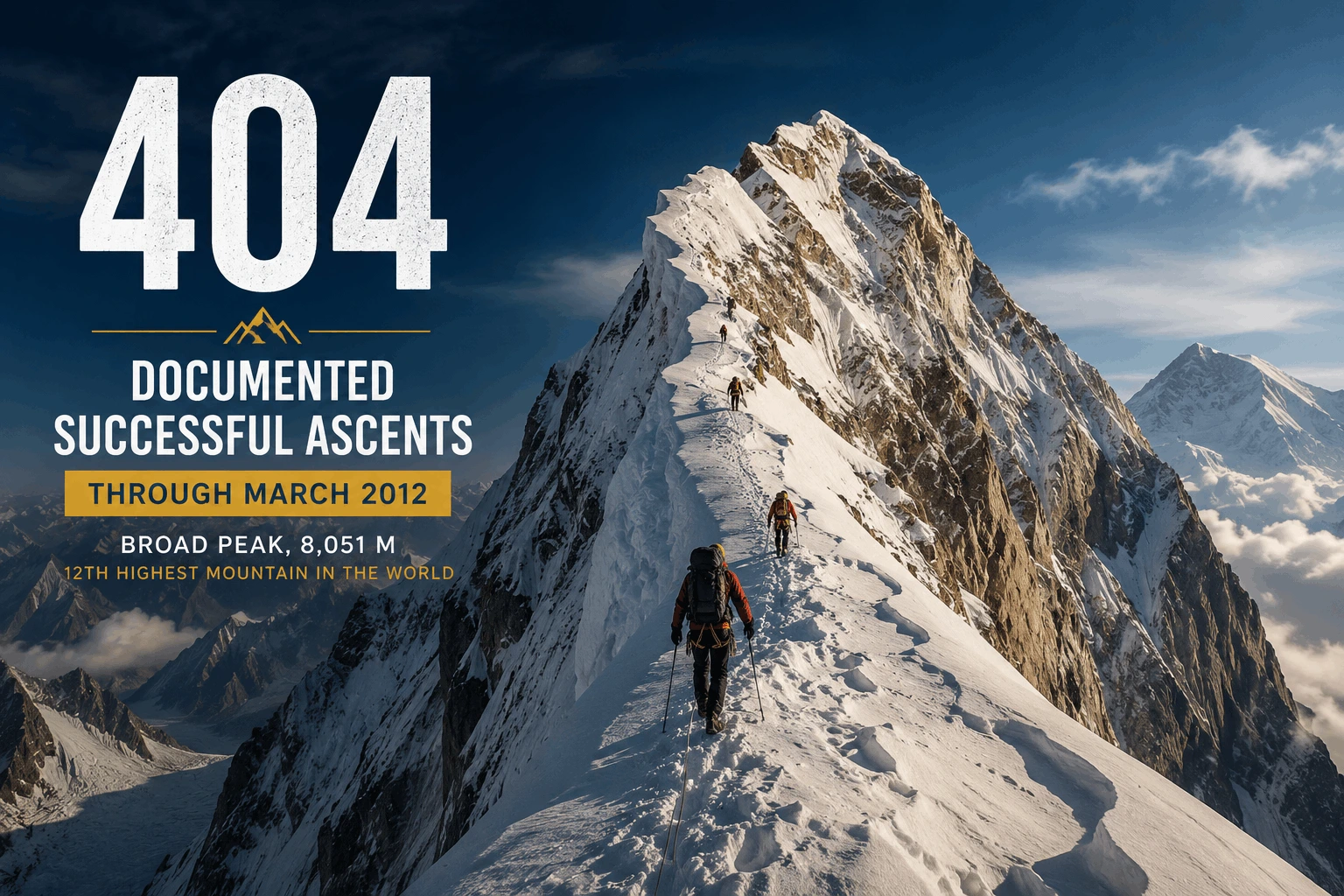
The strongest documented figure for Broad Peak total successful summits is 404 ascents as of March 2012, according to NASA Earth Observatory. NASA paired that figure with 21 recorded deaths, producing a fatality rate of about 5% at that point in time.
That 404 figure is historical, not today’s total. Broad Peak has been climbed for another 14 years since NASA’s cutoff, so the actual lifetime number is certainly higher. The problem is that there is no equally authoritative, publicly accessible source that gives a continuously updated lifetime summit total for the mountain.
That distinction matters because Broad Peak is not statistically as simple as a mountain with one obvious summit point. Its summit ridge includes several named high points, and historical climbing records do not always use identical definitions or cutoff dates. The result is a deceptively difficult question: how many people have actually summited Broad Peak?
The most defensible answer is therefore not a made-up current number. It is this:
Broad Peak had 404 documented successful ascents by March 2012, according to NASA. The true cumulative total in 2026 is higher, but a current, independently verified lifetime summit count is not publicly established.
Broad Peak Summit Count at a Glance
| Statistic | Best-supported figure | Date / context |
|---|---|---|
| Elevation | 8,051 m commonly cited | Modern mountaineering convention |
| NASA elevation | 8,047 m | NASA’s 2012 dataset |
| World ranking | 12th highest | Commonly listed |
| First ascent | June 1957 | Austrian expedition |
| Documented successful ascents | 404 | NASA, March 2012 |
| Recorded deaths at same cutoff | 21 | NASA, March 2012 |
| NASA fatality rate | ~5% | Based on its 2012 figures |
| Reported deaths through end of 2025 | At least 39 | Reported in 2026 coverage citing Pakistani mountaineering authorities |
| 2026 avalanche deaths | 10 | July 30, 2026 |
| Current lifetime summit total | Not independently established | No comparable current database figure found |
NASA specifically reports 404 successful Broad Peak ascents and 21 deaths as of March 2012. The mountain is generally listed at 8,051 m today, while NASA’s older dataset uses 8,047 m; both figures appear in reputable mountaineering sources.
The important distinction
404 is not the number of people who have ever climbed Broad Peak.
It is the number of successful ascents recorded by NASA through March 2012. One climber can make multiple successful ascents, so “ascents” and “individual climbers” are not necessarily the same thing.
That wording is important throughout this article.
How Many People Have Summited Broad Peak?
If you are looking for one number, 404 is the strongest documented historical benchmark.
NASA’s Earth Observatory reported 404 successful ascents by March 2012, together with 21 deaths. The source describes the mountain’s central summit as a subsidiary peak rather than a separate mountain, which also illustrates why summit definitions matter when comparing statistics.
But 404 should not be presented as Broad Peak’s current lifetime total.
Climbers continued attempting the mountain throughout the 2010s, 2020s and the 2026 season. Therefore:
404 = documented minimum benchmark through March 2012.
Current total = higher, but not reliably established by a comparable public source.
That is a much more defensible answer than publishing an attractive but unsupported number such as 425, 450 or 500.
Why Broad Peak Summit Counts Differ
The disagreement is not necessarily caused by bad record keeping. Broad Peak itself creates several counting problems.

1. The True Summit and Rocky Summit Are Not the Same Point
Broad Peak has a long summit ridge rather than one immediately obvious summit block.
One of its best-known subsidiary points is the Rocky Summit, approximately 8,028 m high. The American Alpine Club’s historical material explicitly identifies Broad Peak’s main summit, Central Summit and Rocky Foresummit as separate points on the massif.
This distinction has caused real confusion in climbing history.
In 1988, Polish climber Maciej Berbeka reached the Rocky Summit during a winter attempt and believed he had reached the true summit. Later, photographs and a better understanding of the ridge showed that he had stopped short of the main summit. His experience is one of the clearest examples of why “I reached the top” and “I reached Broad Peak’s true summit” are not always equivalent claims.
The issue was not unique to Berbeka. In 1983, Anna Czerwińska reached the Rocky Summit but turned back, while Krystyna Palmowska continued to the main summit and became the first woman to climb Broad Peak. Guinness World Records and American Alpine Club records document the distinction.
Why this matters statistically
If one historical record counts ascents to a subsidiary summit while another counts only the true summit, the two totals cannot be compared as though they measure exactly the same thing.
That is one reason a single “all-time Broad Peak summit count” needs a definition before it can be treated as meaningful.
2. Broad Peak Has Multiple Named High Points
The massif is commonly described using several named points along its summit ridge.

| Summit / high point | Commonly cited elevation | Status |
|---|---|---|
| Broad Peak Main Summit | 8,051 m | True summit |
| Rocky Summit / Foresummit | ~8,028 m | Subsidiary high point |
| Broad Peak Central | ~8,011 m | Subsidiary summit |
| Broad Peak North | ~7,490 m | Lower northern summit |
| Kharut Kangri | ~6,942 m | Separate lower peak |
Specialist American Alpine Club material labels Broad Peak North, Broad Peak Central, Broad Peak Rocky Foresummit and Broad Peak itself as distinct points on the massif.
The exact elevations should not be treated as immutable to the metre because different surveys and sources use slightly different measurements. The important point for summit statistics is which point a source is counting, not whether one source writes 8,047 m and another 8,051 m.
The Maciej Berbeka Story Explains the Problem Better Than Any Statistic
In 1988, Berbeka became the first person to reach above 8,000 m on Broad Peak in winter when he climbed to the Rocky Summit. He believed he had reached the actual summit.
He had not.
Years later, he returned to Broad Peak specifically to finish what he had started. On March 5, 2013, Berbeka, Adam Bielecki, Tomasz Kowalski and Artur Małek completed the first winter ascent of the true summit. Berbeka and Kowalski died during the descent. The American Alpine Club’s account records the team’s passage through the approximately 7,900 m area between Broad Peak Central and the Rocky Summit before continuing toward the main summit.
The lesson for summit statistics is simple:
Broad Peak’s summit history contains genuine cases where experienced climbers reached a very high point but did not reach the true summit.
That makes historical verification more complicated than simply adding every reported “summit” to a spreadsheet.
Broad Peak Summit History: The Ascents That Changed the Mountain
Rather than listing every expedition, the most useful way to understand Broad Peak’s history is through the milestones that changed how the mountain was climbed or recorded.
1957: The First Ascent
Fritz Wintersteller, Marcus Schmuck, Kurt Diemberger and Hermann Buhl made the first ascent of Broad Peak in June 1957.
The original expedition climbed via the western side of the mountain. Contemporary Himalayan Journal material describes the Western Spur as the chosen line to the main summit, while NASA describes the first ascent route as the southwest face.
The expedition is notable because the climbers climbed without bottled oxygen and carried their own equipment rather than relying on high-altitude porters. NASA specifically highlights those characteristics.
1975: Broad Peak Central and a Tragedy
A Polish team traversed Broad Peak Central in 1975, but three climbers died during the expedition. The Mountain Exploration Foundation’s Broad Peak reference records the tragedy and later describes the 1984 traverse of the three main summits by Jerzy Kukuczka and Wojciech Kurtyka.
1982: Reinhold Messner
Reinhold Messner reached the Broad Peak summit in 1982 with Pakistani climbers Nazir Sabir and Sher Khan. Contemporary Himalayan Club records list the August 2, 1982 ascent.
1983: The First Woman
Krystyna Palmowska reached Broad Peak’s main summit on June 30, 1983, becoming the first woman to summit the mountain. American Alpine Club records document the ascent and also record Anna Czerwińska turning back between the false and main summits.
1984: A Remarkable One-Day Ascent
Krzysztof Wielicki completed a one-day ascent and descent of Broad Peak in July 1984. The Himalayan Club’s historical record lists his July 14 ascent, while the Polish Press Agency describes the climb as taking less than 22 hours from base camp to summit and back.
The same year, Jerzy Kukuczka and Wojciech Kurtyka completed a major traverse involving Broad Peak’s northern, central and main summits.
1988: The False Summit That Became Part of Broad Peak’s History
Berbeka’s Rocky Summit ascent brought the mountain’s complicated summit geography into sharp focus. His 2013 return eventually produced the first winter ascent of the true summit.
2013: First Winter Ascent of the True Summit
On March 5, 2013, Berbeka, Bielecki, Kowalski and Małek completed the first winter ascent. Berbeka and Kowalski did not return to Camp 4 and were subsequently declared dead.
This remains one of the defining chapters in Broad Peak’s modern history because it connected the mountain’s summit-verification problem with one of its most important winter expeditions.
How Many Successful Summits Has Broad Peak Had?
There are three different answers depending on what you mean.
The documented historical answer
404 successful ascents by March 2012.
That is the strongest specific cumulative figure I found from a named institutional source. NASA provides both the ascent count and the corresponding death count, making this particularly useful as a consistent historical baseline.
The current answer
More than 404.
That follows simply from continued climbing after March 2012. It would be unreasonable to claim that 404 remains the lifetime total in 2026.
The exact 2026 answer
Not publicly established by a comparable authoritative cumulative database figure.
That is the important part.
I would not publish an exact current total unless you have a source that explicitly documents its methodology and cutoff date.
Broad Peak Success Rate
This is where many articles become misleading.

Broad Peak success-rate figures are often presented as if there were one official percentage for the mountain. I could not establish such a universally accepted current figure from a primary database.
Commercial operators can report their own success rates based on their clients and expedition structure. For example, Seven Summit Treks has historically promoted a high Broad Peak success rate based on its own expedition experience, but that is not the same thing as an all-expedition mountain-wide success rate.
So I would not state “Broad Peak has a 25–40% success rate” as though it were an official current statistic.
A better conclusion is:
Broad Peak’s overall success rate varies substantially by season, expedition model, weather, route conditions, acclimatization and definition of a successful attempt. No single current percentage should be treated as an official mountain-wide rate without a clearly defined dataset.
That is less flashy than a single percentage, but considerably more defensible.
Broad Peak Fatality Rate and Death Toll
NASA’s historical snapshot gives us the cleanest starting point:
- 404 successful ascents
- 21 deaths
- ~5% fatality rate
- Cutoff: March 2012
That does not mean Broad Peak’s current fatality rate is still 5%.
It means NASA calculated approximately 5% from the figures available at that time.
A later 2026 report from Le Monde, citing the mountain’s history, stated that Broad Peak had claimed at least 39 lives by the end of 2025.
Then came the July 2026 avalanche.
The 2026 Broad Peak Avalanche
On July 30, 2026, an avalanche struck Broad Peak at approximately 6,600 m between Camp 2 and Camp 3, sweeping away a 10-person international climbing group. Contemporary reporting places the incident at around 9:30 a.m. local time.

The ten climbers were:
- Nirmal “Nimsdai” Purja
- Sohail Sakhi
- Mallory Geis
- Pur Bahadur Gurung
- Nima Sherpa
- Nadhira Al Harthy
- Kili Pemba Sherpa
- Nawang Thindu Sherpa
- Gyalu Sherpa
- Wang Zhong
The complete ten-person list is independently reflected in later reporting and specialist accounts.
By August 1, authorities and expedition sources had confirmed that there were no survivors. The recovery operation continued because several victims remained buried or inaccessible in extremely difficult terrain.
The final recovery
This point should now be updated from the earlier draft.
On August 21, 2026, local volunteers recovered Mallory Geis’s remains. The Associated Press reported that she was the final missing member of the ten-person team, effectively bringing the search to a close. The Alpine Club of Pakistan confirmed the recovery.
Specialist mountaineering reporting also subsequently identified Geis as the last missing victim to be located.
Therefore, the earlier AP-versus-specialist uncertainty should no longer be presented as an unresolved issue in the final article. The recovery picture has since been clarified.
What the 2026 Avalanche Does to Broad Peak’s Statistics
The safest way to calculate the updated death toll is to keep the source chain explicit.
A 2026 report stated that Broad Peak had recorded at least 39 deaths through the end of 2025.
The July 30, 2026 avalanche then killed 10 more climbers.
That produces:
39 + 10 = at least 49 recorded deaths through the 2026 avalanche.
I would phrase the figure as “at least 49”, rather than simply “49,” because the underlying 39 figure is itself reported as “at least 39.”
And importantly, 49 deaths does not give us a new fatality percentage.
To calculate a meaningful current fatality rate, we would need a compatible current denominator for successful ascents or climber attempts.
We do not have that denominator from a comparably authoritative public source.
So:
At least 49 deaths can be supported by the available 2025-to-2026 reporting chain, but a precise current Broad Peak fatality rate cannot be calculated responsibly from those figures alone.
Broad Peak’s Main Risks
The statistics make more sense when viewed alongside the mountain’s actual hazards.
Avalanches
The 2026 disaster demonstrates how dangerous avalanche terrain can remain even on a route used by commercial expeditions. The 2026 avalanche struck between Camps 2 and 3 at roughly 6,600 m.
Falls
The upper mountain contains exposed terrain, steep sections and a long summit ridge. A fall during descent can become particularly serious after the physical demands of a summit push.
Altitude
Broad Peak rises above 8,000 m, where oxygen deprivation, exhaustion and altitude-related illness become major concerns.
Weather
Rapid changes in high-altitude weather can turn a manageable summit attempt into a survival situation.
Exhaustion and late descent
The danger does not end when a climber reaches the summit. The descent can be the most consequential part of a summit day, particularly when climbers are already exhausted.
Broad Peak’s history repeatedly demonstrates that summit success and safe return are two different achievements.
Broad Peak vs. K2
Broad Peak and K2 are unusually close geographically and are often discussed together, but comparing their statistics requires caution.

Broad Peak is approximately 8 km from K2 in the Karakoram, while K2 is considerably higher and is generally regarded as the more technically demanding objective. Broad Peak’s standard route is nevertheless a serious high-altitude climb, not a “beginner” 8,000er.
| Factor | Broad Peak | K2 |
|---|---|---|
| Elevation | ~8,051 m | 8,611 m |
| World ranking | 12th | 2nd |
| General technical reputation | Less technical than K2 on the normal route | Extremely technical |
| Major hazards | Avalanche, altitude, weather, falls | Technical climbing, avalanche, seracs, altitude, weather |
| Infrastructure | Varies by expedition and season | Varies, but generally a more demanding objective |
| Can statistics be directly compared? | Only with matching datasets | Only with matching datasets |
The key point is that a lower historical fatality percentage does not make Broad Peak safe.
K2 and Broad Peak have also been climbed under different conditions, by different numbers of expeditions and with different levels of commercial infrastructure over different periods. A raw percentage can hide those differences.
What Do Broad Peak’s Summit Numbers Actually Tell Us?
Three conclusions are defensible.
1. 404 is the strongest documented historical benchmark
NASA recorded 404 successful ascents by March 2012. That is the number to use when a source needs a specific, attributable historical figure.
2. The real lifetime total in 2026 is higher
Fourteen additional years of climbing make it impossible for 404 to represent the current lifetime total.
But higher does not mean we are entitled to invent a precise number.
3. Summit statistics need definitions
Broad Peak’s Rocky Summit, Central Summit and other ridge points show why a summit count is not simply a matter of adding names.
A good statistic should tell the reader:
- what is being counted,
- which summit qualifies,
- what date the count stops,
- whether it counts ascents or individual climbers,
- and where the number came from.
Without those details, an impressive-looking number can be less useful than a carefully qualified one.
Frequently Asked Questions
How many successful summits has Broad Peak had?
NASA recorded 404 successful ascents as of March 2012. The current lifetime total is higher, but I could not establish a comparable authoritative public figure for 2026.
How many people have summited Broad Peak?
At least 404 successful ascents had been recorded by March 2012. However, “ascents” does not necessarily mean 404 different people because individual climbers can summit the same mountain more than once.
What is Broad Peak’s current summit count?
There is no sufficiently authoritative, publicly documented current lifetime total that I would recommend presenting as fact. The safest benchmark remains NASA’s 404 successful ascents through March 2012.
What is Broad Peak’s success rate?
There is no single current mountain-wide percentage that can be treated as an official success rate without defining the dataset. Commercial operators may report their own success rates, but those figures describe their expeditions rather than every Broad Peak attempt.
How many people have died on Broad Peak?
NASA recorded 21 deaths through March 2012. Later 2026 reporting stated that the mountain had claimed at least 39 lives by the end of 2025. The July 2026 avalanche killed another 10 climbers, bringing the reported cumulative toll to at least 49 through that disaster.
What was Broad Peak’s fatality rate?
NASA calculated a fatality rate of approximately 5% from 404 successful ascents and 21 deaths as of March 2012. That is a historical figure, not a current 2026 fatality rate.
Does Rocky Summit count as summiting Broad Peak?
No. Rocky Summit is a subsidiary high point on the summit ridge rather than Broad Peak’s true main summit. Historical climbing records provide real examples of climbers reaching Rocky Summit without reaching the main summit.
What is Broad Peak’s true summit?
The true summit is the mountain’s main summit, generally cited at about 8,051 m today. NASA’s older dataset uses 8,047 m, illustrating the small elevation differences found between sources.
When was Broad Peak first climbed?
Broad Peak was first climbed in June 1957 by Fritz Wintersteller, Marcus Schmuck, Kurt Diemberger and Hermann Buhl. NASA describes the first ascent as following the southwest face, while contemporary expedition material refers to the Western Spur.
Who was the first woman to climb Broad Peak?
Krystyna Palmowska became the first woman to summit Broad Peak on June 30, 1983. Her climbing partner Anna Czerwińska reached the Rocky Summit but turned back before the main summit.
Is Broad Peak easier than K2?
Broad Peak’s standard route is generally regarded as less technically demanding than K2, but that is a relative comparison. Broad Peak remains an extremely serious 8,000-metre climb with major avalanche, altitude, weather and fall hazards.
What happened in the 2026 Broad Peak avalanche?
On July 30, 2026, an avalanche struck a 10-person international climbing group between Camp 2 and Camp 3 at roughly 6,600 m. All ten climbers died.
Who died in the 2026 Broad Peak avalanche?
The victims were Nirmal Purja, Sohail Sakhi, Mallory Geis, Pur Bahadur Gurung, Nima Sherpa, Nadhira Al Harthy, Kili Pemba Sherpa, Nawang Thindu Sherpa, Gyalu Sherpa and Wang Zhong.
Were all ten victims eventually recovered?
The final missing victim, Mallory Geis, was located on August 21, 2026. The Associated Press reported that her recovery concluded the search for the ten-member team, and the Alpine Club of Pakistan confirmed the discovery.
How did the 2026 avalanche change Broad Peak’s statistics?
It added 10 confirmed deaths to the mountain’s historical death toll. It does not, by itself, allow a new lifetime fatality percentage to be calculated because a reliable current summit/attempt denominator is still unavailable.
How many people summited Broad Peak in 2026?
A definitive full-season 2026 summit total is not established in the sources reviewed for this article. The July 30 avalanche significantly disrupted the season, so I would not publish a precise number without a recognized database or expedition-level dataset supporting it.
Final Answer: How Many People Have Successfully Summited Broad Peak?
The strongest documented figure is 404 successful ascents as of March 2012, according to NASA.
That is the number I would use when answering the question with a specific, verifiable figure.
But it is not Broad Peak’s current lifetime total.
The actual number of successful ascents is higher because climbing continued for another 14 years. However, without a current authoritative database figure using a clearly defined methodology, publishing an exact 2026 total would create false precision.
The same principle applies to the death toll. NASA recorded 21 deaths through March 2012; later reporting put the mountain at at least 39 deaths through the end of 2025, and the July 2026 avalanche added 10 more, producing at least 49 reported deaths through that event.
So the most honest summary is:
404 documented successful ascents by March 2012. More than 404 today. No sufficiently authoritative current lifetime summit total publicly established. At least 49 reported deaths through the 2026 avalanche.
That is a less sensational answer than giving readers a neat round number.
It is also the answer the evidence actually supports.


This Post Has 7 Comments