
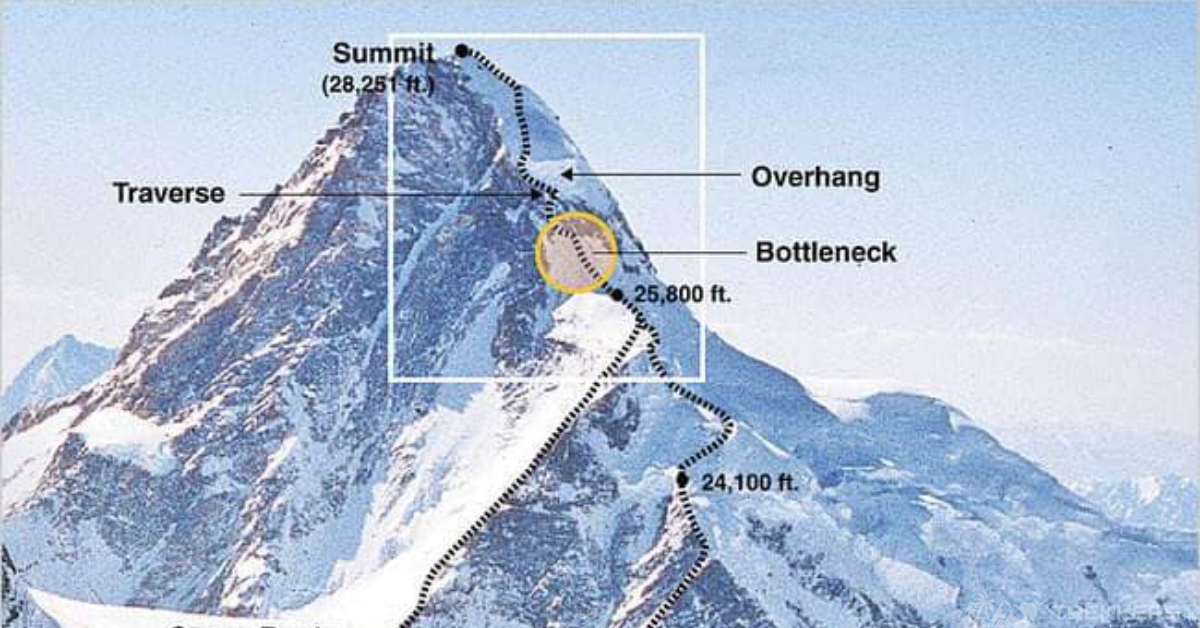
Have you ever wondered why K2 is the most dangerous mountain to climb? Despite not being the world’s highest peak, it is renowned as one of the most perilous mountains to conquer. Conquering K2 is an endeavor that demands heart and soul. One of the primary reasons that makes it difficult is the notorious K2 Bottleneck.
Read this to know more about the K2 bottleneck and why it is the hardest part of summiting K2, the Savage Mountain.
What is the Bottleneck on K2 mountain?
A bottleneck is the part of K2 just before the top, at the height of 8,200 m. It is located along the South-East Spur, commonly referred to as the Abruzzi Spur. It serves as the primary route climbers use to reach the summit of K2.
Why is it called Bottleneck?
The bottleneck area is a narrow and challenging passage on the mountain. It is the point where the route constricts and passes through a risky section. This name is used metaphorically because it is like a bottleneck in a bottle. Because it restricts the flow and creates a challenging and potentially dangerous situation for climbers.
Is Bottleneck K2’s Deadly High Altitude Challenge?
The Bottleneck on K2 is widely considered the deadliest and most challenging section of the mountain, acting as a, “death zone” gatekeeper at over 8,200 meters. It is a narrow, steep (50-60 degrees) icy couloir located just 400m below the summit, forcing climbers to pass under a massive, unstable ice cliff (serac) that can release deadly avalanches without warning.
High Fatality Rate:
The precariousness of the ridge is mostly due to its steep angles and 60-degree slope, which makes it highly risky to make the summit push. Adventure Stats stated out of the last 14 fatalities, 13 fatalities occurred on the bottleneck.
Technical Slope:
K2’s rocky terrain is covered with snow and has 50- to 60-degree inclined planes. Climbers need help to make the summit push and need strong guidance and training to reach the top.

Seracs:
Seracs overhang the area of the bottleneck. They are large blocks of ice that can break off and fall anytime, which leads to lethal injuries or might even kill people. So only, slow and steady steps, proper guidance, and meticulous preparations will make the path easy to cover.
Avalanches:
The bottleneck is the feature of the mountain, which is more prone to avalanches. This is a serious threat to mountaineers as tons of snow sweep away climbers, becoming the burial of them.
Weather Conditions:
The harsh weather at k2 requires physical agility to bear it. Fierce winds, low temperatures (plunging as low as −30°C in summer and −50°C in winter), and feet in foot snow hit you best to oust from the mountain ascension, but the conquerors know well not to quit.

Why opt for bottleneck, knowing its alarming dangers and risks?
Despite many routes to climb the K2, why mountaineers choose the southeast ridge of the peak is always a recurring question. While the bottleneck presents a challenging terrain, climbers consider it a less time-consuming route compared to other possible paths. Time management in this crucial journey is unequivocally important because the altitude has different threats to the physical health of climbers, like high altitude sickness, nausea, fatigue, and weather changes like avalanches, rock falling, thin air, and low oxygen.
On a final note, the bottleneck of K2 is precarious. It is imperative to ascend the mountain with a proper guide and gear up with all necessary equipment. Additionally, It is important to do your research before attempting the climb.


