
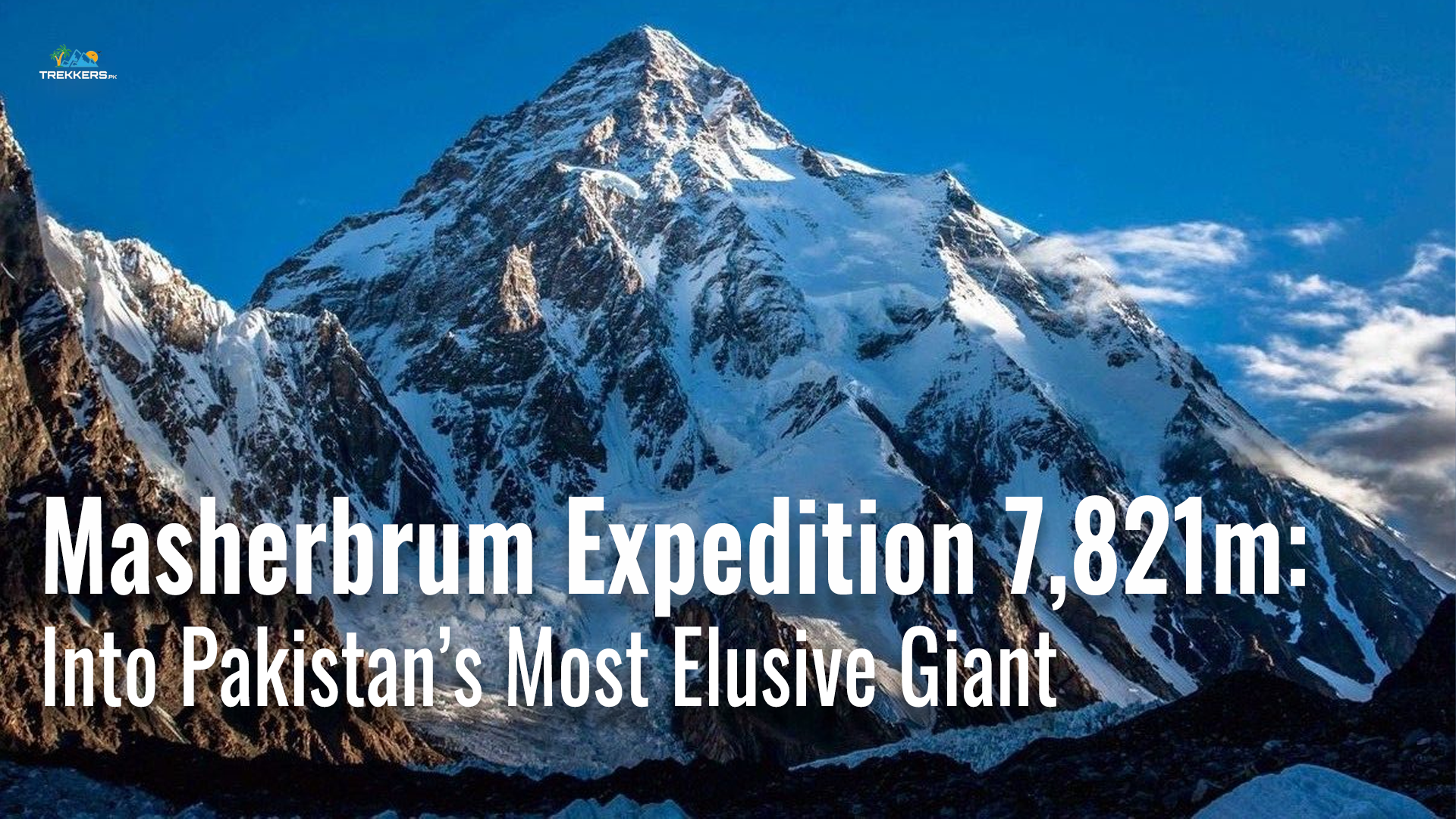
A Mountain That Doesn’t Need An Introduction
Masherbrum, also known as K1, is located in the Baltistan region of Gilgit-Baltistan, Pakistan, within the mighty Karakoram Range. Rising above the serene valleys and glaciers of Northern Pakistan, it is one of the most striking peaks in the region. My dad has always been a big traveler. From a very young age, I used to love snooping through his photo albums from the multiple trips he took in his early twenties. The thin layer of dust on all the albums never bothered me because those memories always prevailed for me. Since those days, Masherbrum has had a special place in my heart.
I also loved seeing the pride and absolute happiness in my dad’s eyes every time I would tell him I wanted to travel just like him. So the day I turned twenty, my dad gifted me a map, all the gear I needed for the trip, and his jacket that he kept so he could pass it down to me.
From all the stories my dad had told me, I knew for certain that the trip had to be scheduled in either June or September. As trekking routes remain more accessible, and weather conditions are relatively stable, it is the best time to explore the raw beauty of Pakistan.
Masherbrum: The 7,821m Beauty in Gilgit
Masherbrum is one of the most captivating sights in northern Pakistan, attracting trekkers, climbers, and adventure seekers from all over the world.
The name “Masherbrum” is believed to come from the Balti language, where “Masha” refers to a queen and “Brum” means mountain, giving it the fitting title of “Queen of Mountains”. Unlike many peaks that dominate through publicity and tourism, Masherbrum feels quieter, more mysterious, and deeply connected to the raw identity of the Karakoram.
For travelers interested in trekking in Pakistan, Masherbrum offers something rare: isolation, scale, and a feeling of untouched wilderness that is becoming harder to find. It is surrounded by rocky terrain and snow-covered peaks. Tall rock walls above icy rivers and glacier-fed valleys, while the nearby land changes constantly between snow, stone, and open alpine areas. This contrast creates an atmosphere that can feel almost unreal, especially at sunrise and sunset, when light moves slowly across the mountain’s sharp ridges.
What made the mountain more intriguing for me was its difficulty and unpredictability. Unlike heavily commercialized trekking destinations, the routes surrounding Masherbrum still feel untouched and personal, allowing travelers to experience northern Pakistan in a more authentic and immersive way.
Masherbrum’s Reputation Amongst Climbers
Despite being overshadowed by peaks as famous as K2, Masherbrum has earned a legendary reputation within the climbing world.
First successfully climbed in 1960 by an American-Pakistani expedition, the mountain has remarkably few successful summits compared to the other major peaks in the Karakoram. Masherbrum is immensely difficult to climb due to its steep faces, unpredictable weather conditions, avalanche risks, and technical climbing routes.
Over many years, numerous experienced climbing teams have attempted different routes to the northwest and northeast of Masherbrum, and many more have attempted to reach the summit from other directions. Because of extreme snow amounts, poor glacier conditions, and very poor visibility at high elevation, many were forced to turn around. A few climbers lost their lives when trying to scale the mountain, increasing the mountain’s challenging allure among climbing enthusiasts.
Even in recent years, elite climbers like Czech mountaineer Marek Holeček and his expedition partner Radoslav Groh faced brutal conditions on Masherbrum, battling deep snow, freezing temperatures, and near-zero visibility while attempting a difficult alpine-style ascent.
Their expedition highlighted the tremendous difficulty of tackling the unforgiving mountain,even for world-class climbers. The extreme terror of a mountain like Masherbrum is what creates its great respect. It is respected not only for its beauty, but for the challenge it presents and the unpredictable nature of this mountain.
The Journey: Where My Dad’s Old Adventures Became Mine

For me, the journey toward Masherbrum began with a surprise I never saw coming. My father was adamant that I take on this journey independently. I was initially bummed that he couldn’t join me at such an integral moment of my life, but I could also see where he was coming from.
The morning of my flight, I was so nervous that I could barely finish a cup of coffee. My bags were packed the night before, so I didn’t have anything to stress about, yet I couldn’t help but feel jittery. When I walked outside, I noticed my dad loading twice the amount of luggage into the car. I shared a confused look with my mom, who was standing in our garage with me, but as soon as my dad looked at me with a smirk on his face, I knew what it meant. He wasn’t just dropping me off at the airport; he was coming with me.
After a surprisingly comfortable flight, we landed in Islamabad, Pakistan. Even after my dad’s insistence on staying in Islamabad for at least two days and properly acclimatizing to the altitude, I just couldn’t wait any longer. So, after a day in Islamabad, we started from Skardu.
The further we moved towards Skardu, the more we were gradually getting pulled deeper into the Karakoram region. The road towards Hushe Valley seemed endless in the best possible way, winding through rivers, rocky terrain, and vast landscapes that made everything feel distant. My father spent most of the drive pointing toward peaks in the distance, recognising routes and formations the way someone recognizes places they once belonged to. Watching him speak about the mountains again felt strangely emotional, as though some forgotten part of him had actually returned.
Hushe itself felt untouched by time. The village carried a stillness that immediately slowed everything down. From there, the trek began gently, following the Hushe River through open valleys and glacier-fed streams. At first, the journey felt manageable, almost peaceful, but the terrain gradually became steeper and more demanding.
As we went higher in altitude, everything became very subdued and quiet; there was nothing but the sound of our boots making noise on the loose and rugged rocks, and the colder breeze above through the valley as it passed through us. I felt really tired at times, but my father kept moving along with a determined calmness that made it hard for me to complain to him about how exhausted I felt.
Even after many years of not being in these mountains, he seemed to know them as well now as when he last saw them.
The Challenges During The Journey

“It is not the mountain we conquer, but ourselves.” Sir Edmund Hillary
Saying that the journey was easy, though, would be far from accurate. While northern Pakistan travel offers up many trekking peaks that attract crowds of climbers every season, Masherbrum does not. Perched high in the Karakoram, Masherbrum looms with unpredictable storms, hazardous terrain, and notoriously low summit odds. In truth, only several expeditions throughout history have ever made it to the summit. Many seasoned climbers attempting to summit have retreated due to avalanches, deep snow pack, poor visibility, and merciless climbing conditions.
Expeditions have faced days trapped inside tents at high altitude, hurricane-force winds, and glacier sections so unstable that progress became painfully slow. Some climbers never made it back at all.
It didn’t take long into our journey to see why this mountain has gained such notoriety. The further we ascended, the more brutal it became. Loose rock, biting winds, and thin air made what should have been easy stretches of trail, draining. At times, the silence of the valley was eerie, it felt as if the mountain was telling you that it functioned by its own rules.
And honestly, that danger is part of what makes Masherbrum unforgettable.
The Best Travel Tips for The Trip
Some of the tips that you need to know to have a safe and enjoyable trip are;
- The best time to visit the Karakoram ranges is June to September for more stable weather conditions.
- Carrying warm layers, hiking boots, sunscreen, gloves, water, energy snacks, and basic first aid supplies is essential.
- Allow proper time for acclimatisation.
- Travel with experienced guides if trekking in remote regions.
- Stay updated on weather conditions.
- Carry essential equipment for glacier and high-altitude trekking.
Avoid rushing the journey and pace yourself carefully.


This Post Has One Comment